r
v
Heating and Air Conditioning
\
N:04:01
J
SAFETY PRECAUTIONS
Air conditioning systems are filled with liquid or
gaseous refrigerant which is under high pressure at
most times.
The closed system must be kept free of any dirt,
air, or water vapor and liquid. When servicing an
air conditioned car, observe the following:
1.
Do not steam clean, solder, weld or braze near
the air conditioning hoses, connections or
components.
2.
Do not open a refrigerant line or connection
except when necessary. Cover all openings
with clean tape, caps, or plugs, if this occurs.
3. Dp not adjust the refrigerant valves.
LIQUID REFRIGERANT
KEEP LIQUID REFRIGERANT AWAY FROM EYES
AND
SKIN.
Liquid refrigerant can affect a person's
eyes and skin because it freezes the tissues it
contacts. SAFETY GOGGLES should always be
worn when servicing refrigerant systems. If the
refrigerant should come in contact with the eyes,
do not rub them. Splash the eyes, or the affected
area,
with large quantities of cold water for several
minutes. If further medication is necessary, the
affected area should be checked and treated by a
physician.
ALWAYS EXHAUST REFRIGERANT VAPORS
AWAY FROM CAR OR THROUGH WALL OR
ROOF VENTS
While
Refrigerant-12
is normally not poisonous, if
large quantities are discharged in a room with an
open flame or sucked into the car engine while
running,
dangerous chemicals will be produced.
Engines will be connected to exhaust tubes —
ventilated rooms are required when servicing the
A/C System.
AVOID CONTACT WITH SKIN
The refrigerant at atmospheric pressure vaporizes
rapidly so that if allowed to get on the
skin,
the
latent heat of vaporization will rob the heat from
the skin at that point with danger of frost bite at
that part. It is especially dangerous to get the
t^'-H
PSB
refrigerant in the eye as the moisture in the eyeball
will be frozen with the risk of being blinded. Thus,
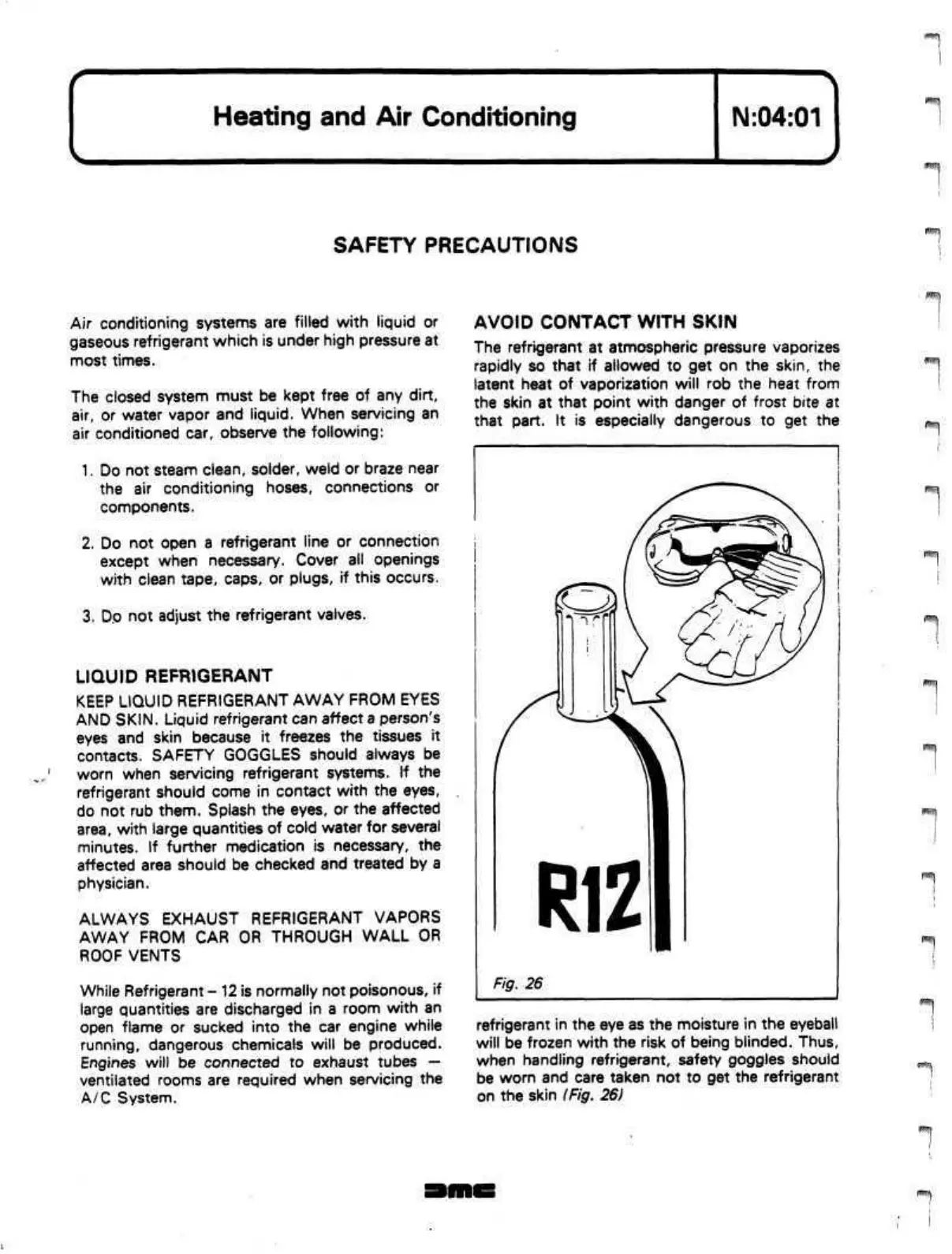
when handling refrigerant, safety goggles should
be worn and care taken not to get the refrigerant
on the skin (Fig. 26)
mm
F~->.
f^^


 To Next Page
 Loading...