i
(
i
r
n-;
D:01:12
v.
Fuel Emission and Exhaust System
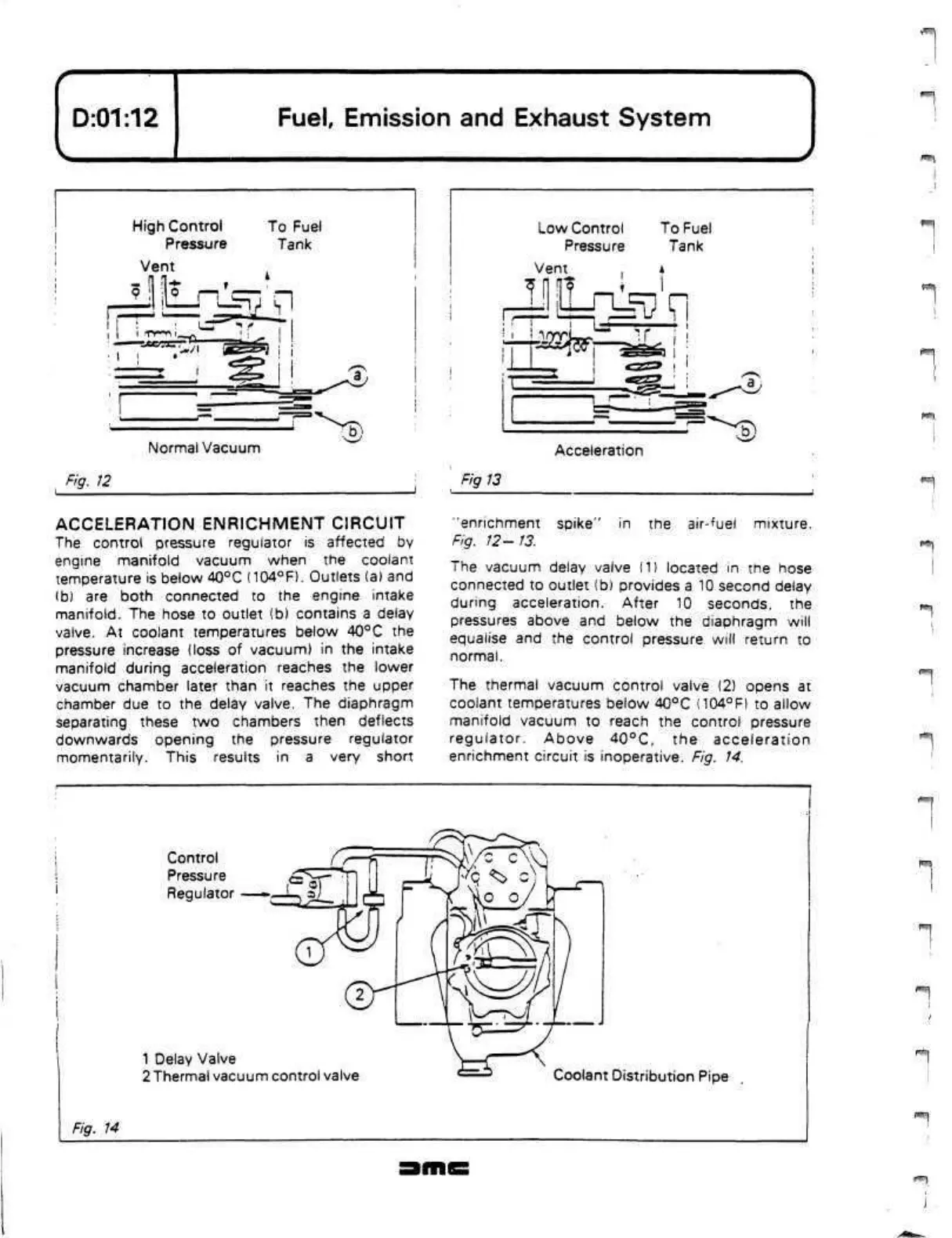
High Control To Fuel
Pressure Tank
Vent
illLn^V
Normal Vacuum
Fig. 12
ACCELERATION ENRICHMENT CIRCUIT
The control pressure regulator is affected by
engine manifold vacuum when the coolant
temperature is below
40°C
(104°F). Outlets (a) and
(b) are both connected to the engine intake
manifold.
The hose to outlet (b) contains a delay
valve.
At coolant temperatures below 40°C the
pressure increase (loss of vacuum) in the intake
manifold during acceleration reaches the lower
vacuum chamber later than it reaches the upper
chamber due to the delay valve. The diaphragm
separating these two chambers then deflects
downwards opening the pressure regulator
momentarily. This results in a very short
Low Control To Fuel
Pressure Tank
Vent
A
Acceleration
Fig 13
f
y
y\
"enrichment spike" in the air-fuel mixture.
Fig.
12-13.
The vacuum delay valve (1) located
in
the hose
connected to outlet (b) provides a 10 second delay
during acceleration. After 10 seconds, the
pressures above and below the diaphragm will
equalise and the control pressure will return to
normal.
The thermal vacuum control valve (2) opens at
coolant temperatures below 40°C (104°F) to allow
manifold vacuum to reach the control pressure
regulator. Above
40°C,
the acceleration
enrichment circuit is inoperative. Fig.
14.
$*!••)
<•'"•
I
Control
Pressure
Regulator
1 Delay Valve
2
Thermal vacuum control valve
Coolant Distribution Pipe
Fig. 14
J


 To Next Page
 Loading...