Fuel,
Emission and Exhaust System
D:01:11
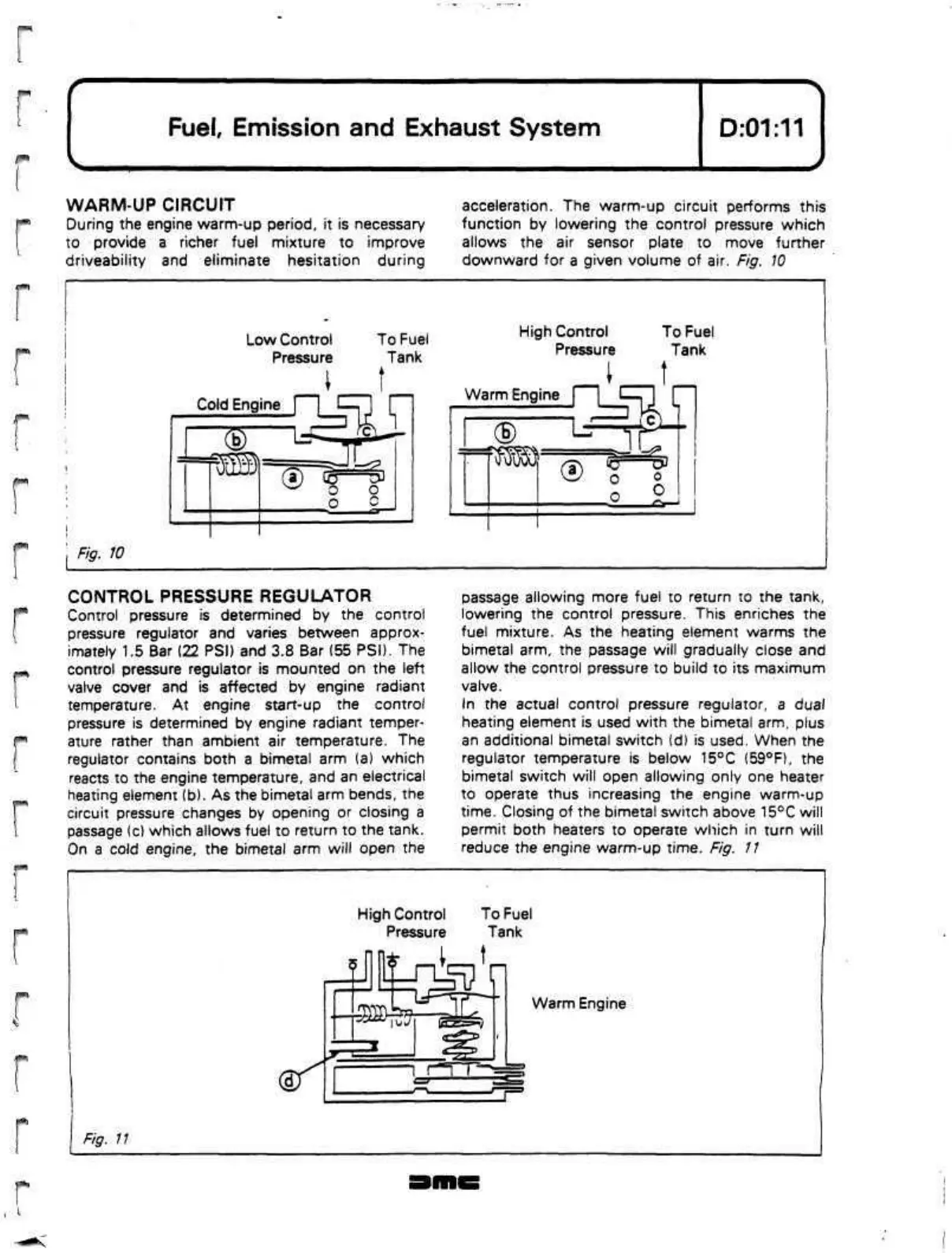
WARM-UP CIRCUIT
During the engine warm-up period, it is necessary
to provide a richer fuel mixture to improve
driveabiiity and eliminate hesitation during
acceleration. The warm-up circuit performs this
function by lowering the control pressure which
allows the air sensor plate to move further
downward for a given volume of air. Fig. 10
Low Control
Pressure
To Fuel
Tank
4
Cold Engine
PH
I—j
| |
<E>
®
Lb CxJ
o
o
Fig. 10
High Control
Pressure
To Fuel
Tank
Warm Engine
It
®
n
i=
1C
®
0
o
=£.
o
C
CONTROL PRESSURE REGULATOR
Control pressure is determined by the control
pressure regulator and varies between approx-
imately 1.5 Bar (22 PSD and 3.8 Bar (55 PSD. The
control pressure regulator is mounted on the left
valve cover and is affected by engine radiant
temperature. At engine start-up the control
pressure is determined by engine radiant temper-
ature rather than ambient air temperature. The
regulator contains both a bimetal arm (a) which
reacts to the engine temperature, and an electrical
heating element (b). As the bimetal arm bends, the
circuit pressure changes by opening or closing a
passage (c) which allows fuel to return to the tank.
On a cold engine, the bimetal arm will open the
passage allowing more fuel to return to the tank,
lowering the control pressure. This enriches the
fuel mixture. As the heating element warms the
bimetal arm, the passage will gradually close and
allow the control pressure to build to its maximum
valve.
In the actual control pressure regulator, a dual
heating element is used with the bimetal arm, plus
an additional bimetal switch (d) is used. When the
regulator temperature is below 15°C (59°F), the
bimetal switch will open allowing only one heater
to operate thus increasing the engine warm-up
time.
Closing of the bimetal switch above 15°C will
permit both heaters to operate which in turn will
reduce the engine warm-up time. Fig.
11
High Control
Pressure
To Fuel
Tank
Lt,
Warm Engine
Fig. 11


 To Next Page
 Loading...