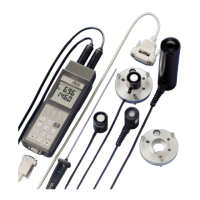
* LP 9021 LUM6
Probe for measuring LUMINANCE, measuring range from 1 to 1999 x 10
3
candles/m
2
.
Measuring angle 6°. CIE filter for correction of the response according to the human eye.
* LP BL
Stand for supporting and levelling probes.
* TP 870
Immersion temperature probe, Pt100 sensor, diam. 3x230 mm, measuring range -50...+400°C.
* TP 870/C
Contact temperature probe, Pt100 sensor, diam. 4x230 mm, measuring range -50...+400°C.
* TP 870/P
Penetration temperature probe, Pt100 sensor, diam. 4x150 mm, measuring range -50...+400°C.
* TP 870/A
Air temperature probe, Pt100 sensor, diam. 4x230 mm, measuring range -50...+250°C.
* CP RS232C
Connecting cable from SUB D female 9-pole to SUB D female 25-pole, for serial gate RS232C.
METHOD OF USING THE INSTRUMENT AND WARNINGS
1. Do not expose the probes to gases or liquids that could corrode the material of the sensor or
the probe; clean the probe carefully after use.
2. Do not bend the connectors applying upward or downward force.
3. Do not bend or force the contacts when inserting the probe connector in the instrument.
4. Do not bend, deform or drop the probes as this could cause irreparable damage.
5. Always use the most suitable probe for the measurement to be taken.
6. Do not use the temperature probes in the presence of corrosive gases or liquids; the container
in which the sensor is housed is made of stainless steel AISI 316, while the container for the
contact probe is of AISI 316 plus silver.
Do not let the surfaces of the probe come in contact with sticky surfaces or with substances
that can corrode or damage the probe. If the sensor breaks or becomes faulty it must be repla-
ced. In this case the probe must be recalibrated.
7. Above 400°C, avoid violent blows or thermal shock to the Pt100 temperature probes as these
could cause irreparable damage.
8. To obtain a reliable temperature measurement, too fast temperature variations must be avoi-
ded.
9. Temperature probes for surface measurements must be held in a vertical position with respect
to the surface. Apply a drop of oil or heat-conductive paste between the surface and the sensor
so as to improve contact and reduce the reading time. Do not use water or solvents to do this.
10. Temperature measurements on non-metal surfaces require a great deal of time on account of
their low heat conductivity.
11. The probes are not insulated from their external casing. Be very careful not to come
into contact with live parts (above 48 V) as this could be dangerous not only for the
instrument but also for the operator, who could suffer an electric shock.
102
ENGLISH


 To Next Page
 Loading...