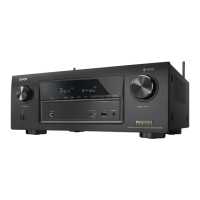
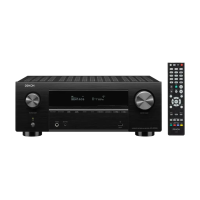
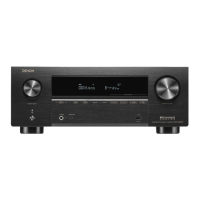
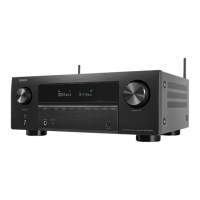
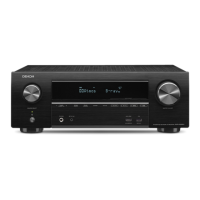
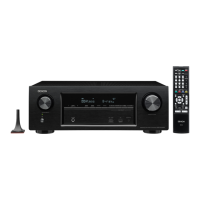
The Denon AVR-X3300W is an integrated network AV receiver designed to deliver high-quality audio and video performance for home entertainment systems. This device serves as the central hub for various audio and video sources, processing signals and distributing them to speakers and displays. Its network capabilities allow for seamless integration with home networks, enabling access to online music services and other network-connected features.
Front Panel Features and Usage:
The front panel of the AVR-X3300W is equipped with several controls and indicators for easy operation.
- Power Operation Button (1): This button is used to turn the power of the MAIN ZONE (the primary listening area where the unit is located) on or off (standby).
- Power Indicator (2): This indicator provides visual feedback on the unit's power status. It lights white when the power is on, remains off during normal standby, and lights red under specific conditions such as "HDMI Control" being set to "On," "HDMI Pass Through" being set to "On," or "Network Control" being set to "Always On."
- SOURCE SELECT Knob (3): This knob allows users to select the desired input source for the receiver.
- Remote Control Sensor (4): This sensor receives signals from the remote control unit, enabling remote operation of the receiver.
- Display (5): The display shows various pieces of information, including input mode, surround back status, decoder status, Audyssey® status, tuner reception mode, sleep timer status, and a circle indicator for online music or iPod/USB playback.
- MASTER VOLUME Knob (6): This knob adjusts the overall volume level of the audio output.
- Tuner Preset Channel Buttons (TUNER PRESET CH +, -) (7): These buttons are used to select preset broadcast stations.
- ZONE2 ON/OFF Button (8): This button turns the power of ZONE2 (a separate room) on or off, allowing for multi-zone audio playback.
- ZONE2 SOURCE Button (9): This button selects the input source specifically for ZONE2.
- DIMMER Button (10): Each press of this button cycles through different brightness levels for the display.
- STATUS Button (11): Each press of this button switches the status information displayed on the screen.
- QUICK SELECT Buttons (12): These buttons (1-4) allow users to recall various registered settings with a single press, including input source, volume level, and sound mode settings.
- Headphones Jack (PHONES) (13): This jack is used to connect headphones. When headphones are plugged in, audio output from connected speakers or PRE OUT connectors is automatically muted. To prevent hearing loss, users are advised not to raise the volume excessively when using headphones.
- AUX1-HDMI Connector (14): This connector is used to connect HDMI output compatible devices such as video camcorders and game consoles.
- USB Port (15): This port is used to connect USB storage devices (like USB memory devices) and the USB cable supplied with an iPod.
- SETUP MIC Jack (16): This jack is used to connect the supplied Sound calibration microphone for audio setup.
Display Indicators:
The display provides detailed information about the receiver's current status:
- Input Mode Indicators (1): These light up according to the audio input mode settings of each input source (e.g., AUTO, HDMI, DIGITAL, ANALOG).
- Surround Back Indicator (2): This lights when audio signals are being output from the surround back speakers.
- Decoder Indicators (3): These light when Dolby or DTS signals are input or when the Dolby or DTS decoder is active.
- Audyssey® Indicator (4): This lights when "MultEQ® XT," "Dynamic EQ," or "Dynamic Volume" has been set up.
- Tuner Reception Mode Indicators (5): These light up based on reception conditions when the input source is "Tuner." "TUNED" indicates a properly tuned broadcast, and "STEREO" indicates FM stereo reception.
- Sleep Timer Indicator (6): This lights when the sleep mode is active.
- Circle Indicator (7): This is displayed when the input source is "Online Music" or "iPod/USB" during music playback.
- Volume Indicator (8): Shows the current volume level.
- MUTE Indicator (9): Blinks when the sound is muted.
- Information Display (10): Displays the input source name, sound mode, setting values, and other relevant information.
- Input Signal Indicators (11): These light up corresponding to the detected input signal (e.g., PCM, DIG, ANA).
- ZONE2 Indicator (12): Lights up when ZONE2 power is turned on.
Rear Panel Connections and Usage:
The rear panel offers a comprehensive array of connectors for integrating the AVR-X3300W into a home theater system.
- Rod Antennas for Bluetooth/Wireless LAN (1): These antennas should be stood upright for connecting to a network via wireless LAN or to a handheld device via Bluetooth. The antenna clip can be removed for transport by rotating it 90 degrees left and pulling it out. It should be reattached by reversing these steps.
- REMOTE CONTROL Jacks (2): Used to connect infrared receivers/transmitters for operating the unit and external devices from a different room.
- RS-232C Connector (3): Used to connect home automation controller devices. Before use, ensure the unit is powered on, then turn off power from the external controller, and verify the unit is in standby mode.
- Video Connectors (VIDEO) (4): Used to connect devices equipped with video connectors, such as set-top boxes.
- NETWORK Connector (5): Used to connect to a LAN cable for wired LAN network connectivity.
- Digital Audio Connectors (DIGITAL AUDIO) (6): Used to connect devices with digital audio connectors, including TVs (with or without HDMI ARC), set-top boxes, DVD players, or Blu-ray Disc players.
- HDMI Connectors (7): Used to connect devices with HDMI connectors, including TVs (with or without HDMI ARC), set-top boxes, DVD players, or Blu-ray Disc players.
- AC Inlet (AC IN) (8): Used to connect the power cord.
- TRIGGER OUT Jack (9): Used to connect devices equipped with the trigger function.
- FM/AM Antenna Terminals (ANTENNA) (10): Used to connect FM antennas and AM loop antennas.
- Analog Audio Connectors (AUDIO) (11): Used to connect devices with analog audio connectors, such as set-top boxes, DVD players, or Blu-ray Disc players.
- Speaker Terminals (SPEAKERS) (12): Used to connect speakers.
- PRE OUT Connectors (13): Used to connect a subwoofer with a built-in amplifier or an external power amplifier.
- Component Video Connectors (COMPONENT VIDEO) (14): Used to connect devices with component video connectors, such as TVs without HDMI, set-top boxes, DVD players, or Blu-ray Disc players. Note: Do not touch the inner pins of the connectors on the rear panel to avoid permanent damage from electrostatic discharge.
Remote Control Features and Usage:
The remote control provides full functionality for operating the AVR-X3300W.
- ZONE SELECT Buttons (1): Switch between MAIN ZONE and ZONE2 operation.
- Input Source Select Buttons (2): Select the desired input source.
- Channel/Page Search Buttons (CH/PAGE ▲▼) (3): Select radio stations or switch pages.
- MUTE Button (X) (4): Mutes or unmutes the audio output for the main zone or ZONE2.
- Information Button (INFO) (5): Displays status information on the TV screen.
- Cursor Buttons (▲▼◀▶) (6): Select items in menus.
- BACK Button (7): Returns to the previous screen.
- System Buttons (8): Perform playback-related operations.
- Tuning Up/Tuning Down Buttons (TUNE +, -): Select FM or AM broadcasts.
- QUICK SELECT Buttons (1-4) (9): Recall registered settings for input source, volume, and sound mode.
- SOUND MODE Buttons (10): Select the sound mode.
- Remote Control Signal Transmitter (11): Transmits signals from the remote control unit.
- SLEEP Button (12): Sets the sleep timer.
- POWER Button (ن) (13): Turns the power on/off for the main zone or ZONE2.
- ECO Mode Button (14): Switches to ECO Mode.
- VOLUME Buttons (▲▼) (15): Adjust the volume level for the main zone or ZONE2.
- OPTION Button (16): Displays the option menu on the TV screen.
- ENTER Button (17): Confirms selections.
- SETUP Button (18): Displays the main setup menu on the TV screen.
Maintenance Features:
- Reset Procedure: If the microprocessor freezes or behaves erratically, a reset can restore normal operation. This involves simultaneously pressing and holding the "TUNER PRESET CH +" button, the "TUNER PRESET CH -" button, and the "POWER" button on the AVR until "INITIALIZED" appears on the display. Important: Back up settings before performing a reset, as all saved settings will be lost.
- Troubleshooting Before Reset: Before resetting, users should check all connections carefully, look for setup errors, and back up their settings. Writing down preferred settings can facilitate re-setup.
- Web (Browser) Control: The Web Control feature allows users to back up settings by saving a configuration file to their hard drive. Compatible browsers include Internet Explorer 10+, Mozilla Firefox 24+, Google Chrome 29+, and Safari 5.x+.
- Installer Setup: If an installer set up the system, it's recommended to contact them first for a reset and re-setup, as specific EQ calibrations (Audyssey) may need to be reapplied.
- Firmware Updates: The unit can update its firmware over the internet. When connected to a network (Wi-Fi or Ethernet), it automatically searches for updates. Users can choose to update "NOW," "LATER," or "IGNORE." This notification can be disabled in the "Setup" menu. If an update is interrupted, "Update retry" will appear, and the unit will attempt to resume. If it times out, messages like "Connection fail," "Download fail," "Updating fail," "Server is busy," or "Login failed" may appear. Users can manually check for updates via the "SETUP" menu under "GENERAL" and "FIRMWARE." The latest firmware can also be downloaded from the Denon website. Users can display the current firmware version on the TV screen via the "SETUP" menu under "GENERAL" and "INFORMATION." A list of recent updates/upgrades is available on the Denon website.
The Denon Limited Warranty is honored only in the U.S.A.
- Length of Warranty: 3 years for units purchased new, and 1 year for refurbished (B-Stock) units, from the date of original consumer purchase from an authorized Denon Electronics (USA), LLC dealer.
- What is Covered: Defects in material and workmanship during the warranty periods.
- What is Not Covered: Products not distributed or purchased from an authorized dealer in the U.S.A.; products with defaced, modified, or removed serial numbers; damage from accidents, acts of nature, abuse, misuse, neglect, unauthorized repair, opening/modification, or failure to follow instructions; repairs by unauthorized personnel; shipping damage (claim to be presented to carrier); items subject to normal wear (tape heads, cartridges, stylus, battery); periodic check-ups not disclosing defects; use outside the U.S.A.; damaged magnetic tape or CD/DVD/BD discs; industrial, commercial, or professional applications; installation or removal charges.
- What Denon Will Pay For: Repair or, at its option, replacement with new, reconditioned, or equivalent models, without charge for parts or labor, if found defective during the warranty period.
- How to Obtain Warranty Performance: Units may be taken or shipped to an authorized Denon service station or Denon Electronics. Users are responsible for transporting the unit and initial shipping charges. Denon will pay return shipping if repairs are covered by warranty. A copy of the original sales slip, name, address, daytime phone number, model, serial number, and problem description must be included. For CD/DVD/BD players, one failed disc should be enclosed for testing.
- Legal Rights: This warranty provides specific legal rights, and other rights may vary by state. It is expressly made in lieu of all other warranties, expressed or implied, including merchantability and fitness for a particular purpose. Liability is limited to repair or replacement, and incidental or consequential commercial or property damages are not covered. Denon is not responsible for products lost, stolen, or damaged during shipping. Limitations on implied warranties and exclusions of incidental/consequential damages may not apply in all states. This warranty cannot be altered except in writing signed by an officer of Denon Electronics USA, LLC.

 Need help?
 General
 Weight and Dimensions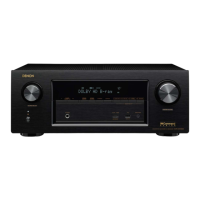

 To Next Page