EasyManua.ls Logo

Denon D-MA5DV - Page 41

Denon D-MA5DV
107 pages
Print Icon
To Next Page IconTo Next Page
To Previous Page IconTo Previous Page
Loading...
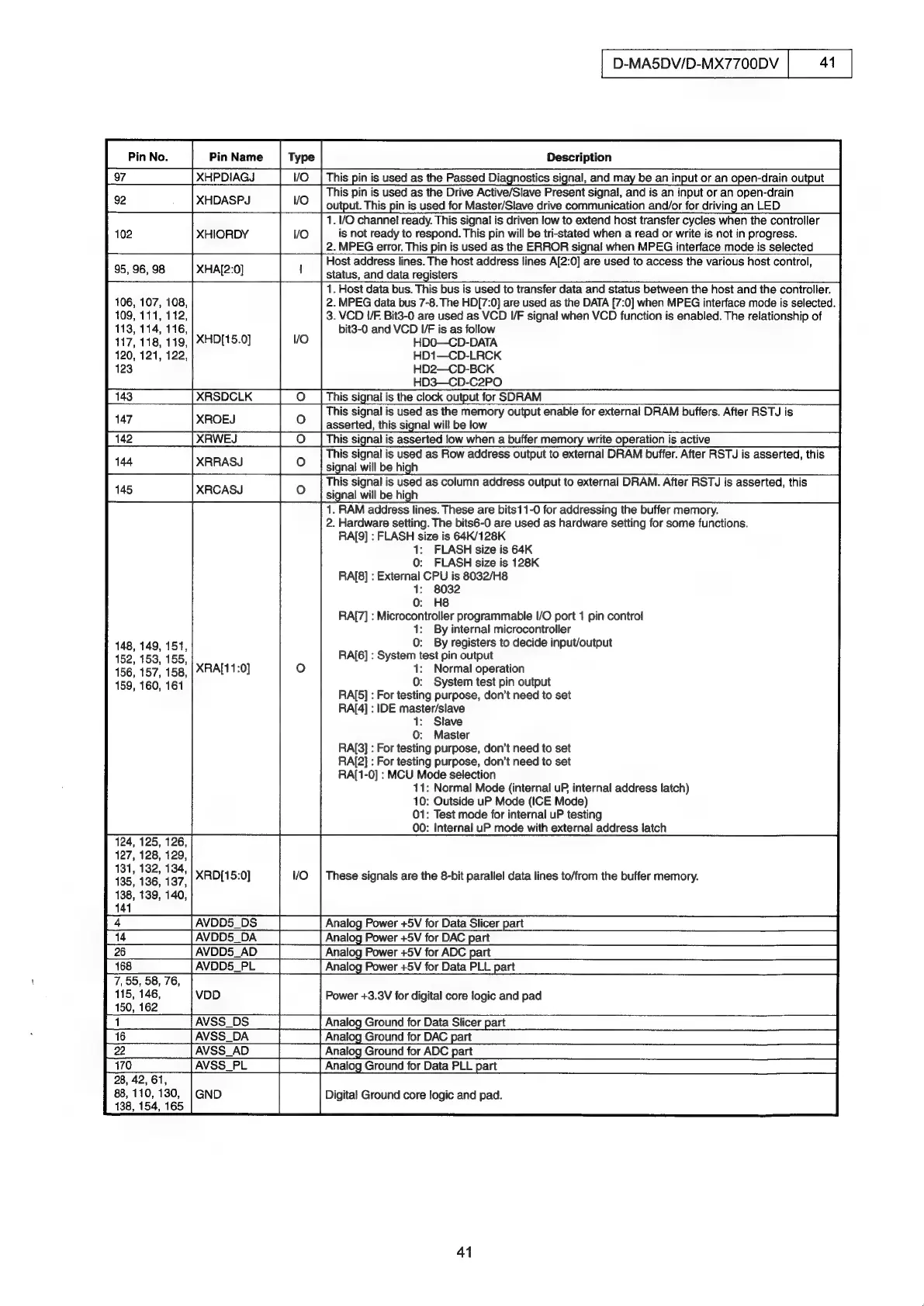
D-MASDV/D-MX7700DV
HPDIAGJ
This
pin
is
used
as the
Passed
Diagnostics
signal,
and
may
be
an
input
or
an
open-drain
output
This
pin
is
used
as
the
Drive
Active/Slave
Present
signal,
and
is
an
input
or
an
open-drain
XHDASPJ
vO
output.
This
pin
is
used
for
Master/Slave
drive
communication
and/or
for
driving
an
LED
wo
I
x
>
x
|
K
[xX]
&K
LX
<
Di}
D
|Di
DvD
ID
1s]
O}D
|S!
0
j=]
>
|>r
imm
|o
or
M1WM
je}
©
1O
Lal
sllg
afte
ad
4
x
1.
/O
channel
ready.
This
signal
is
driven
low
to
extend
host
transfer
cycles
when
the
controller
XHIORDY
vO
is
not
ready
to
respond.
This
pin
will
be
tri-stated
when
a
read
or
write
is
not
in
progress.
2.
MPEG
error.
This
pin
is
used
as
the
ERROR
signal
when
MPEG
interface
mode
is
selected
Host
address
lines.
The
host
address
lines
A[2:0]
are
used
to
access
the
various
host
control,
status,
and
data
registers
1.
Host
data
bus.
This
bus
is
used
to
transfer
data
and
status
between
the
host
and
the
controller.
2.
MPEG
data
bus
7-8.
The
HD[7:0]
are
used
as
the
DATA
[7:0]
when
MPEG
interface
mode
is
selected.
3.
VCD
I/F.
Bit3-0
are
used
as
VCD
I/F
signal
when
VCD
function
is
enabled.
The
relationship
of
1
02
95,96,98
|
XHA[2:0]
La
|
106,
107, 108,
109,
111, 112,
113,
114, 116,
bit3-0
and
VCD
I/F
is
as
follow
117,
118, 119,
|
XHD[15.0]
vO
HDO—CD-DATA
120,
121, 122,
HD1—CD-LRCK
123
HD2—CD-BCK
HD3—CD-C2PO
|
O
|
This
signal
is
the
clock
output
for
SDRAM
This
signal
is
used
as
the
memory
output
enable
for
external
DRAM
buffers.
After
RSTJ
is
asserted,
this
signal
will
be
low
5
This
signal
is
asserted
low
when
a
buffer
memory
write
operation
is
active
|
Oo
|
rn
This
signal
is
used
as
Row
address
output
to
external
DRAM
buffer.
After
RSTJ
is
asserted,
this
signal
will
be
high
This
signal
is
used
as
column
address
output
to
external
DRAM.
After
RSTJ
is
asserted,
this
signal
will
be
high
1.
RAM
address
lines.
These
are
bits11-0
for
addressing
the
buffer
memory.
2.
Hardware
setting.
The
bits6-0
are
used
as
hardware
setting
for
some
functions.
RA{9]
:
FLASH
size
is
64K/128K
1:
FLASH
size
is
64K
0:
FLASH
size
is
128K
RA{8]
:
External
CPU
is
8032/H8
1:
8032
0:
H8
RA[7]
:
Microcontroller
programmable
I/O
port
1
pin
control
1:
By
internal
microcontroller
0:
By
registers
to
decide
input/output
RA[6]
:
System
test
pin
output
1:
Normal
operation
0:
System
test
pin
output
RA|[5]
:
For
testing
purpose,
don’t
need
to
set
RA[4]
:
IDE
master/slave
1:
Slave
0:
Master
RA[3]
:
For
testing
purpose,
don’t
need
to
set
RA[2]
:
For
testing
purpose,
don’t
need
to
set
RA[1-0]
:
MCU
Mode
selection
11:
Normal
Mode
(internal
uP,
internal
address
latch)
10:
Outside
uP
Mode
(ICE
Mode)
01:
Test
mode
for
internal
uP
testing
00:
Internal
uP
mode
with
external
address
latch
143
147
142
144
145
148,
149,
151,
152,
153,
155,
156,
157,
158,
159,
160,
161
XRA[11:0}
124,
125,
126,
127,
128,
129,
131,
132, 134,
XRDI15:
:
.
135,
136, 137,
[15:0]
VO
|
These
signals
are
the
8-bit
parallel
data
lines
to/from
the
buffer
memory.
138,
139,
140,
141
p4
CS
LAVDDS_DS_
[Analog
Power+5VforDataSlicerpart
Cd
[
[Analog
Power+5VforDACpartSSOSC~—SSCSCSCSC‘“‘<‘<‘<;CSCSt*
AVDDS_AD_
|
_[AnalogPower+5VforADC
part
C—C(‘“CSC*SCSCSCSC‘*d”
AVDD5_PL
|__|
Analog
Power
+5V
for
Data
PLL
part
115,
146,
VDD
Power
+3.3V
for
digital
core
logic
and
pad
150,
162
(1
—~—~—~—~«{AVSS_DS__—_{__|
Analog
Ground
for
Data
Slicer
part
p16
CAVSS_DA
|__|
Analog
Ground
for
DAC
part
|
22
CJAVSS_AD
|__|
Analog
Ground
for
ADC
part
1170
~~=~——Ss[AVSS_PL_—s{_—_|
Analog
Ground
for
Data
PLL
part
88,
110,
130,
|
GND
Digital
Ground
core
logic
and
pad.
138,
154,
165
41

Related product manuals