EasyManua.ls Logo

Desoutter AFD415 Series - User Manual

Desoutter AFD415 Series
68 pages
Print Icon
To Next Page IconTo Next Page
Loading...
Part no 440933
Issue no 12
Date 11/2016
Page 1 / 68
www.desouttertools.com
AFD415
WARNING
To reduce the risk of injury, before using or servicing tool, read and understand the
following information as well as separately provided safety instructions
(Item number: 354343).
22
AVERTISSEMENT
Avant toute utilisation ou intervention sur l’outil, veillez à ce que les informations
suivantes ainsi que les instructions fournies dans le guide de sécurité
(Code article : 354343) aient été lues, comprises et respectées.
26
ADVERTENCIA
Antes de utilizar la herramienta o intervenir sobre ella, asegúrense de que la
información que gura a continuación, así como las instrucciones que aparecen en la
guía de seguridad (Código artículo: 354343) han sido leídas, entendidas y respetadas.
30
WARNUNG
Werkzeuge erst benutzen, wenn die nachstehenden Hinweise und die Regeln des
Sicherheitsleitfaden (Artikel-Nr. 354343) gelesen und verstanden wurden.
34
AVVISO
Prima di qualsiasi utilizzazione o intervento sull’attrezzo, vericate che le
informazioni che seguono e le istruzioni contenute nella guida di sicurezza
(Codice articolo: 354343) siano state lette, comprese e rispettate.
38
AVISO
Antes de utilizar ou intervir na ferramenta, leia atentamente e respeite as
informações seguintes assim como as instruções fornecidas no manual de
segurança (Código artigo: 354343).
42
VAROITUS
Lue huolellisesti seuraavat ohjeet samoin kuin turvallisuusohjeet
(Tuotekoodi : 354343) ennen työkalun käyttöönottoa.
46
VARNING
Läs noga igenom dessa säkerhetsinstruktioner liksom anvisningarna i
säkerhetsguiden (Artikelkod: 354343) innan du börjar använda verktyget.
49
Model Part number Series
AFD415-490 2051480164 C
AFD415-790 2051480194 C
AFD415-1250 2051480124 C
AFD415-2100 2051480144 C
AFD415-3400 2051480154 C
AFD415-5400 2051480174 C
AFD415-7000 2051480184 C
AFD415-18000 2051480134 C
Question and Answer IconNeed help?

Do you have a question about the Desoutter AFD415 Series and is the answer not in the manual?

Overview

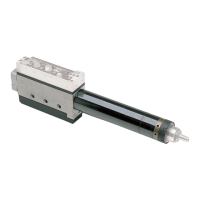
This document describes the AFD415 series of automatic feed drills, designed for professional use in drilling holes in wood, metal, and plastics. The device is not intended for any other applications. Use of non-original spare parts or accessories, including chucks, may lead to reduced performance, increased maintenance, higher vibration levels, and void the manufacturer's warranty.

Function Description

The AFD415 is an automatic feed drill that requires an emergency stop mechanism when used standalone or integrated into a machine. A suitable circuit diagram for an emergency stop is provided in Figure 2 (page 21).

The complete valve block module (1) integrates all control functions and signal sources for external control. The controls and their locations are identified and detailed in the drilling operation section.

Control Valve (Figure 3, page 5)

The control valve module (1) includes:

  • Main Air Inlet (2): 1/4" BSP or NPT threaded.
  • "P" Inlet (3): M5 threaded. This is the signal point for peck feed or dwell control circuit.
  • Manual Retract Button (4): Red button for manual retraction.
  • "I" Remote Start Inlet (5): M5 threaded. Receives an external signal to initiate the tool cycle.
  • Manual Start Button (6): Green button for manual start.
  • "R" Retract Outlet (7): 1/4" BSP threaded. Supplies air for retraction.
  • "S2" Solenoid Valve Position (8*): For electrical emergency retraction.
  • "SW2" Proximity Switch Position (9*): Detects a signal at the end of a cycle for interface kit connection (i.e., high at depth).
  • Stroke Control Valve (10): Regulates the stroke length.
  • Feed Rate Adjustment Screw (11): Adjusts the feed rate.
  • "S1" Solenoid Valve Position (12*): For electrical start.
  • Retract Rate Adjustment Screw (13): Adjusts the retraction speed.
  • Feed Rate Adjustment Screw (14): Adjusts the feed rate.
  • "O" Port (15): 1/8" BSP threaded. Receives a signal to reset the feed to the start position for peck feed or dwell control.
  • "SW1" Proximity Switch Position (16*): Detects a signal at the beginning of a cycle for interface kit connection (i.e., high at home position).
  • "M" Port (17): M5 threaded. Used for sequence control. The signal is produced when the tool is at rest.

The "M" port is intended for pilot valve operation and should not be used as an air supply source for other purposes.

Simple Control Valve (Figure 4, page 59)

This module is used for remote control of the tool. Both (1a) and (1b) detect a signal when the tool is at the home position. An external circuit is required to control the speed of advance and retract feeds. When using a simple control block, replace screw (55) with an extended head screw (383983).

Accessories

  • Mounting Clamps: A full range of clamps, bases, and columns are available from Desoutter.
  • Hydraulic Check Unit (HCU): This device is useful for blind hole drilling at a preset feed rate. If material needs to be broken through, or if another hole needs to be entered, feed acceleration may occur, potentially breaking the drill bit. To prevent this, an HCU is strongly recommended.
  • Peck Feed Drills: The Desoutter Peck Feed Drill System is recommended when the depth of the hole to be drilled is five or more times the hole diameter. This helps clear chips and avoids excessive overheating of the drill bit. Hole size accuracy is improved, and drill bit run-out is minimized.

Important Technical Specifications

  • Weight: 10.5 kg
  • Maximum Air Pressure (Pmax): 8 bar
  • Minimum Air Pressure (Pmin): 6 bar
  • Air Supply - Main: Requires water-free, filtered air supply at 6.3 bar (91.4 Psig) with a flow rate of 9.9 l/s (21 cu.ft/min), controlled by a pressure regulator selected from the Desoutter Air Line Service Equipment Catalogue.
  • Air Supply - Remote: Basic requirements are the same as above, but the pressure must be at least 2.7 bar (40 Psig), and the flow rate requirement when signaling is 0.47 l/s (1 cu.ft/min). Signal duration should be kept to a minimum to reduce air consumption.
  • Lubrication: If lubrication is required, an in-line lubricator should be fitted downstream of the filter. Use ISO VG 15. Full power is achieved with a lubricated air supply.

Usage Features

Setting Drilling Operation (Figure 5, page 5)

The drill bit must be at least 6 mm (0.25") above the workpiece.
  • This setting describes a unit with an HCU. For standard tool setup, HCU references should be ignored.
  • Adjust the gap between (1) and (2) by sliding (3) to equal the required drilling depth PLUS the distance the drill bit is above the workpiece.
  • Lock in position with (4) at the recommended torque.
  • Position the HCU in (3).
  • Adjust the gap between (6) and (7) to the required distance above the workpiece.
  • Unscrew (8) away from the HCU to adjust the resistance within the HCU to the minimum.
  • Fully open Figure 3 (13).
  • Close Figure 3 (11).
  • Connect the air supply and press Figure 3 (6).
  • Adjust Figure 3 (11/13) to achieve the required advance and retract feeds for the operation.
  • Use Figure 5 (1) for final depth adjustment.
  • Lock using Figure 5 (9).
  • Perform a series of trial drillings to determine ideal advance and HCU settings using Figure 3 (11).

Setting Tapping Operation (Figure 5, page 5)

  • Note 1: It is crucial to set the tool's advance rate to match the pitch of the thread to be tapped. Incorrect advance will result in a deformed thread, more noticeable in plastics or light alloys.
  • Note 2: The retract rate should be slightly faster than the advance rate to ensure a clean withdrawal of the tap.
  • Mount the tool with the selected tap securely retained in the chuck, above a test block for sample tapping.
  • The end of the tap MUST be at least 14 mm (9/16") above the test block to allow for tapping head reversing engagement travel.
  • Adjust the gap between Figure 5 (2) and (1) to equal the tapping depth PLUS the distance the tap is above the workpiece.
  • Adjust Figure 3 (11/13) to achieve the required advance and retract feeds for the operation.
  • Perform a trial tapping operation and inspect the finished thread form. Adjust Figure 3 (11/13) as necessary and repeat until Notes 1 and 2 are satisfied.

Maintenance Features

Servicing Requirements

  • Lubricants:
    • Grease - Molykote Longterm W2 for splines and guide rod.
    • Grease - Molykote G68 for gearbox.
    • Grease - Molykote PG75 Plastislip for O-Rings.
    • Grease - BP FG00EP for bearings.
  • Cleaning:
    • Requires a container for immersing components and good quality clean paraffin.
    • Soak components in paraffin, ensuring full immersion and agitation to flush air passages.
    • Remove components, dry thoroughly, and blow through air passages to remove moisture.
    • Place components in an airtight container until assembly.
    • Dispose of dirty paraffin according to health and safety regulations.
  • Maintenance Instructions:
    • The complete bearing sleeve is under spring (16) compression. While resisting the thrust from spring (16), carefully unscrew and remove the bearing sleeve, followed by the spring.
    • Service should be performed at 1000-hour intervals. Always quote tool model number, serial number, and spare part number when ordering spares.
    • All torque figures are ± 5%.
    • Dismantle the tool using the exploded view.
    • Clean all components and inspect for wear or damage; replace if necessary.
    • Apply new lubricant to relevant parts according to the list.
    • Replace the front seal after dismantling the tool.
    • Special tools shown in the exploded view are in addition to normal workshop tools.
    • When disposing of components, lubricants, etc., ensure relevant safety procedures are followed.
    • Wear protective gloves and eye protection during cleaning of parts. Eating or smoking is prohibited during cleaning, dismantling, or assembling the tool.

Desoutter AFD415 Series Specifications

General IconGeneral
BrandDesoutter
ModelAFD415 Series
CategoryDrill
LanguageEnglish