
 Need help?
Do you have a question about the DeVilbiss Healthcare drive Scout and is the answer not in the manual?
Provides contact details for support, warranty, sales, and service information.
Specifies suitable indoor/outdoor environments and surfaces for scooter use.
Defines the intended user group, weight limit, and required user capabilities.
Describes the scooter's purpose for transporting users with restricted mobility.
States the primary indication for using the scooter.
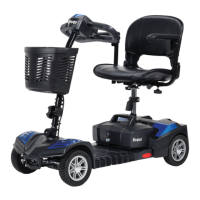
Provides a general description of the scooter's design and classification.
Explains the meaning of warning and caution symbols in the manual.
Emphasizes the need for a risk assessment before use, listing potential considerations.
Lists conditions or user factors that make the scooter unsuitable for use.
Details the maximum user weight and loading capacity of the scooter.
Stresses the importance of user familiarity and training for safe operation.
Lists crucial safety warnings for operating the scooter, including usage conditions.
Warns against modifications, use in hazardous environments, and unsupervised use.
Provides safety instructions for using the freewheel mode.
Specifies ambient temperature limits and conditions for transport and storage.
Outlines conditions and methods for safely transporting and storing the scooter.
Details battery care for storage and classification for air transport.
Advises on preventing and addressing flat spots on wheels during storage.
Provides a step-by-step guide for disassembling the scooter without tools.
Details the procedure for re-assembling the scooter after disassembly.
Emphasizes ensuring the tiller adjustment knob is fully tightened after assembly.
Explains common symbols found on the scooter and their meanings.
Defines symbols related to product identification, manufacturer, and handling.
Explains symbols related to environmental conditions and usage restrictions.
Identifies major parts of the scooter with labels and visual aids.
Lists the approximate weights of the main scooter components.
Provides essential instructions and safety advice for preparing the scooter.
Outlines critical safety precautions for charging the scooter's battery.
Details how to charge the battery pack and through the tiller.
Explains the meaning of the charger's LED indicators and recommended charging times.
Describes essential checks to perform before operating the scooter for safety.
Specifies the ambient temperature and humidity limits for operation.
Identifies the main controls on the handlebar and their functions.
Explains the function of the key ignition and speed adjustment dial.
Details how to lock and unlock the tiller for safe operation.
Describes how to use the wigwag paddle for movement and braking.
Explains how to use the horn button and front light.
Details how to rotate and adjust the seat height.
Explains how to interpret the battery level indicator.
Explains how to interpret LED flashing for scooter problems.
Guides on how to adjust the tiller to a suitable position.
Explains the purpose and reset procedure for the circuit breaker.
Describes how to use the freewheel lever for manual movement.
Warns against using freewheel mode on inclines or while occupied.
Emphasizes caution, awareness, and avoiding certain conditions while driving.
Advises on proper seating, avoiding moving parts, and carer proximity.
Highlights safety regarding children and keeping feet within the scooter.
Provides guidance on approaching and maneuvering over obstacles like kerbs.
Warns against exceeding ground clearance and reversing over obstacles.
Advises on safe techniques for driving up and down inclines.
Warns about stability and maximum slope angles for safe operation.
Advises on avoiding inclement weather and its effects on the scooter.
Provides guidance on night driving and handling different surface types.
Details steps to take after using the scooter, including key removal and storage.
Outlines safety measures and warnings related to cleaning the scooter.
Provides instructions on how to clean the scooter frame and painted surfaces.
Lists critical safety warnings and prohibitions for maintenance activities.
Provides general advice on routine maintenance and seeking professional help.
Lists routine checks for maintaining the scooter's operating condition.
Lists common signs that may indicate a serious problem with the scooter.
Offers steps to resolve common minor faults with the scooter.
Advises on contacting providers for component replacement and repair services.
Provides guidance on disposing of scooter parts and packaging according to WEEE policies.
Warns about the need for decontamination before disposing of parts.
Explains how electromagnetic interference can affect the scooter's performance.
Provides warnings and recommendations to prevent EMI with the scooter's control system.
Lists technical specifications for the Scout scooter, including dimensions, speed, and weight.
Lists technical specifications for the Scout Explorer model.
Details the warranty period, coverage, exclusions, and claims process.
Provides a schedule for daily, weekly, monthly, and six-monthly inspections.
Recommends an annual service by an authorized engineer.
 General
| Anti-Tip Wheels | Yes |
|---|---|
| Weight Capacity | 300 lbs |
| Overall Length | 42 inches |
| Overall Width | 21 inches |
| Battery Charger | Off-board |
| Seat Depth | 16 inches |
| Ground Clearance | 2.5 inches |

 To Next Page
