Line output:
The line output is designed to transfer the incoming signal from one speaker, to another active speaker. This
way, multiple speakers can be daisy-chained easily, for public address applications.
The line output has the same signal as the master signal from the speaker. For instance, when you mix
signals of the line and mic inputs, this mix will be transferred to other active speakers.
It is not possible to connect passive speakers, as there is no powered output available.
Stand adapter:
The built-in stand adapter on the bottom of the speaker is equipped with a tightening knob. This makes sure
the speaker is clamped to your stand perfectly. This also prevents unwanted rattling noise and movement
when positioned on a stand.
Monitor feet:
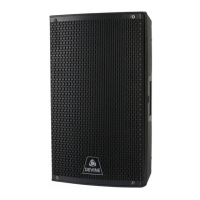
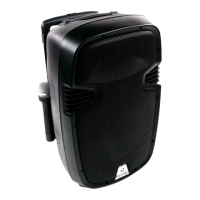
The side handles of the speaker are equipped with special monitor feet. This way, and without the use of
separate feet, you can use the speaker as a floor monitor.
Fixed installation:
This speaker has no rigging hardware for flying use or installation. When installing this speaker in a fixed
position, always use a wall bracket with 35mm tube to mount the speaker to. Do not install the speaker
directly above any audience and do not position the speaker in a position which may harm anyone if it falls
down unexpectedly.
Optimal high frequency dispersion:
Optimal high frequency dispersion for larger amounts of people is created when these speakers are placed
on universal speaker stands with 35mm top diameter. This way, the high frequency dispersion can be spread
more easily towards your audience. As high frequencies tend to reflect when they reach an object (such as a
wall or person) and low frequencies can move through objects more easily (thanks to resonance), this will
provide better sound quality for your audience.
To improve the low frequencies when placed on a speaker stand, experiment with the two-band equalizer
(Bass, Treble) to create the optimal sound. When used on the floor as a stage monitor, the low frequencies
probably need to be decreased as acoustic coupling with the floor creates more low frequency response
naturally.
Any information and illustrations shown in this user manual are subject to change without further notice.
User manual version: 1.0 Creation date + author initials: 09-01-2014 RV Revision date + author initials: 13-01-2014 RV



 To Next Page