Introduction
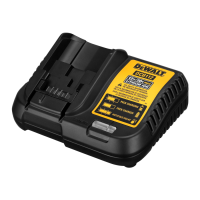
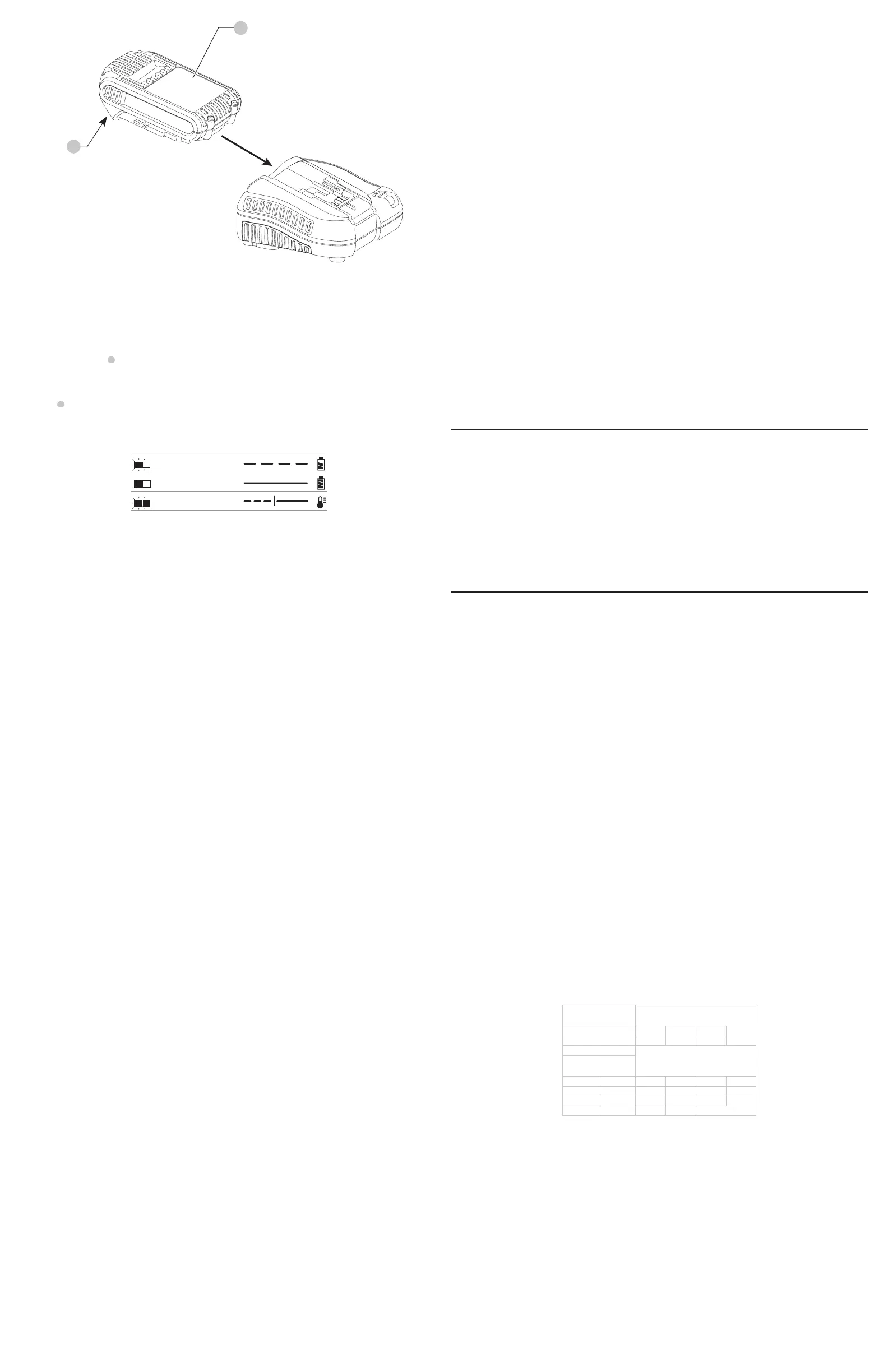
The DCB112 battery charger (Fig.A) is designed to charge DeWALT 12–20V Max* lithium ion battery packs. This charger requires
no adjustment and is designed to be as easy as possible to operate. Simply place your battery pack into the receptacle of a
plugged in charger and it will automatically charge the pack. Consult the chart at the end of this manual for compatibility of
chargers and battery packs.
Charging a Battery (Fig. A)
1. Plug the charger into an appropriate outlet before inserting battery pack.
2. Insert the battery pack
1
into the charger, making sure the battery pack is fully seated in the charger. The red (charging)
light will blink continuously indicating that the charging process has started.
3. The completion of charge will be indicated by the red light remaining ON continuously. The battery pack is fully charged
and may be used at this time or left in the charger. To remove the battery pack from the charger, push the battery release
button
2
on the battery pack.
NOTE: To ensure maximum performance and life of lithium-ion battery packs, charge the battery pack fully before first use.
Charger Operation
Refer to the indicators below for the charge status of the battery pack.
Charging
Fully Charged
Hot/Cold Pack Delay*
* The red light will continue to blink, but a yellow indicator light will be illuminated during this operation. Once the battery pack
has reached an appropriate temperature, the yellow light will turn off and the charger will resume the charging procedure.
The compatible charger(s) will not charge a faulty battery pack. The charger will indicate faulty battery pack by refusing to light
or by displaying a problem pack or charger blink pattern.
NOTE: This could also mean a problem with a charger.
If the charger indicates a problem, take the charger and battery pack to be tested at an authorized service center.
Hot/Cold Pack Delay
When the charger detects a battery pack that is too hot or too cold, it automatically starts a Hot/Cold Pack Delay, suspending
charging until the battery pack has reached an appropriate temperature. The charger then automatically switches to the pack
charging mode. This feature ensures maximum battery pack life.
A cold battery pack will charge at a slower rate than a warm battery pack. The battery pack will charge at that slower rate
throughout the entire charging cycle and will not return to maximum charge rate even if the battery pack warms.
Never operate the charger if the fan does not operate properly or if ventilation slots are blocked. Do not permit foreign objects
to enter the interior of the charger.
Electronic Protection System
Li-Ion tools are designed with an Electronic Protection System that will protect the battery pack against overloading,
overheating or deep discharge.
The tool will automatically turn off if the Electronic Protection System engages. If this occurs, place the lithium-ion battery pack
on the charger until it is fully charged.
Wall Mounting
These chargers are designed to be wall mountable or to sit upright on a table or work surface. If wall mounting, locate the
charger within reach of an electrical outlet, and away from a corner or other obstructions which may impede air flow. Use
the back of the charger as a template for the location of the mounting screws on the wall. Mount the charger securely using
drywall screws (purchased separately) at least 1" (25.4 mm) long, with a screw head diameter of 0.28–0.35" (7–9mm), screwed
into wood to an optimal depth leaving approximately 7/32" (5.5 mm) of the screw exposed. Align the slots on the back of the
charger with the exposed screws and fully engage them in the slots.
Charger Cleaning Instructions
WARNING: Shock hazard. Disconnect the charger from the AC outlet before cleaning. Dirt and grease may be removed from
the exterior of the charger using a cloth or soft non-metallic brush. Do not use water or any cleaning solutions.
Important Charging Notes
1. Longest life and best performance can be obtained if the battery pack is charged when the air temperature is between 65°F
and 75°F (18° – 24°C). DO NOT charge the battery pack in an air temperature below +40°F (+4.5°C), or above +104°F
(+40°C). This is important and will prevent serious damage to the battery pack.
2. The charger and battery pack may become warm to the touch while charging. This is a normal condition, and does not
indicate a problem. To facilitate the cooling of the battery pack after use, avoid placing the charger or battery pack in a
warm environment such as in a metal shed or an uninsulated trailer.
3. If the battery pack does not charge properly:
a. Check operation of receptacle by plugging in a lamp or other appliance;
b. Check to see if receptacle is connected to a light switch which turns power off when you turn out the lights;
c. Move the charger and battery pack to a location where the surrounding air temperature is approximately 65°F – 75°F
(18° – 24°C);
d. If charging problems persist, take the tool, battery pack and charger to your local service center.
4. The battery pack should be recharged when it fails to produce sufficient power on jobs which were easily done previously.
DO NOT CONTINUE to use under these conditions. Follow the charging procedure. You may also charge a partially used
pack whenever you desire with no adverse effect on the battery pack.
5. Foreign materials of a conductive nature such as, but not limited to, grinding dust, metal chips, steel wool, aluminum foil,
or any buildup of metallic particles should be kept away from charger cavities. Always unplug the charger from the power
supply when there is no battery pack in the cavity. Unplug the charger before attempting to clean.
6. Do not freeze or immerse the charger in water or any other liquid.
Storage Recommendations
1. The best storage place is one that is cool and dry, away from direct sunlight and excess heat or cold.
2. For long storage, it is recommended to store a fully charged battery pack in a cool dry place out of the charger for
optimalresults.
NOTE: Battery packs should not be stored completely depleted of charge. The battery pack will need to be recharged
beforeuse.
SAVE THESE INSTRUCTIONS FOR FUTURE USE
MAINTENANCE
Repairs
The charger and battery pack are notserviceable.
WARNING: To assure product SAFETY and RELIABILITY, repairs, maintenance and adjustment (including brush inspection
and replacement, when applicable) should be performed by a DeWALT factory service center or a DeWALT authorized service
center. Always use identical replacementparts.
Register Online
Thank you for your purchase. Register your product nowfor:
• WARRANTY SERVICE: Registering your product will help you obtain more efficient warranty service in case there is a
problem with yourproduct.
• CONFIRMATION OF OWNERSHIP: In case of an insurance loss, such as fire, flood or theft, your registration of ownership
will serve as your proof ofpurchase.
• FOR YOUR SAFETY: Registering your product will allow us to contact you in the unlikely event a safety notification is
required under the Federal Consumer SafetyAct.
Register online at www.dewalt.com/register.
Three Year Limited Warranty
DeWALT will repair, without charge, any defects due to faulty materials or workmanship for three years from the date of
purchase. This warranty does not cover part failure due to normal wear or tool abuse. For further detail of warranty coverage
and warranty repair information, visit www.dewalt.com or call 1-800-4-DeWALT (1-800-433-9258). This warranty does not apply
to accessories or damage caused where repairs have been made or attempted by others. THIS LIMITED WARRANTY IS GIVEN IN
LIEU OF ALL OTHERS, INCLUDING THE IMPLIED WARRANTY OF MERCHANTABILITY AND FITNESS FOR A PARTICULAR PURPOSE,
AND EXCLUDES ALL INCIDENTAL OR CONSEQUENTIAL DAMAGES. Some states do not allow limitations on how long an implied
warranty lasts or the exclusion or limitation of incidental or consequential damages, so these limitations may not apply to you.
This warranty gives you specific legal rights and you may have other rights which vary in certain states orprovinces.
In addition to the warranty, DeWALT tools are covered byour:
1 YEAR FREE SERVICE
DeWALT will maintain the tool and replace worn parts caused by normal use, for free, any time during the first year
afterpurchase.
2 YEARS FREE SERVICE ON DEWALT BATTERY PACKS
DC9071, DC9091, DC9096, DC9182, DC9280, DC9360, DCB120, DCB127, DCB201, DCB203BT, DCB207, DCB361
3 YEARS FREE SERVICE ON DEWALT BATTERY PACKS
DCB200, DCB204, DCB204BT, DCB203, DCB205, DCB205BT, DCB206 DCB230, DCB606, DCB609
NOTE: Battery warranty voided if the battery pack is tampered with in any way. DeWALT is not responsible for any injury caused
by tampering and may prosecute warranty fraud to the fullest extent permitted bylaw.
90 DAY MONEY BACK GUARANTEE
If you are not completely satisfied with the performance of your DeWALT Power Tool, Laser, or Nailer for any reason, you can
return it within 90 days from the date of purchase with a receipt for a full refund – no questionsasked.
LATIN AMERICA: This warranty does not apply to products sold in Latin America. For products sold in Latin America,
see country specific warranty information contained in the packaging, call the local company or see website for
warrantyinformation.
FREE WARNING LABEL REPLACEMENT: If your warning labels become illegible or are missing, call 1-800-4-DeWALT (1-800-
433-9258) for a freereplacement.
FRANCAIS
Fig. A
1
2
Définitions : symboles et termes d'alarmes sécurité
Ces guides d'utilisation utilisent les symboles et termes d'alarmes sécurité suivants pour vous prévenir de situations dangereuses
et de risques de dommages corporels ou matériels.
DANGER: indique une situation dangereuse imminente qui, si elle n’est pas évitée, entraînera la mort ou des
blessuresgraves.
AVERTISSEMENT: indique une situation potentiellement dangereuse qui, si elle n’est pas évitée, pourrait entraîner la mort
ou des blessuresgraves.
ATTENTION: indique une situation potentiellement dangereuse qui, si elle n’est pas évitée, pourrait entraîner des
blessures légères oumodérées.
(Si utilisé sans aucun terme) Indique un message propre à la sécurité.
AVIS : indique une pratique ne posant aucun risque de dommages corporels mais qui par contre, si rien n’est fait pour
l’éviter, pourrait poser des risques de dommages matériels.
POUR TOUTE QUESTION OU REMARQUE AU SUJET DE CET OUTIL OU DE TOUT AUTRE OUTIL DeWALT, COMPOSEZ LE NUMÉRO
SANS FRAIS : 1-800-4-DeWALT (1-800-433-9258).
AVERTISSEMENT! Lire tous les avertissements de sécurité et toutes les directives.
Le non-respect des avertissements et des directives pourrait se solder par un choc électrique, un incendie et/ou une
blessuregrave.
CONSERVER CES CONSIGNES
Directives de sécurité importantes propres à tous les chargeurs de piles
AVERTISSEMENT : lire toutes les instructions et toutes les consignes de sécurité propres au bloc-piles, au chargeur
et à l’outil électrique. Tout manquement aux avertissements et instructions pose des risques de décharges
électriques, d’incendie et/ou de blessures graves.
• Avant d’utiliser le chargeur, lire toute consigne et tout avertissement apposés sur le chargeur, le bloc-piles et le
produit utilisant le bloc-piles.
• NE PAS tenter de charger de bloc-piles avec des chargeurs autres que ceux décrits dans ce manuel. Le chargeur et son
bloc-piles ont été conçus tout spécialement pour fonctionnerensemble.
• Ces chargeurs n’ont pas été conçus pour une utilisation autre que recharger les blocs-piles rechargeables DeWALT.
Toute autre utilisation comporte des risques d’incendie, de chocs électriques ou d’électrocution.
• Protéger le chargeur de la pluie ou de laneige.
• Tirer sur la fiche plutôt que sur le cordon pour débrancher le chargeur. Cela permet de réduire les risques d’endommager
la fiche ou le cordon d’alimentation.
• S’assurer que le cordon est protégé de manière à ce que personne ne marche ni ne trébuche dessus, ou à ce qu’il ne
soit ni endommagé ni soumis à aucunetension.
• N’utiliser une rallonge qu’en cas de nécessité absolue. L’utilisation d’une rallonge inadéquate comporte des risques
d’incendie, de chocs électriques ou d’électrocution.
• Pour utiliser un chargeur à l’extérieur, le placer dans un endroit sec et utiliser une rallonge conçue pour l’extérieur.
L’utilisation d’une rallonge conçue pour l’extérieur réduit les risques de chocsélectriques.
• Pour la sécurité de l’utilisateur, utiliser une rallonge de calibre adéquat (AWG, American Wire Gauge [calibrage
américain normalisé des fils électriques]). Plus le calibre est petit, et plus sa capacité est grande. Un calibre16, par exemple, a
une capacité supérieure à un calibre18. L’usage d’une rallonge de calibre insuffisant causera une chute de tension qui entraînera
perte de puissance et surchauffe. Si plus d’une rallonge est utilisée pour obtenir une certaine longueur, s’assurer que chaque
rallonge présente au moins le calibre de fil minimum. Le tableau ci-dessous illustre les calibres à utiliser selon la longueur de
rallonge et l’intensité nominale indiquée sur la plaque signalétique. En cas de doute, utiliser le calibre suivant. Plus le calibre est
petit, plus la rallonge peut supporter decourant.
Calibre minimum pour les cordons d'alimentation
Volts
Longueur totale du cordon
d'alimentation en mètre (pieds)
120 V 7,6 (25) 15,2 (50) 30,5 (100) 45,7 (150)
240 V 15,2 (50) 30,5 (100) 61,0 (200) 91,4 (300)
Ampères
AWG
Plus que Pas plus
que
0 6 18 16 16 14
6 10 18 16 14 12
10 12 16 16 14 12
12 16 14 12 Non recommandé
• Ne poser aucun objet sur le chargeur. Ne pas mettre le chargeur sur une surface molle qui pourrait en bloquer la
ventilation et provoquer une surchauffe interne. Éloigner le chargeur de toute source de chaleur. Le chargeur dispose
d’orifices d’aération sur le dessus et le dessous duboîtier.
• Ne pas le faire fonctionner avec un cordon d’alimentation ou une ficheendommagée.
• Ne pas utiliser le chargeur s’il a reçu un coup, fait une chute ou a été endommagé de quelque façon que ce soit. Le
ramener dans un centre de réparationagréé.
• Ne pas démonter le chargeur. Pour tout service ou réparation, le rapporter dans un centre de réparation agréé. Le
fait de le réassembler de façon incorrecte comporte des risques de chocs électriques, d’électrocution et d’incendie.
• Débrancher le chargeur du secteur avant tout entretien. Cela réduira tout risque de chocs électriques. Le fait de retirer
le bloc-piles ne réduira pas cesrisques.
• NE JAMAIS tenter de connecter 2 chargeursensemble.
• Le chargeur a été conçu pour être alimenté en courant électrique domestique standard de 120 volts. Ne pas tenter
de l’utiliser avec toute autre tension. Cela ne s’applique pas aux chargeurs de postesmobiles.
AVERTISSEMENT: risques de chocs électriques. Ne laisser aucun liquide pénétrer dans le chargeur, des chocs électriques
pourraient en résulter.
AVERTISSEMENT: risques de brûlure. Ne submerger le bloc-piles dans aucun liquide et le protéger de toute infiltration de
liquide. Ne jamais tenter d’ouvrir le bloc-piles pour quelque raison que ce soit. Si le boîtier plastique du bloc-piles est brisé ou
fissuré, le retourner dans un centre de réparation pour y être recyclé.
ATTENTION: risques de brûlure. Pour réduire tout risque de dommages corporels, ne recharger que des blocs-piles
rechargeables DeWALT. Tout autre type de piles pourrait exploser et causer des dommages corporels etmatériels.


 To Next Page
 Loading...