Need help?
Do you have a question about the DeWalt DW443 and is the answer not in the manual?
Provides detailed specifications for the DEWALT DW443 sander, including voltage, power, and dimensions.
Explains the meaning of safety symbols used in the manual, detailing different levels of hazard and warnings.
Covers safety measures for the work environment and electrical precautions to prevent accidents.
Measures to ensure operator safety, such as staying alert and using protective equipment.
Guidelines for proper usage, maintenance, and care of the power tool to ensure longevity.
Safety advice specific to sanders, including paint sanding and dust handling.
Procedures for environmental protection, cleaning, and disposal of the tool and debris.
Lists package items and specifies the tool's designed purpose.
Instructions for assembling parts, fitting discs, and using extension cables.
Guidance on how to operate the sander safely and effectively.
Procedures for maintaining the tool's condition and cleaning it after use.
Information on recommended accessories and environmentally responsible disposal.
Outlines the 30-day satisfaction guarantee, free service contract, and full warranty.
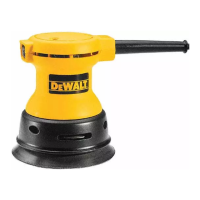
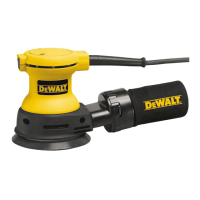
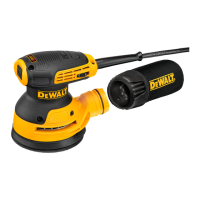
The DEWALT DW443 is a right-angle random orbit sander designed for professional sanding of wood and plastics. This power tool is double insulated, meaning no earth wire is required, and is intended for dry use only, not under wet conditions or in the presence of flammable liquids or gases. It is a professional-grade tool, and children should not come into contact with it. Inexperienced operators require supervision when using this tool.
The DW443 sander operates by moving the sanding pad in a random orbit pattern, which helps to produce a smooth finish with minimal scratch marks in all directions. This means it is not necessary to sand with the grain of the material. The tool is equipped with an electronic speed control dial, allowing the user to adjust the sanding speed to suit different materials and applications. Generally, harder materials may require a higher speed setting, but the correct setting is often a matter of experience.
For dust management, the sander features a dust extraction system. It can be used with an attached dustbag or connected to an external vacuum extractor. Proper dust extraction is achieved with perforated abrasive sanding discs, which allow dust to be drawn away from the work surface and into the collection system. This is particularly important when sanding materials that produce toxic dust, such as certain woods (e.g., beech, oak) and metals. However, it is crucial to note that the dustbag or vacuum extractor should not be used when sanding metal, and magnesium should never be sanded with this tool.
The sander is activated via an on/off switch. For user comfort and control, it is designed to be held with one hand on the side handle and the other on the main handle.
To begin using the DW443, the side handle (f) should be fitted if necessary. Sanding discs are attached to the hook and loop sanding pad (h). The sander uses 150 mm hook and loop sanding discs with a 6-hole dust extraction pattern. To fit a disc, the sander is placed on a table with the sanding pad facing up. The disc is then placed directly on top of the pad, and the dust extraction holes on the disc are aligned with those on the pad while holding the pad with one hand.
Before starting, the electronic speed control dial (b) is set to the desired speed. The sander is then turned on using the on/off switch (a). When sanding, it is recommended to start with the coarsest grit size and check the work at short intervals. It is important to apply only gentle pressure to the workpiece; excessive pressure does not improve the sanding effect and can lead to increased load on the machine and premature tearing of the abrasive. Overloading the tool should be avoided. Always switch off the tool when work is finished and before unplugging.
For dust collection, the dustbag (c) can be attached to the dust extraction spout (g) using the dustbag adaptor (e). For optimal efficiency, the dustbag should be emptied when it is about one-third full. Alternatively, a vacuum extractor can be connected. To do this, the dustbag adaptor (e) is removed from the dust extraction spout (g), and the vacuum extractor adaptor (d) is attached to the spout. The vacuum extractor is then connected to the adaptor.
Special precautions are necessary when sanding paint, especially lead-based paint, which is not recommended due to the difficulty of controlling contaminated dust. If sanding any paint, it is advised that no children or pregnant women enter the work area until cleanup is complete. A dust mask or respirator should be worn by all persons in the work area, with the filter replaced daily or when breathing becomes difficult. Eating, drinking, or smoking should not occur in the work area to prevent ingestion of contaminated paint particles. Workers should wash and clean up before eating, drinking, or smoking, and no food, drink, or smoking materials should be left in the work area.
Environmental safety measures for paint sanding include minimizing dust generation, sealing work areas with plastic sheeting, and sanding in a manner that reduces tracking of paint dust outside the work area. Cleanup involves daily vacuuming and thorough cleaning of all surfaces, frequent changing of vacuum filter bags, and proper disposal of plastic drop cloths and dust chips in sealed refuse receptacles. All toys, washable furniture, and utensils used by children should be thoroughly washed after being in the work area.
The DEWALT DW443 is designed for long-term operation with minimal maintenance, but continuous satisfactory operation relies on proper tool care and regular cleaning. Before installing or removing accessories, adjusting settings, or making repairs, the unit must be turned off and disconnected from the power source to reduce the risk of injury from accidental start-up.
The sanding pad (h) and the speed limiter disc (m) are consumable parts and require replacement when signs of wear become evident for the sanding pad, or when the sanding pad speed increases dramatically upon lifting the sander off the workpiece for the speed limiter disc. To replace these parts, first unplug the tool. Then, loosen the four hex head screws (n) and remove the pad. Replace the sanding pad (h) and/or speed limiter disc (m), ensuring the speed limiter disc is properly aligned, and then tighten the hex head screws.
The power tool does not require additional lubrication.
For cleaning, it is recommended to blow dirt and dust out of the main housing with dry air regularly, especially when dirt accumulates around the air vents. Approved eye protection and a dust mask should be worn during this procedure. Solvents or harsh chemicals should never be used for cleaning the non-metallic parts of the tool, as these chemicals can weaken the materials. Instead, use a cloth dampened with water and mild soap. No liquid should ever enter the tool, and no part of the tool should be immersed in liquid.
Only DEWALT-recommended accessories should be used with this product, as other accessories have not been tested and could be hazardous. For information on appropriate accessories, consult your dealer.
The product should not be disposed of with normal household waste but should be collected separately for recycling. This helps prevent environmental pollution and reduces the demand for raw materials. DEWALT provides a collection and recycling facility for its products at the end of their working life; products can be returned to an authorized repair agent for this service.
 General
| Power | 530 W |
|---|---|
| Type of sander | - |
| Eccentricity | 2.5 mm |
| Idle speed (max) | 7600 RPM |
| Oscillating orbit diameter | 5 mm |
| Idle oscillation rate (max) | 6800 OPM |
| Idle oscillation rate (min) | 4000 OPM |
| Power source | AC |
 Weight and Dimensions
| Depth | 320 mm |
|---|---|
| Height | 125 mm |
| Weight | 2700 g |
| Sanding disc diameter | 150 mm |


 To Next Page