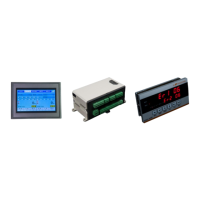
This document describes the DS822-P8M (4821) Multifunctional Programmable Weighing Controller, an instrument designed for various weighing applications.
Function Description
The DS822-P8M (4821) is a versatile programmable weighing controller capable of connecting with digital sensors. It features a standard guide rail for installation and can be connected to both a touch screen and a man-machine interface for display and control. The controller is designed for high precision, reliability, and user programmability, offering a wide range of functions for automated control equipment.
Key functions include:
- Weighing and Calibration: Supports zero setting, tare operation, and calibration of scales, including correction for angular and axial differences, and sensor number adjustment. It allows for both manual zero setting and calibration of load points.
- Parameter Setting: Provides extensive parameter configuration through F and P parameters, covering internal working parameters, operation items, and control settings.
- Input/Output Control: Manages multiple switch inputs, switch outputs, analog output ports (4-20mA), and an analog input port (4-20mA) for external control parameters.
- Communication: Features a full-function communication port (RS485) supporting top-loose, standard Modbus RTU, and multiple continuous transmission modes. It also includes an RS232 serial port for programming.
- Display Management: Supports connection to one or two large-screen displays, with configurable content for both the main and auxiliary displays.
- Process Control: Integrates with workflow processes, allowing for timed shutdown functions and input/output position adjustment to adapt to damaged ports without modifying the core process.
- Self-Test and Diagnostics: Includes power-on self-test, fault display codes for various errors (internal RAM, ROM, clock, sensor failures, overload, undervoltage), and instrument test functions for LEDs, nixie tubes, relay outputs, pulse inputs, and communication ports.
- Security: Implements password control with three levels (user-1, user-2, administrator) to restrict access to certain operations and parameter modifications.
- Factory Settings: Allows for restoration of factory settings, with a warning to save important parameters like tare value and calibration coefficients beforehand.
Important Technical Specifications
Hardware Resources and Functions:
- Switch Inputs: 6 common switch input points, configurable for passive switch, button, relay output, or NPN/PNP transistor switch input. Supports DC voltage signals (6-24V).
- Relay Outputs: 8 relay output contacts with a capacity of AC220V/DC30V, 5A. Can be directly connected to low-power resistive and inductive loads.
- OC Gate Output: 2-channel OC gate outputs, corresponding to outputs 6 and 7.
- Analog Output: 2 channels of 4-20mA analog output.
- Analog Input: 1 channel of 4-20mA analog input.
- USB Interface: 1 USB interface.
- Communication Interface: RS232/RS485 for communication with computers, PLCs, and large screen displays. The RS485 port supports digital sensors (up to 16 sensors) with a 12V power supply (>400mA). ADJ and V- shorting can increase sensor supply voltage for longer distances.
- Sensor Power Supply: DC12V or 24V (current > 400mA).
- Overall Dimensions: Main engine: 199 × 124 × 117 mm; Opening size: 188 × 113 mm.
Main Performance Indicators:
- Power Supply Voltage: Wide voltage AC100-240V, 50-60Hz.
- Service Temperature: -10℃ to 40℃.
- Storage and Transportation Temperature: -65℃ to +150℃.
- Relative Humidity: ≤ 90%.
- Number of Sensors Connected: Top song digital protocol sensors, up to 63.
Communication Protocols:
- Top Loose Communication Protocol: Master-slave protocol based on ASCII code bytes, with unique addresses for each instrument. Data frames include XON, ADDR, CMD, DATA, CHK, and XOFF. The check code (CHK) is calculated by XORing previous bytes and ORing with 0x40.
- Continuous Sending Mode: When F06 is set to 4, 5, 6, or 7, the instrument continuously transmits data (e.g., gross weight, net weight, tare weight, total accumulated quantity) at 35ms intervals in various formats (e.g., Top Loose, TOLEDO, Yaohua, HB8212, EX2001).
- Modbus RTU Communication: Supports standard Modbus RTU function codes for reading and writing register attributes, including P parameters (P01-P99), output values, AD values, calibration coefficients, and working states of process executors. Registers are typically 4 bytes, signed, read/write, or 2 bytes, unsigned, read-only.
Usage Features
- User-Friendly Interface: The display panel features 6 independent setting keys, each with dual functions depending on the context (short press vs. long press). The digital tube display provides clear feedback on parameters and status.
- Password Protection: Operations are protected by a multi-level password system (user-1, user-2, administrator) to prevent unauthorized changes. The manufacturer's password is dynamic.
- Flexible Configuration:
- Parameter Setting: F parameters (fixed meaning, internal working) and P parameters (control parameters) can be viewed and modified.
- Display Customization: Users can freely set the content displayed on the upper and lower rows of the digital tube display using F20 and F21 parameters.
- I/O Remapping: The input/output position adjustment function (F32 parameter) allows remapping of physical input/output ports to internal numbers, useful for bypassing damaged ports without altering the process.
- Calibration Process:
- Zero Setting: Manual zero setting is possible, with an unlimited range after logging in with user-1 password or higher.
- Load Point Calibration: Involves selecting a sensor, entering a target weight, and adjusting the calibration coefficient.
- Analog Output/Input Calibration: Allows for two-point adjustment of 4-20mA signals to ensure accuracy, typically performed if the factory calibration needs fine-tuning.
- Process Management: The instrument supports workflows, with F19 indicating the current workflow number. It can automatically start processes after power-on if configured.
- Timed Shutdown: A timed shutdown function (F32 parameter) can be set, requiring administrator-level access.
- Communication Flexibility: Supports various communication modes and protocols, making it adaptable to different system integrations.
Maintenance Features
- Self-Diagnostic System: The instrument performs a power-on self-test and displays error codes for various internal and external faults (e.g., RAM/ROM failure, sensor failure, overload, undervoltage). This aids in quick troubleshooting.
- Test Functions: Dedicated test functions (F14, F15, F16, F26, F28) allow for checking the functionality of LEDs, nixie tubes, relay outputs, pulse inputs, and communication ports (RS232, RS485).
- Fault Codes: A comprehensive list of fault codes is provided for both boot-up failures and normal operation, along with suggested processing methods (e.g., "Repair in factory," "Check input voltage," "Check sensor").
- Data Retention: A button cell inside the instrument saves the working state before power failure, ensuring that settings are recalled after power-up.
- Factory Reset: The "Restore factory settings" function (F31) can be used to revert the instrument to its default state, which can be useful for resolving configuration issues. Users are advised to save important data before performing a reset.
- Password Recovery: In case of forgotten login passwords, users are directed to contact the manufacturer for relevant operation information.
- Documentation: The manual provides detailed instructions for operation, parameter setting, calibration, and troubleshooting, which is crucial for maintenance and support.

 Need help?
 General

 To Next Page