This document is a training manual for self-propelled scissor lifts, specifically the JCPT-HD/DC series, manufactured by Zhejiang Dingli Machinery Co., Ltd. It provides comprehensive information on the operation, maintenance, and technical specifications of these aerial work platforms.
Function Description:
The JCPT-HD/DC series self-propelled scissor lifts are designed to elevate personnel, along with their tools and materials, to aerial work sites. They feature a scissor-type lifting mechanism that allows for vertical extension of the platform. The machines are equipped with both ground and platform controls, enabling flexible operation. Safety features such as emergency stop buttons, tilt alarms, and pothole guards are integrated to ensure safe operation. The lifts are capable of driving in both stowed and elevated positions, though with limited speed when raised. They also include steering capabilities for maneuverability.
Important Technical Specifications:
The manual lists various models within the JCPT-HD/DC series, each with specific load capacities and occupant limits. Key specifications include:
- Maximum Occupants: Varies by model and indoor/outdoor use. For example, the JCPT0807HD/DC allows 2 occupants indoors and 1 outdoors, while the JCPT1412HD/DC allows 3 occupants indoors only.
- Platform Allowable Maximum Load: Ranges from 200 kg (JCPT1612HD/DC) to 450 kg (JCPT1012HD/DC).
- Extension Deck Allowable Maximum Load: Consistently 113 kg across all listed models.
- Battery Weight: Each battery serves as a counterweight crucial for stability. Individual battery weights vary by model (e.g., 26 kg for JCPT0807HD/DC, 37 kg for JCPT1412HD/DC). Total battery weight also varies (e.g., 104 kg for JCPT0807HD/DC, 148 kg for JCPT1412HD/DC).
- Drive Speed (Platform Raised): Should not exceed 0.8 km/h (0.2 m/s).
- Slope Rating (Stowed Position): Maximum 25% (14°) for both slope and side slope across all models.
- Electrical System: Operates on 24VDC battery power. Chargers typically accept 190V-270V AC input.
- Hydraulic System Pressure Settings: Detailed in a table, showing pressure values (in Mpa) for steering, full load lifting, no load lifting, and high-speed drive, which vary by model.
- Motor Controllers: Different types are used depending on the model (e.g., JCPT0807DC/GDC uses a specific motor controller, while HD models use a hydraulic drive motor controller, and other DC models use a DC pump motor controller and DC drive motor controller).
- Pump Motors: Power ratings vary (2.0kW, 3.3kW, 4.5kW) depending on the model.
- Drive Motors: Electric drive motors (2x24V/500W or 2x24V/1500W) or hydraulic drive motors (2x200cc, 2x300cc, 2x375cc) are used based on the model.
Usage Features:
- Pre-operation Inspection: A thorough visual inspection is required before each work shift, covering components like electrical wiring, hydraulic hoses, batteries, drive motors, tires, limit switches, and safety features.
- Workplace Inspection: Operators must assess the work area for hazards such as slopes, obstructions, unstable surfaces, and wind conditions.
- Function Tests: Step-by-step procedures are provided to test emergency stop, lift/lower, steering, and drive functions from both ground and platform controls. This includes testing limited drive speed when elevated and tilt sensor operation.
- Ground Controls: Features a key switch for platform/off/ground control selection, platform up/down toggle switch, circuit breaker, overload indicator light, and a red emergency stop button.
- Platform Controls: Includes a thumb rocker switch for steer functions, drive function select button, drive speed button, red emergency stop button, LED diagnostic display, horn button, lift function select button, and a proportional control handle for lift and drive functions.
- Emergency Lowering: A red button allows for emergency lowering of the platform.
- Safety Arm: Used to support the scissor stack during inspection or maintenance. For JCPT1412HD/DC~JCPT1612HD/DC models, two safety arms must be engaged simultaneously.
- Brake Release: Procedures for releasing brakes are detailed for both hydraulic and electric drive models, often involving chocking wheels and using specific switches or pumps.
- Parameter Adjustment: The manual describes how to enter "Speed Adjust State" and "Machine Options State" to modify settings like drive speed (high, low, elevated), lift speed, and steering speed. It also covers selecting machine option codes and saving new data.
- Sensor Setting and Load Calibration: Procedures for setting the zero point of tilt and angle sensors, and for performing empty load and full load calibrations, are provided to ensure accurate operation and overload protection.
Maintenance Features:
- Hydraulic Oil Change: Recommended every 2 years or 2000 hours. Involves disconnecting batteries, draining old oil, cleaning the tank, refilling with L-HV46 hydraulic oil, and bleeding the system. Warnings are given against operating the pump without oil.
- Hydraulic Filter Change: Recommended after the first 50 hours, then every 1 year or 1000 hours. Involves removing, cleaning, and replacing the filter, and marking the replacement date.
- Battery Maintenance: Weekly checks and cleaning are advised. Water levels should be checked every two weeks and topped up with distilled water if plates are exposed, ensuring batteries are fully charged before adding water. Battery connections should be checked for corrosion and tightness (torque 11-12Nm). Batteries not in use for extended periods should be charged monthly.
- Wheel Drive Hub Maintenance: Applicable to new JCPT0807DC-1614DC models. Involves checking oil level every 3 months or 150 hours, and changing the lubricating oil every 2 years or 1200 hours. Specific EPGL, SAE 90 multipurpose hypoid gear oil (Mobile HD85W-90) is recommended.
- Slider & Spout Maintenance: Weekly greasing of the slider and spout areas is crucial for performance and to prevent shaking or abnormal sounds during lifting. Only normal grease should be used, not hydraulic oil, engine oil, or diesel.
- Fault Code Troubleshooting: A detailed section provides a list of fault codes, their descriptions, corresponding models, and solutions to diagnose and resolve operational issues.

 Need help?
 General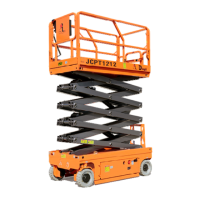

 To Next Page