EasyManua.ls Logo

DLS Effects RotoSIM - User Manual

DLS Effects RotoSIM
2 pages
Print Icon
To Next Page IconTo Next Page
Loading...
RotoSIM
User Manual
By DLS
!
!!
!
Effects
Features:
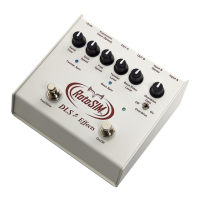
Fast/Slow Switch: Select Fast or Slow speed by pushing and releasing this momentary switch
On/Off Switch: Engages the effect when On (green LED will light), True bypass when Off.
Ramp Time: Controls how long it takes to ramp up or down to the set speed (when switching from Fast to
Slow, or Slow to Fast speeds)
Slow Speed: Controls Slow speed (knob factory set so 12:00 O’clock is actual Rotating speaker slow speed)
Fast Speed: Controls the Fast speed (knob factory set so 12:00 O’clock is actual Rotating speaker fast speed)
Tweeter Level: Adjusts how much and how intense the Tweeter horn is.
Bass Level: Adjusts how much and how intense the Bass horn (rotor) is.
Overdrive On – Off switch: Selects between no overdrive (clean), and internal overdrive effect
Overdrive Gain: Controls how much overdrive is added (when Overdrive is On)
Tweeter Spin LED: Blinks at the tweeter horn spin rate
Bass Spin LED: Blinks at the bass horn (rotor) spin rate
Hookup Configurations: (Mono In: Mono Out), (Mono In: Stereo Out), (Stereo In: Stereo Out)
(See hookup diagram pdf at www.dlseffects.com)
TM
Input A
Input B
Stereo
OUT A
OUT B
Bass Rotor
Level
Tweeter Spin
On/Off Fast/Slow
DLS
!
Effects
Tweeter
Level
Ramp
Time
Overdrive Gain
Off
On
Overdrive
Bass Spin
Fast
Speed
Slow
Speed
Expression
Input (Speed)
Note1:
Output A is designed to sound slightly different
than
Output B. OUTA is a little
more transparent and truer
sounding
.
Output B is deeper and thicker sounding. The musician can experiment with both outputs while the instrument is plugged
into INA. (This also gives a nicer stereo sound spread when used in stereo).
Note
2
:
Fast Speed
and Slow Speed knobs are set at factory so 12 o’clock is the actual speed of a Leslie (knobs are offset)
Question and Answer IconNeed help?

Do you have a question about the DLS Effects RotoSIM and is the answer not in the manual?

Summary

Key Features

Fast;Slow Switch

Selects fast or slow speed via momentary switch.

On;Off Switch

Engages the effect with a green LED indicator; true bypass when off.

Ramp Time

Controls transition time between fast and slow speeds.

Speed Controls

Adjusts slow and fast speed settings for rotating speaker effect.

Level Controls

Adjusts tweeter and bass horn intensity and volume.

Overdrive Controls

Switches overdrive on/off and adjusts gain level.

LED Indicators

Blinds at the rate of tweeter and bass horn spin.

Hookup Configurations

Details mono/stereo input/output connection options.

Internal Adjustments and Settings

Expression Input

External pedal controls speed; use for dryer sound or stereo image.

Potentiometer Settings

Describes factory settings for gain, lag, blend, and volume pots.

Power Input

9 to 13.8vdc input, 90ma minimum required for full effect depth.

Technology and Specifications

Details analog/digital circuitry, sample rate, enclosure, controls, and weight.

Safety and Warning Precautions

Static Discharge Warning

Discharge static by touching metal before opening unit to prevent damage.

Moisture and Water Concerns

Do not use near water or moisture to prevent damage or injury.

Power Supply Precautions

Use only supplied transformer; unplug if overheating and contact dealer.

Hookup and Grounding Safety

Ensure proper grounding to prevent injury or death; consult electrician if unsure.

Service and General Handling

Do not service internally; handle with care to prevent injury.

Overview

The RotoSIM is a user-friendly effects pedal designed to simulate the sound of a rotating speaker, commonly associated with Leslie speakers. It offers a hybrid of analog and digital circuitry to achieve its unique sound.

Function Description

The RotoSIM pedal allows musicians to add a rotating speaker effect to their instrument's sound. It features separate controls for the "tweeter" (high-frequency horn) and "bass rotor" (low-frequency rotor) components of the rotating speaker, enabling a wide range of sonic textures. The device includes an internal overdrive effect, allowing users to switch between a clean sound and a driven, overdriven tone. An expression pedal can be connected to control the speed of the effect, offering dynamic real-time manipulation.

Important Technical Specifications

  • Power: The RotoSIM requires 9 to 13.8VDC, with a minimum current draw of 90mA. It uses a 2.1mm jack, and polarity does not matter. A DC adapter is included. For optimal effect depth, a minimum of 9VDC is recommended.
  • Technology: It employs a hybrid of analog and digital circuitry. This includes Hi Quality Analog (HQA) electronics combined with 16-bit digital electronics.
  • Sample Rate: The digital processing operates at 44.1KHz, with 256x oversampling. The analog instrument signal remains analog and is mixed with the signal processing.
  • Enclosure: The pedal is housed in a solid, heavy-gauge steel enclosure, measuring 5"W x 4.9"D x 2.4"H. It features a powder coat paint finish for durability.
  • Controls: All controls are steel switches, pots, and 1/4" jacks.
  • Weight: The unit weighs 2.5 lbs.
  • Outputs: The RotoSIM offers two outputs, OUT A and OUT B. Output A is designed to sound slightly more transparent and "truer," while Output B provides a deeper and thicker sound. These can be used for a stereo spread when an instrument is plugged into INA.
  • Inputs: It has an Input A for instruments and an Input B (Stereo) for a second input. When Input B is used, it is routed to OUT B, and a stereo image is generated from Input A and mixed with the isolated Input B. An Expression Input is also available for external pedal control.

Usage Features

The RotoSIM offers a comprehensive set of controls for shaping the rotating speaker effect:

  • Fast/Slow Switch: This momentary switch allows users to toggle between fast and slow rotation speeds.
  • On/Off Switch: Engages or disengages the effect. A green LED indicates when the effect is active. It features true bypass when off.
  • Ramp Time: Controls the duration it takes for the effect to transition between fast and slow speeds.
  • Slow Speed: Adjusts the slow rotation speed. The knob is factory-set so that 12 o'clock corresponds to the actual slow speed of a Leslie speaker.
  • Fast Speed: Adjusts the fast rotation speed. Similar to the Slow Speed, 12 o'clock is factory-set to the actual fast speed of a Leslie.
  • Tweeter Level: Controls the intensity and presence of the tweeter horn.
  • Bass Level: Controls the intensity and presence of the bass horn (rotor).
  • Overdrive On – Off switch: Selects between a clean sound (no overdrive) and the internal overdrive effect.
  • Overdrive Gain: Adjusts the amount of overdrive added when the Overdrive is engaged.
  • Tweeter Spin LED: Blinks at the current spin rate of the tweeter horn.
  • Bass Spin LED: Blinks at the current spin rate of the bass horn (rotor).
  • Expression Input: An external expression pedal (e.g., Roland EV-5, Yamaha FC7) can be used to control the speed. For a "dryer" sound, set the RotoSIM to Slow speed before plugging in the expression pedal. For a "fast" sound, set it to Fast speed.
  • Hookup Configurations: Supports Mono In: Mono Out, Mono In: Stereo Out, and Stereo In: Stereo Out configurations.

Maintenance Features

  • Internal Adjustments: The device includes internal trim pots for fine-tuning various parameters:
    • Blend: Adjusts the amount of effect added (CW adds more, CCW less). Factory set to full CW, then back CCW 1/16 turn.
    • InputA pot: Increases gain for Input A (CW increases gain). Factory set to full CCW, then back CW 1/4 turn (25%).
    • InputB pot: Increases gain for Input B (CW increases gain). Factory set to full CW, then back CCW 1/3 turn (30%).
    • OUTA pot: Increases volume for Output A (CW increases volume). Factory set to full CCW, then back CW 1/4 turn (25%).
    • OUTB pot: Increases volume for Output B (CW increases volume). Factory set to full CCW, then back CW 1/10 turn (10%).
    • Bass Lag: Controls how much slower the bass rotor rotates compared to the tweeter signal (CCW makes bass rotate much slower). Factory set to full CCW, then back CW 1/4 turn (25%).
    • Tweeter response: Adjusts the "swirl" sound (CW for more swirl, CCW for more pronounced and throbbing rotors). Factory set to full CW, then back CCW 1/3 turn (30%).
  • Warning on Internal Adjustments: Users are explicitly warned not to adjust internal pots unless instructed, as improper adjustment can damage the unit and void the warranty.
  • Static Discharge: Before opening the RotoSIM, users are advised to discharge themselves by touching a metal surface (e.g., a water pipe) to prevent static electricity from damaging electronic parts.
  • General Care: The product is heavy and should be handled with care to prevent injury.
  • Service: Users should not attempt to service, open, or alter the product or power transformer. For servicing, the unit should be sent to a qualified dealer or the manufacturer.
  • Moisture & Water: The product should not be used near water or moisture. Care should be taken to prevent liquids from spilling onto or entering the enclosure.
  • Power Supply: Only the transformer supplied with the unit should be used. If excessive heat or a burning smell is detected, the transformer and product should be immediately unplugged, and the dealer contacted. Power supply cords should be routed to prevent being walked on, pinched, or damaged.
  • Hookup & Grounding: Precautions must be taken to ensure proper grounding and power connections. Improper hookup or grounding can cause injury or death. If there are questions, a qualified electrician should be consulted.

DLS Effects RotoSIM Specifications

General IconGeneral
BrandDLS Effects
ModelRotoSIM
CategoryMusic Pedal
LanguageEnglish