
 Need help?
Do you have a question about the DNA TOOLS-00169 and is the answer not in the manual?
Ensures a safe environment by keeping the work area clean and well-lit, avoiding hazards.
Covers precautions for safe electrical connections and avoiding shock hazards.
Details personal protective equipment and safe operating practices to prevent injury.
Guidelines for proper operation, maintenance, and handling of power tools for longevity and safety.
Instructions for charging, using, and maintaining battery packs to ensure safety and performance.
Guidance on professional servicing and repair of power tools and battery packs.
Steps to prepare the tool before operation, including checking accessories and charging the battery.
Instructions for charging the battery using the provided charger and understanding LED indicators.
Steps for correctly inserting and removing the battery pack from the tool.
How to operate the variable speed trigger for starting, stopping, and controlling the tool.
Explanation of the lever for changing rotation direction and locking the trigger.
Guidelines for cleaning the tool's housing and ventilation openings, and general care instructions.
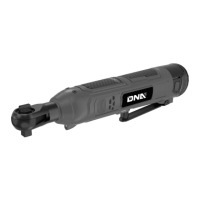
This document describes a Cordless Ratchet Wrench, model numbers TOOLS-00169/00170, which is a power tool designed for screwing in and unscrewing screws, as well as for tightening and loosening nuts.
The manual emphasizes several safety precautions. The presence of a safety symbol (an exclamation mark within a triangle) indicates a caution, warning, or danger, highlighting the potential for accidents if warnings are ignored. Users are advised to read the instruction manual to reduce the risk of injury. Personal protective equipment, specifically ear protection, eye protection, and gloves, is required when using the product. The crossed-out wheeled bin symbol indicates that the item should be disposed of separately from household waste, in accordance with local environmental regulations for recycling, to minimize environmental impact and potential negative effects on human health.
General power tool safety warnings are provided, including the importance of keeping the work area clean and well-lit, avoiding explosive atmospheres, and keeping children and bystanders away. Electrical safety guidelines cover matching power tool plugs to outlets, avoiding body contact with earthed surfaces, protecting power tools from rain or wet conditions, and proper cord handling. Personal safety measures include staying alert, using common sense, avoiding operation while tired or under the influence of substances, and using personal protective equipment such as dust masks, non-skid safety shoes, hard hats, or hearing protection. Preventing unintentional starting by ensuring the switch is in the off-position before connecting to a power source or battery pack is also crucial.
Specific instructions for power tool use and care include not forcing the tool, using the correct tool for the application, and ensuring the switch functions correctly. Users are instructed to disconnect the plug or remove the battery pack before making adjustments, changing accessories, or storing the tool. Proper maintenance of power tools and accessories, including checking for misalignment or breakage of parts, is essential. Cutting tools should be kept sharp and clean. The tool, accessories, and bits should be used in accordance with instructions and working conditions. Handles and grasping surfaces must be kept dry, clean, and free from oil and grease.
Battery tool use and care instructions specify recharging only with the manufacturer-specified charger. Only specifically designated battery packs should be used with the power tool. When not in use, battery packs should be kept away from other metal objects to prevent shorting. In case of liquid ejection from the battery, contact should be avoided, and affected areas should be flushed with water, seeking medical help if eyes are affected. Damaged or modified battery packs or tools should not be used. Battery packs or tools should not be exposed to fire or excessive temperatures above 130 °C (265 °F). All charging instructions must be followed, and charging should occur within the specified temperature range.
Extra safety instructions for the ratchet wrench include wearing hearing protection during impact screwing to prevent hearing loss, securing the workpiece with a clamping device, and holding the power tool firmly to manage high torques. Users should wait until the power tool comes to a complete stop before putting it down to prevent loss of control. The tool should be held by its insulated gripping surfaces when working near hidden wiring to avoid electric shock.
The Cordless Ratchet Wrench operates on a 12 V power supply. It has a no-load speed of 300 revolutions per minute (min⁻¹) and a maximum torque of 45 Nm. The chuck size is 3/8".
Noise/Vibration Information:
The measured sound and vibration values are determined according to EN 62841. Users are advised to wear hearing protection. The vibration emission level is measured in accordance with EN 62841 and can be used for comparison and preliminary exposure assessment. The actual vibration emission may vary based on application, accessories, and maintenance. Factors such as the tool being switched off or running without performing work should be considered to reduce the total exposure level. Additional safety measures to protect the operator from vibration include maintaining the tool and accessories, keeping hands warm, and organizing work patterns. Suggestions for limiting vibration risk include wearing gloves during operation and limiting operating time.
The main parts of the tool include:
Before use: Users should remove all packing material and loose parts. Accessories should be checked for proper fit and suitability. If the machine is new, the battery must be charged first.
Battery: The battery is housed in the handle. To remove it, the battery retention clips must be pressed. A significant drop in operating period per charge indicates a worn-out battery that needs replacement.
Battery charger: The power voltage supply must conform to the rating plate specifications. Users should always inspect the battery charger, cord, and plug before use and have any damage repaired by a qualified professional. The charger should be protected from humidity and operated only in dry areas. It is suitable only for charging rechargeable batteries.
Charging the battery: To charge, plug the charger into the battery, then plug the charger into the main power supply. It is normal for the battery and charger to become warm during charging. After charging, unplug the charger from the main socket and then from the battery.
LED indicator on charger:
About the charger: The feeding should be disconnected before connecting or disconnecting the battery. The charger must only be used with rechargeable batteries; non-rechargeable batteries should never be used. The charger should not be exposed to rain or water.
Insertion and Removal of Rechargeable Battery: Ensure correct orientation when inserting the battery into the machine. It should insert easily without resistance and lock into place with the retention clips. To remove, press the retention clips and pull the battery out.
On/Off Trigger: The On/Off trigger starts the machine and can be held for continuous operation. The rotation speed is variable, increasing with trigger depression. Releasing the trigger switches the machine off.
Reverse-rotation Lever: The machine must come to a complete stop before using the reverse-rotation lever to avoid damage. This lever switches between clockwise (normal) and anticlockwise rotation. When in the central position, the trigger switch is locked, preventing unintentional starting. This central position should be used before putting the machine down.
General Maintenance: Always remove the battery before performing any maintenance work.
Care and cleaning: Ventilation openings should be kept clear, and the product cleaned regularly. The housing should be cleaned with a damp cloth, avoiding solvents, and then thoroughly dried.
Caution: If anything unusual occurs during use, the tool should be switched off, and the battery removed. The tool should be inspected and repaired by a qualified technician before further use. Repairs or maintenance by unqualified personnel can lead to injury. Only identical spare parts should be used for repairs.
Battery Maintenance: Ensure batteries are charged using the correct charger recommended by the manufacturer. After long storage, battery capacity will reduce. To maintain capacity, it is recommended to store fully charged batteries and top-up the charge periodically. Batteries should be stored in a dry, frost-free place, with ambient temperatures not exceeding 40 °C.
The machine, operating instructions, and accessories should be stored in their original packaging. This ensures all information and parts are readily available. The device should be well-packed or stored in its original packaging to prevent transit damage. Always keep the machine in a dry place.
 General
| Brand | DNA |
|---|---|
| Model | TOOLS-00169 |
| Category | Power Tool |
| Language | English |

 To Next Page