Understanding Leakage Reactance Testing
2-2 72A-2243-01 Rev. B 9/04
September 17, 2004
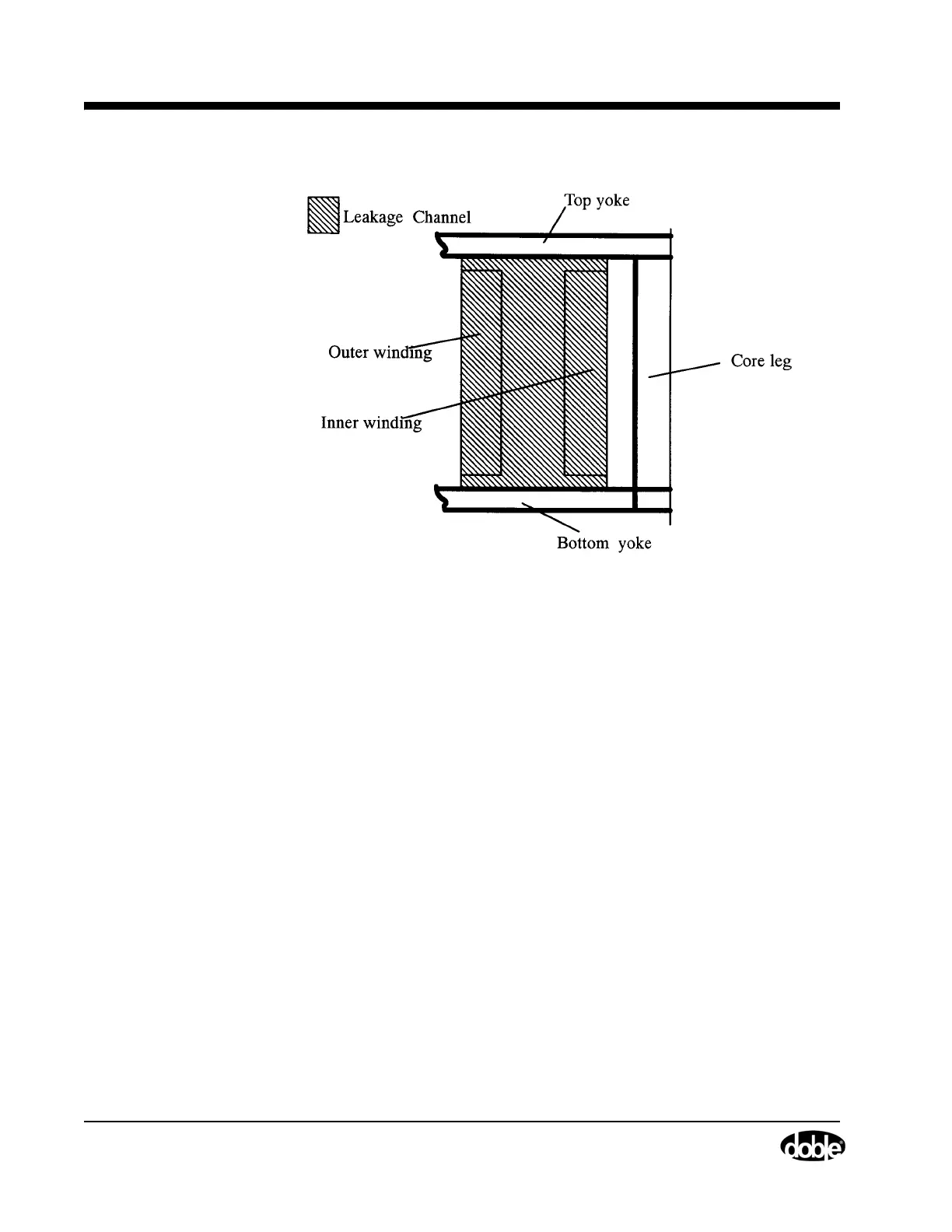
Figure 2.1 Leakage Channel
The leakage channel is the space confined between the inner surface of the
inner winding, the outer surface of the outer winding, and the bottom and the
top yokes. When winding distortion occurs, it changes the reluctance of the
magnetic flux path, resulting in a change of the measured leakage reactance.
The leakage reactance measurement is the simplest of all four tests. During
routine transformer test investigations, it is useful to perform both leakage
reactance and capacitance tests. The changes in both parameters will serve as a
reliable indicator of the winding distortion. Case studies comparing the results
of both measurements are presented in Minutes of the Sixty-First Annual
International Conference of Doble Clients, 1994, sec. 6-5.
It should be noted that the leakage reactance test does not replace the exciting
current measurement; the two are complementary. Leakage reactance is
influenced by the reluctance in the leakage channel, magnetizing current is
influenced by the reluctance in the transformer core and can detect shorted
turns in the windings, shorted core laminations, multiple core grounds and
problems with the LTC and NLTC.



 To Next Page