76 PERIODICAL INSPECTION AND MAINTENANCE
7/26E, 7/31E, 7/41
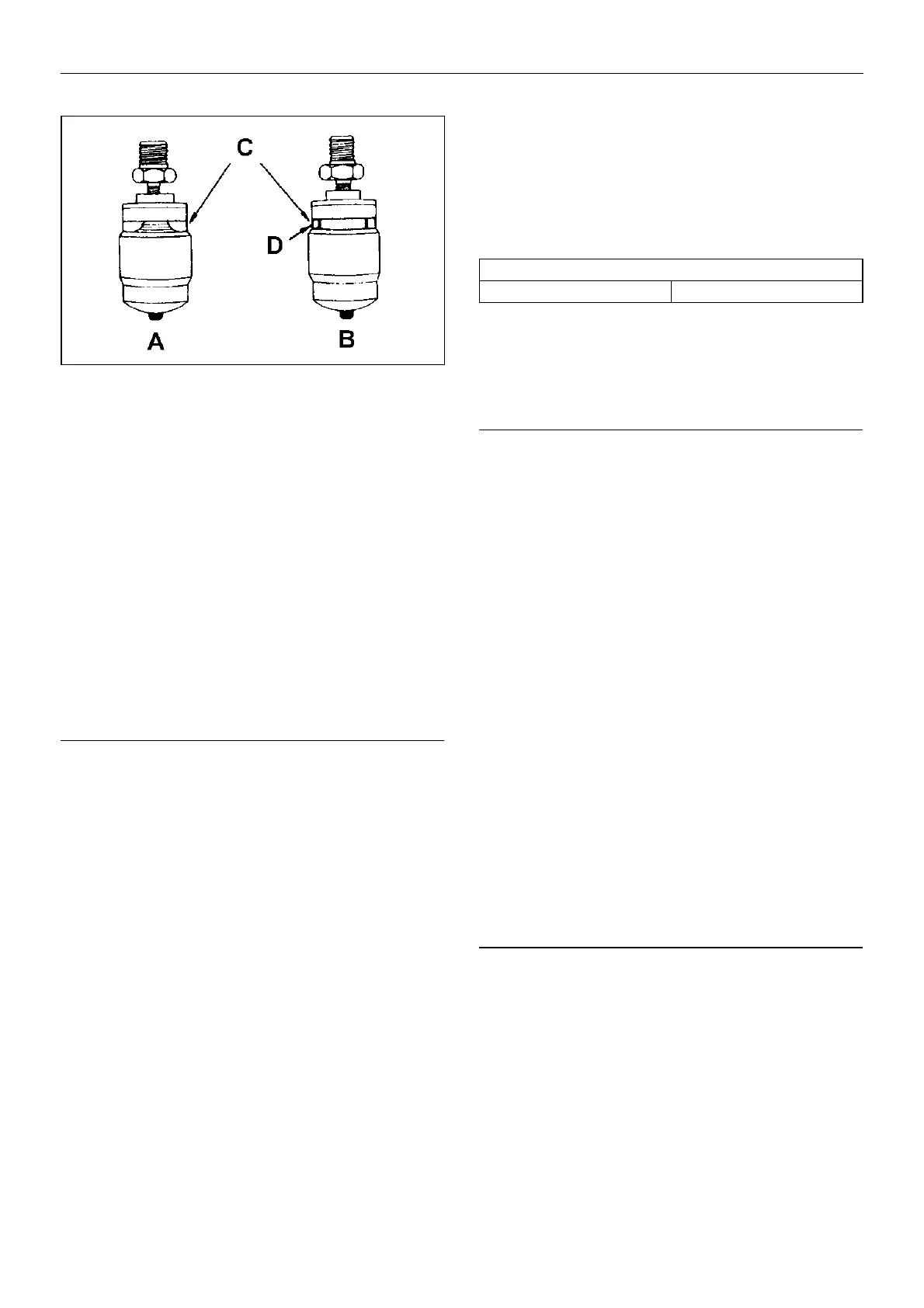
INSPECT THE CONDITION OF THE ELEMENT.
Fig. 32
A Normal
B Clogged
C Indicator
D Red signal
Air cleaner with dust indicator
This indicator is attached to the air cleaner. When the air cleaner
element is clogged, air intake resistance becomes greater and the dust
indicator signal turns to red indicating the element needs to be
changed.
When the signal turns to red, replace the element. Then press the dust
indicator button to reset the indication.
(6) Checking and adjusting cooling fan V-belt (2nd time and after)
Check and adjust the cooling fan V-belt tension every 250 hours
operation from 2nd time and on.
See “inspection after initial 50 hours” section (2)
Inspection every 500 hours operation
(1) Replacing the engine oil and engine oil filter (2nd time and
after)
Replace the engine oil every 500 hours operation from 2nd time and
on. Replace the engine oil filter at the same time. Refer to 50 hour
inspection, section (1).
(2) Replacing the air cleaner element
Air cleaner
Engine performance and life vary with the air intake conditions.
A dirty air cleaner element reduces the amount of intake air, causing
reduced engine output and possible engine damage.
Also, a damaged element leads to abrasion of cylinders and valves,
resulting in increased oil consumption, reduced output and shortened
engine life.
Replace the air cleaner element every 500 hours, even if it is not
damaged or dirty. When replacing the element, clean the inside of the
air cleaner case. If the unit has an air cleaner with double elements, do
not remove the inner element. If the engine output is still reduced (or
the dust indicator still actuates) when the outer element has been
replaced, replace the inner element.
(3) Replacing fuel filter
Replace the fuel filter at specified intervals before it is clogged with dust
to adversely affect the fuel flow. Also, replace the fuel filter after the
engine has fully been cooled.
1) Remove the fuel filter using a filter wrench(customer procured).
When removing the fuel filter, hold the bottom of the fuel filter with a
piece of rag to prevent the fuel oil from dropping. If you spill fuel, wipe
such spillage carefully.
2) Clean the filter mounting surface and slightly apply fuel oil to the
gasket of the new fuel filter.
3) Install the: new fuel filter manually turning until it comes into contact
with the mounting surface, and tighten it further to 1/2 at a turn, using
a filter wrench. Tightening torque: 11.8~15.6N•m(1.2~1.6kgf•m)
4) Bleed the fuel system. Refer to section 2 of inspection at 50 hours.
IMPORTANT: Be sure to use genuine Yanmar part (super fine mesh
filter). Otherwise, it results in engine damage, uneven engine
performance and shorter engine life.
Inspection every 1000 hours operation
(1) Replacing cooling water
Cooling water contaminated with rust or water scale -reduces the
cooling effect. Even when antifreeze agent (LLC) is mixed, the cooling
water gets contaminated due to deteriorated ingredients. Replace the
cooling water at least Once a year.
1) Remove the header tank cap.
2) Remove the bottom radiator hose of the radiator and drain the
cooling water.
3) After draining the cooling water, reconnect the hose.
4) Fill radiator and engine with cooling water via the header tank.
Beware of scalding by hot water
Wait until the temperature goes down before draining the Cooling
water. Otherwise, hot water may splash to cause scalding.
(2) Checking and adjusting the fuel injection valve
As the adjustment requires specialized knowledge and skill, .consult
your dealer. This adjustment is needed to obtain the optimum injection
pattern for full engine performance.
3) Adjusting intake / exhaust valve clearance
As this adjustment requires specialized knowledge and skill, consult
your dealer. The adjustment is necessary to maintain the correct timing
for the opening and closing of valves. Neglecting the adjustment will
cause the engine to run noisily and result in poor engine performance
and other damage.
Inspection every 2000 hours operation
(1) Flushing the cooling system and checking the cooling system
parts
As this maintenance requires specialized knowledge and skill, consult
your dealer. Rust and water scale will accumulate in the cooling system
through many hours of operation. This lowers the engine cooling effect.
And for the engine oil cooler (4TNV98T), they quickly deteriorate the
engine oil.
Cooling system parts: radiator, cooling water pump, thermostat,
cylinder block, cylinder head, oil cooler (4TNV98T).
(2) Checking and replacing fuel hoses and cooling water hoses
As this maintenance requires specialized knowledge and skill, consult
your dealer. Regularly check the rubber hoses of the fuel system and
cooling water system. If cracked or degraded, replace them with new
one. Replace the rubber hoses at least every 2 years.
Applicable fuel filter Part No.
All engines CPN 15892747


 To Next Page
 Loading...