This document is an installation, maintenance, and parts manual for Dorner 3200, 5200 & 5300 Series conveyors, specifically for the Bottom Mount 90° Drive Package using Standard Load Gearmotors.
Function Description:
The device is a drive package designed for Dorner 3200, 5200, and 5300 Series conveyors. It utilizes a bottom-mounted 90° drive configuration with standard load gearmotors to power the conveyor belt. The system incorporates a timing belt and pulleys to transmit power from the gearmotor to the conveyor shaft. The manual details the components, installation procedures, and maintenance requirements for this drive package. It also highlights the use of Dorner's eDrive™ Technology in newer gearmotor configurations.
Important Technical Specifications:
Gearmotor Mounting Package Models:
Models are identified by a code (e.g., 32MBHSA - 16 16) which specifies:
- Product Series: 32 (3200 Series) or 52 (5200 Series)
- Language Code: M (U.S. English) or U (CE English)
- Mount Style: Bottom Mount
- Output Shaft Type: E (e-Drive Gearmotors) or H (Old Style Gearmotors - prior to June 2011)
- Gearmotor Type: S (Standard Load) or K (Indexing / VFD)
- Mount Position: A, B, C, or D (refer to diagrams for detail)
- Belt Type: (flat belt, A through J = cleated belt)
- Drive Pulley: (specified in tables)
- Driven Pulley: (specified in tables)
Gearmotor Specifications (Table 1):
- Output Power:
- U.S. Version: 0.5 hp (0.37 kW)
- CE Version: 0.37 kW
- Input Voltage:
- U.S. Version: 115 VAC (Single-Phase), 208-230/460 VAC (Three-Phase), 230 VAC (VFD Variable Speed), 90 VDC (DC Variable Speed)
- CE Version: 230 VAC (Single-Phase), 230/400 VAC (Three-Phase), 230 VAC (VFD Variable Speed)
- Input Frequency:
- U.S. Version: 60 Hz (Single/Three-Phase), 10-60 Hz (VFD Variable Speed)
- CE Version: 50 Hz (Single/Three-Phase), 25-63 Hz (VFD Variable Speed)
- Input Current (Amperes):
- U.S. Version: 7.4 (115V Single), 2.1-2/1 (208-460V Three), 1.6 (VFD), 5.0 (DC)
- CE Version: 2.6 (230V Single), 2.1/1.2 (230/400V Three), 2.1 (VFD)
- Gearmotor Ratios: 5:1, 10:1, 20:1
- Frame Size: NEMA 56C (U.S.), IEC 71 B5 (CE)
- Motor Type: Totally enclosed, Fan cooled (U.S.)
- Protection Rating: IP55 (CE)
Belt Speeds (Tables 2, 3, 4):
Detailed tables provide RPM, In-lb, N-m, Ft/min, M/min, and Drive/Driven Pulley sizes for various gearmotor configurations (Light Load and Standard Load) across Fixed Speed 90° Gearmotors (U.S. 60 Hz, CE 50 Hz), Variable Speed 90° DC Gearmotors (U.S. 60 Hz, CE 50 Hz), and Fixed Speed 90° VFD Gearmotors. Belt speeds vary significantly based on gearmotor type, voltage, phase, and pulley combination. For example, a 32M060ES4(vp)FN (Standard Load, U.S. 60Hz) with 16/16 drive/driven pulleys operates at 23 Ft/min (7.0 M/min).
Usage Features:
- Mounting Positions: The gearmotor can be operated in positions 1, 3, or 4 (refer to Figure 6 in the manual). For cleated belt conveyors, specific mounting orientations are required to prevent pinch points (Figure 4).
- Adjustable Gearmotor Position: The gearmotor position can be changed by removing and re-orienting four screws, then tightening to 110 in-lb (12 Nm).
- Timing Belt Tensioning: Tensioning is achieved via a tensioner screw. The timing belt should have 1/8" (3 mm) deflection for 6 lb (3 Kg) of force at its mid-point. The tensioner screw should be tightened to 110 in-lb (12 Nm).
- Drive Shaft Keyway: Users are warned that the drive shaft keyway may be sharp and should be handled with care.
- Anti-Seize Application: Anti-seize compound should be applied to the motor shaft before assembly to the gearbox to prevent seizing and ensure proper coupling.
Maintenance Features:
- Required Tools: Hex key wrenches (2 mm, 2.5 mm, 3 mm, 5 mm), adjustable wrench, straight edge, and torque wrench.
- Safety Warnings: Emphasizes locking out power before removing guards or performing maintenance, replacing all guards before running the conveyor, avoiding operation in explosive environments, and being aware of hot gearmotors. Warnings also highlight potential pinch points and mechanical hazards in multi-conveyor systems.
- Timing Belt Replacement: Involves removing the cover, loosening the tensioner, removing the old belt, and installing a new one. If the belt does not slide over the pulley flange, the driven pulley taper-lock screws may need to be loosened to remove the pulley with the belt. Re-installation requires aligning pulleys with a straight edge and proper tensioning.
- Drive or Driven Pulley Replacement: Requires completing initial steps of timing belt replacement, then removing taper-lock screws to loosen and remove the pulley and taper hub assembly. Re-installation involves wrapping the timing belt around the drive pulley and following installation steps.
- Gear Reducer Replacement: This is a more involved process requiring removal of the cover, loosening the tensioner, removing the drive pulley, detaching the motor from the gear reducer (retaining the shaft key), removing the output shaft cover, and then removing the driveshaft and key. The output shaft is held with a tapered press fit, potentially requiring an arbor press for removal. Anti-seize is crucial during reassembly.
- Motor Replacement: For single-phase motors, unplugging the power cord is sufficient. For three-phase and VFD variable speed motors, the terminal box screws and cover must be removed, wire colors recorded, and wires detached. For DC variable speed motors, the motor cord is unplugged at the disconnect. Reassembly involves reversing these steps and applying anti-seize to the motor shaft.
- Parts Availability: Dorner provides pre-configured kits of Key Service Parts for all conveyor products, marked with the Performance Parts Kits logo. These kits are designed for fast installation. For other replacement parts, users are directed to contact an authorized Dorner Service Center or the factory.
- Return Policy: Returns require prior factory authorization (RMA number) and must be new and undamaged. A return charge applies if Dorner is not at fault. Damaged or modified items are not accepted. Returns are not accepted after 60 days from the original invoice date.

 Need help?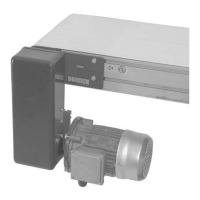

 To Next Page
 General