Need help?
Do you have a question about the Doro 2424 and is the answer not in the manual?
Instructions for installing SIM, memory cards, and battery in the device.
Steps to power the phone on, off, and manage PIN codes.
How to use the dedicated button to initiate an assistance or emergency call.
Restoring phone settings to default values without deleting data.
Performing a full factory reset, deleting all user data and settings.
Details on the device's compliance with radio wave exposure safety limits.
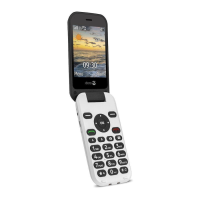
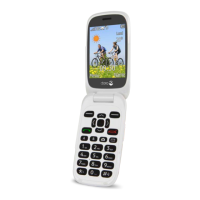
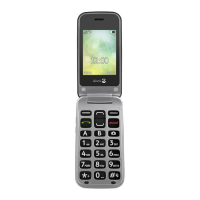
The Doro 2424 is a user-friendly mobile phone designed for ease of use, featuring a clamshell design and a range of functions for communication and daily tasks. It includes a speaker, scroll buttons, left and right selection buttons, call and end call/power on/off keys, speed dial buttons (A and B), a camera key, and a microphone. For convenience, it also has a torch/camera flash, headset socket, torch key, charging cradle connectors, external display, camera lens, lanyard hold, assistance button, volume controls, loudspeaker, and a charging socket.
To begin using the Doro 2424, you first need to install the SIM card, memory card (optional), and battery.
Always use batteries, chargers, and accessories approved for this model to avoid danger and maintain your warranty. When the battery is low, a warning signal will sound, and an icon will be displayed. Connect the mains adapter to a wall socket and the charging socket. Remember to remove any protective plastic film from the display.
Press and hold the red button to turn the phone on or off. Confirm with "Yes" to power off. If your SIM card is PIN-protected, "PIN" will be displayed. Enter the PIN code and press "OK." Use "Clear" to delete incorrect entries. If PIN and PUK codes were not provided, contact your service provider. If too many incorrect PIN attempts are made, "PIN blocked" will appear. You will then need to enter the PUK code, confirm with "OK," enter a new PIN, confirm, and re-enter the new PIN to confirm again.
When starting the phone for the first time, a start-up wizard can guide you through basic settings. You can also run this wizard later.
In the manual, an arrow (→) indicates the next action. Press "OK" to confirm actions. To select an item, scroll vertically using the scroll buttons or highlight it, then press "OK." To scroll horizontally, use the * or # buttons.
Press a numerical key repeatedly until the desired character appears, waiting a few seconds before entering the next. Press the * button for special characters, select with the scroll buttons, and press "OK." Use the scroll buttons to move the cursor. Press # to cycle between upper case, lower case, and numerals.
The default language is determined by the SIM card.
+ before the country code; press * twice for the international prefix +.# to activate or deactivate silent mode.Use keys 2-9 for speed dial from standby. Press and hold the corresponding button to dial.
When the phone is on, you can always make an SOS call by entering the local emergency number followed by the green call key.
The assistance button provides easy access to predefined help numbers. Ensure the function is activated and configured, then test it thoroughly.
In an emergency, ICE information can be critical. Add ICE contacts to improve safety. First responders can access medical information and next of kin. All fields are optional, but more information is better.
Press the shortcut button or "Menu" → "Camera." Press the camera key to take a photo. Press "Options" for more settings. Press "Back" to return to standby.
Connect wirelessly to other Bluetooth® compatible devices like headsets or other phones.
* (down) and # (up); 3 is default. Set "Time" (5-60 seconds) using * (down) and # (up). Press "OK" to confirm.The manual provides a troubleshooting section for common issues such as the phone not switching on (low battery, incorrect installation), charging failures (damaged battery/charger, temperature, incorrect connection), PIN code not accepted (wrong PIN, too many attempts), SIM card errors (damaged, incorrectly installed, dirty/damp), network connection failures (invalid SIM, no coverage), and inability to add contacts (phonebook full). It also addresses issues with functions not supported or subscribed from the network. For most issues, the solution involves checking connections, reinstalling components, or contacting the service provider.
Treat your unit with care to maintain the warranty.
 General
| Display diagonal | 2.4 \ |
|---|---|
| External display | Yes |
| Display resolution | 320 x 240 pixels |
| RAM capacity | 8 MB |
| Compatible memory cards | MicroSD (TransFlash) |
| Rear camera resolution (numeric) | 3 MP |
| Type | Senior phone |
| Product color | Red |
| Market positioning | Elderly phone |
| Form factor | Clamshell |
| Personalization | Wallpaper |
| Phonebook capacity | 300 entries |
| Personal info management (PIM) | Alarm clock, Calculator, Calendar |
| Bluetooth version | 3.0+HS |
| Ringer type | Polyphonic |
| Polyphonic rings quantity | 10 |
| Multimedia Messaging Service (MMS) | Multimedia Messaging Service (MMS) is a standard way to send messages that include multimedia content to and from a mobile phone over a cellular network |
| Subscription type | No subscription |
| Headphone connectivity | 3.5 mm |
| Talk time (2G) | 8 h |
| Battery capacity | 800 mAh |
| Standby time (2G) | 285 h |
| Standby time (3G) | - h |
| Body SAR (EU) | 1.31 W/kg |
| Head SAR (EU) | 0.625 W/kg |
| WAP | - |
| Data network | GPRS, GSM |
| SIM card type | MicroSIM |
| SIM card capability | Single SIM |
| 2G bands (primary SIM) | 900, 1800 MHz |
 Weight and Dimensions
| Depth | 18.5 mm |
|---|---|
| Width | 52 mm |
| Height | 103 mm |
| Weight | 92 g |

 To Next Page