1110
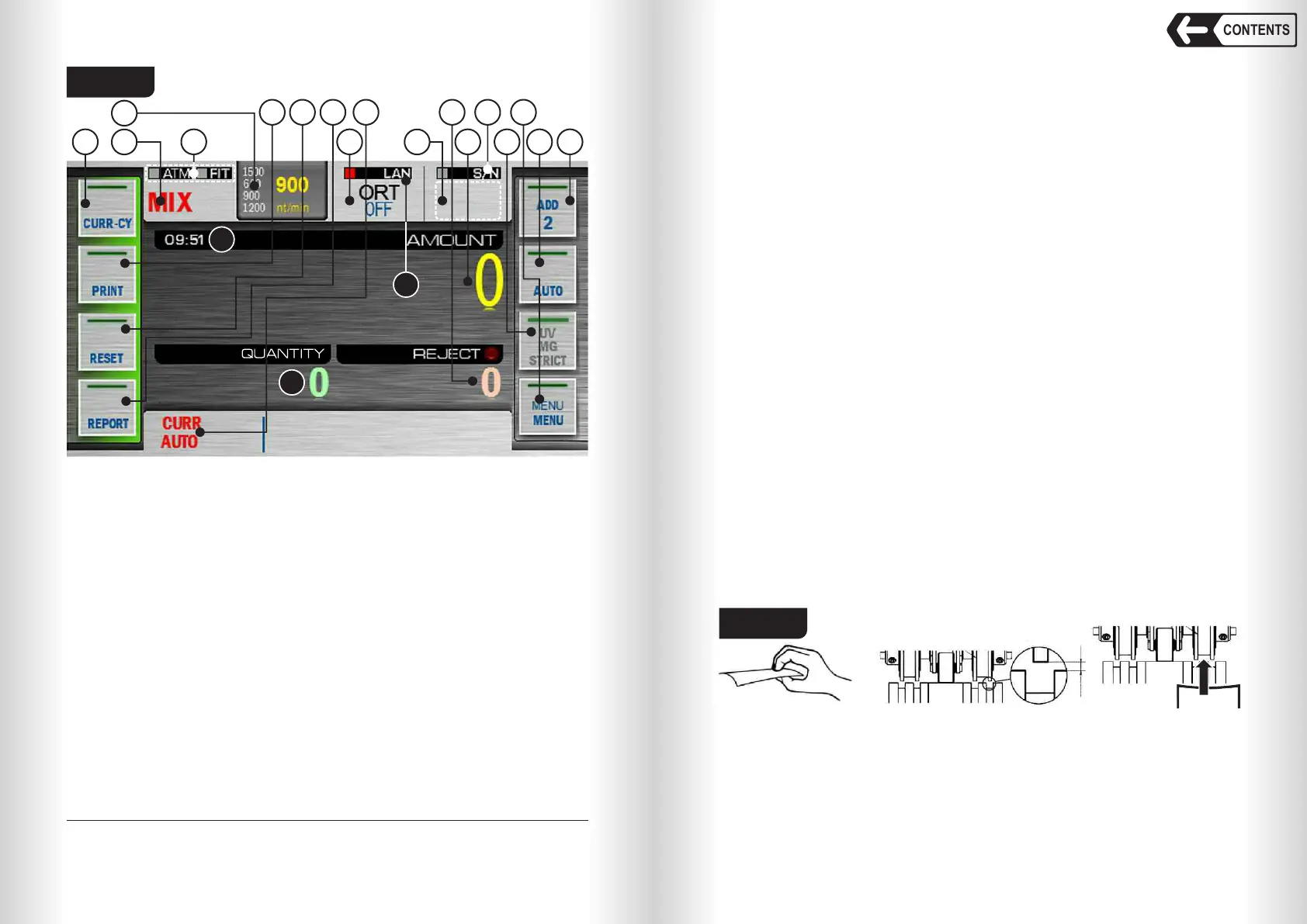
Fig. 13
1 Count mode key;
2 Count speed key;
3 Banknote orientation sorting key;
4 Batch mode key (inactive in MIX and
MULTI modes);
5 Currency select key;
6 Send count results to the printer key;
7 Count reset key;
8 Enter «REPORT» key;
9 ADD mode on/off key;
10 Auto / Manual start key;
11 UV detection, Magnet detection,
optical density and strict test on/off key;
12 Settings menu key;
13 Selected currency indicator /
Currency select key;
14 Counted banknotes quantity;
15 Rejected banknotes quantity;
16 Counted sum;
17 System time;
18 Ethernet connection indicator (red -
off; green-blue or green-grey flashing
– exchange data with the server);
19 Banknote S/N detection indicator;
20 System time.
2
Now the counter is ready to count the banknotes in factory default mode :
– Language: English;
– Currency: auto recognition by the first note in the batch;
– Count mode: MIX;
– Start mode: AUTO;
– ADD mode: off
– Batch mode: off
– Count rate: 900 notes per minute
– UV-T, UV-R detection: off
– MG (magnet) detection: off
– DEN (density) detection: on
– Orientation sorting (ORT): off
– Information output: printer (manual); 9600bps
– Advanced rendering mode: off
– Sound volume: 50%
– Screen brightness: 100%
– Display theme: grey
– Stacker limit: 200 banknotes
– Reject pocket limit: 50 banknotes
– User profile: “I”
– Serial numbers detection: off
– Fitness mode: off
3 Adjust the feeder gap. The manufacturer presets the gap in accordance with
the currencies to be counted. However, if the counter often rejects the
genuine banknotes and the report (see section «Operation Keys»,
REPORT Key, Fig. 49) returns «Small Notes Gap», «Double Note» or
«Dimensions» as the reason of the banknotes rejection, then turn screw 1
slightly clockwise (toward «–») to reduce the gap (see Fig. 1). If the
rejection report returns «Skew Error», «Length» or «Dimensions», then turn
screw 1 slightly counterclockwise (toward «+») to increase the gap (see
Fig. 1). The gap between separating rollers and feeding rollers should make
one note to pass free between the rollers but prevent two notes put together
from passing (see Figure 14). To check a gap, use a banknote of good
quality, not worn out one. Rotate the feeding wheels to set the position of the
rollers so that there are no ripples in a place where the note passes. Put the
short side of the banknote between the separating rollers and feeding
rollers. The banknote should pass through with a little tension. If one
banknote passes very easily, then decrease the gap. If one banknote
passes between the rollers with difficulty, then increase the gap. Continue
gap setting until the banknote passes through rollers with a little tension.
2
Factory default settings may be revised to match customer requirements.
CONTENTS
А
Banknote
C
B
The gap
Fig. 14
4 Adjust banknote guides to the longest banknote in the counted batch,
prepare the batch as shown in Fig.15: take out torn, wet, dirty and greasy
notes. The banknotes should not protrude from the batch.
Put the prepared banknotes in the centre of the hopper, avoiding the skew.
The counter will start operation. Counting is stopped when the number of
the notes equal to the stacker capacity has been counted. After the
banknotes have been removed out of the stacker, the device resumes
operation automatically.
Banknote counter DORS 820 Banknote counter DORS 820
1
2
6
4
5
3
7
9
8
10
11
12
13
14
15
16
17
19
20
18


 To Next Page
 Loading...