EasyManua.ls Logo

Douglas A-4M - JATO Firing Delay, Distance Two MK; Mod 2; 5 KS-4500 JATO Bottles

Douglas A-4M
68 pages
Print Icon
To Next Page IconTo Next Page
To Previous Page IconTo Previous Page
Loading...
I
NA
VAIR
01-40
AVI\I- l
Sectiun
XI
Part
2
JATO
FIRING
DELAY
, MINIMUM
TAKEOFF
DISTANCE
- TWO
MK
7 MOD 2,
5KS
-
4500
JATO
BOTTLES
The
minimum
ground
Tun
distance
and
the
total
dis-
tance
to
clea
r :l
50-foot
obstlcJe
may
be
realized
by
'iring
the
JATO
bottles
so
that
burnout
occurs
at
1ft-off.
Burnout
at
lift-off
is
recommended
faT
the
following
re
aso
ns
:
1.
Bu
r nout at
lift-off
produces
the
shor
t
est
takeoff
distance.
2.
A
misfire
can
be
detected
early
and
the
takeoff
can
be
aborted
well
before
the
refusal
point.
The
following
trim
settin
gs
are
required
for
JATO
operation
to
:I\"oio
excessive
nose-hi!(h
att
it
udes
at
low
gross
weights
due
to
noseup
pitching
moments
genera
ted
by
possible
,JATO
burning
aIter
lift-off.
Gross
Weight
Recommended
Trim
(Pounds)
(De~rees
Noseu,e)
13.500
2
17.500
5
22.500
7
24.500
8
With
the
above
recommended
trim
sett
ings.
the
flight
u'im
stick
forc(>
without
,
JA
TO
burning
va
r
ies
linearly
with g
ross
weight
from
approximately
12
pounds
pu!l
at
16,000
pounds
gross
wei
ght to 3
pounds
pull
at
24.500
pounds
gross
weight.
This
stick
force
is
not
objectionable
since
a
redu
ction
in
angle-of
-
att3ck
is
required
to
maintain
airspeed
01'
to
continue
acceleration.
Il
is
recommended
that
th
e
firing
point
be
esbblished
by
distance
markers
alongside
the
Tunway.
This
recommendation
is
made
for
the
following
reasons:
1.
USing a
time
interval
from
brake
release
is
('onsidered
to
be
too
inaccurate.
2.
Using
a
irspeed
as
a
reference
for
JATO
firing
would not
be
possible
since,
generally,
JATO
firing
occurs
at
a
speed
below
the
speed
at
which
the
ai
r -
speed
indic,lt.or
begins
to
registe
r .
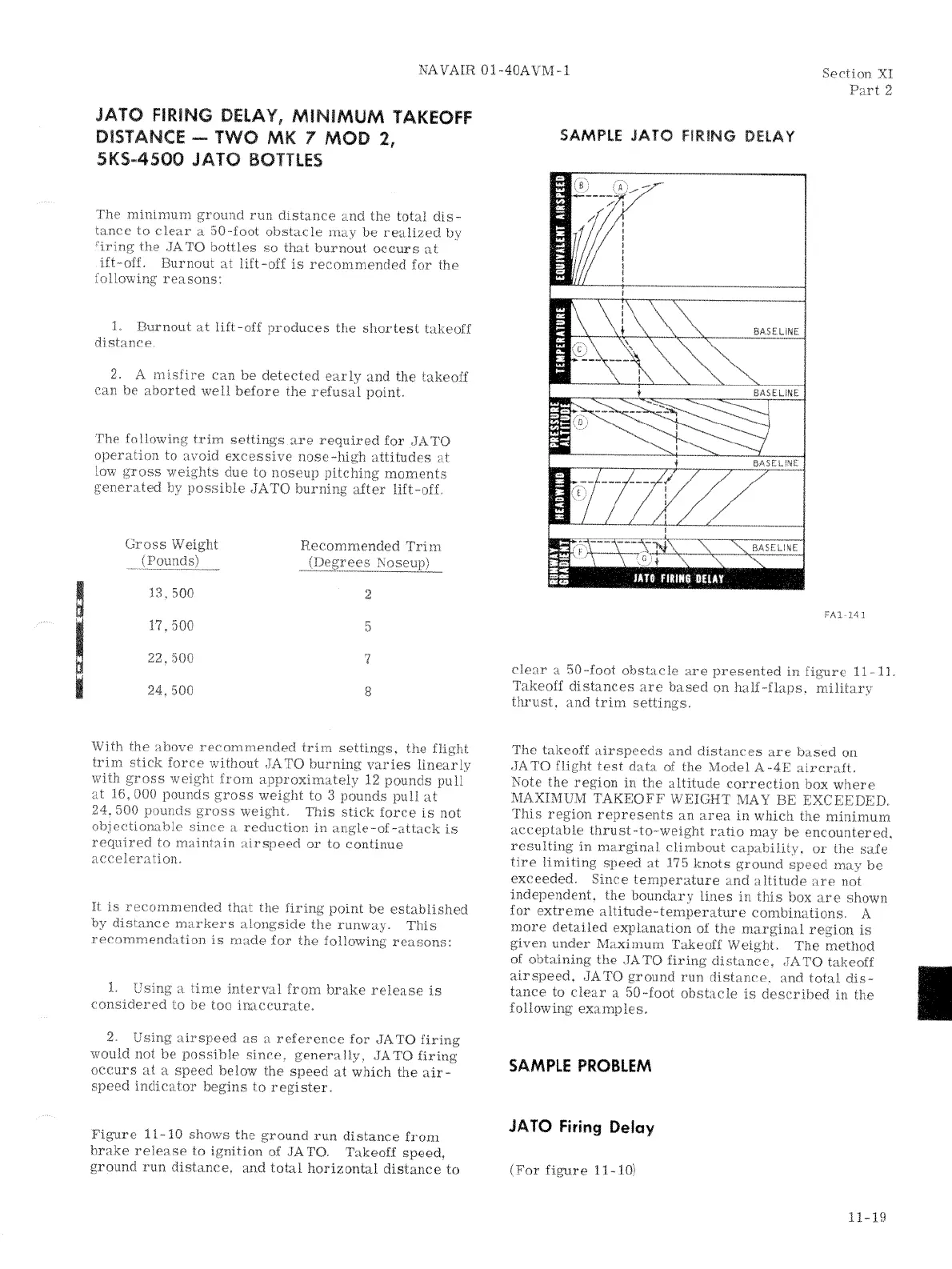
Figure
11-10
shows
the
grou
nd
run
dist
a
nce
from
brake
release
to
ignition
of JA TO.
Takeo
ff
speed,
ground
run
dist.tnce
.
and
total
hor
izo
n
ta
l dis
tance
to
SAMPLE
JATO F
IR
ING
DElAY
F~1-141
clea
r a
50-foot
obst:\cle
a
re
presented
in
fib'Ure 11-11 .
Takeoff
distances
are
based
on
half-flaps,
military
tlu'
usL
and
trim
settings.
The
takeoff
ai
rspeeds
and
distances
are
based
on
JA
TO fli ght
test
data
of
the
I1100el
A
-4E
aircraft.
Note
the
region
in
the
altitude
cOl'I'ection box wher e
1\IAXE\'l
UM
TA
K
EOFF
WEIGHT
MA
Y
BE
EXCEEDED.
This
re
gion
represents
an
area
In
which
the
minimum
acc
eptable
thrust-to
·weighl
ratio
may
be
encouniered.
resulting
in
ma
r gin:ll
climb
out
capabili
tr.
0
1'
the
safe
tire
limiti
ng
spee
d
at
175
knots
ground
speed
may
be
exc
e
eded.
Since
temper:l
t
ure
and
al
titude
are
not
independent.
the
boundary
lines
in
this
box ar e shown
for
extreme
aHitude·temperature
combinations.
A
more
detailed
explanation
of t
he
margin:tl
regioll
is
given
undel' I\Iax
imum
T;lkeoff
Weigh
t
The
me
t
hod
of
obtaining
the
.J
ATO
firing
dist
anc
e.
,JATO
takeoff
airspeed,
JATO
ground
run
distance,
and
total
dis-
tance
to
clear
a
50-foot
obstacle
is
described
in
the
following
examples.
SAMPLE
PROBLEM
JATO Firing Delay
(Fo
r figur
t!
11
-10)
11-19