Need help?
Do you have a question about the DOUK AUDIO TONE and is the answer not in the manual?
Details the long press for power on/off and short press for play/pause functionality.
Explains rotating for volume adjustment and short press for audio input mode selection.
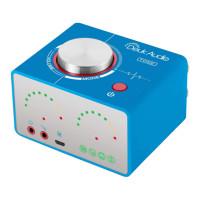
The Douk Audio TONE is a versatile Bluetooth Digital Power Amplifier designed to integrate seamlessly into various home audio systems. It supports multiple audio inputs and outputs, making it compatible with a wide range of devices, from traditional computers and laptops to modern smartphones and tablets.
The device serves as a central hub for audio amplification, accepting input from RCA, 3.5mm AUX, USB, and Bluetooth sources. It then amplifies the audio signal for output through banana speaker jacks and a 3.5mm headphone jack. This allows users to connect their preferred audio sources and enjoy amplified sound through either speakers or headphones.
The front panel features a unique dual LED display that visually represents the volume level and dynamically responds to the music, enhancing the user experience. A prominent VOLUME/MODE knob allows for precise control over the audio output and selection of the desired input mode. A power button is also present for turning the device on/off and for play/pause functionality. Highlight lamps on the front panel provide visual feedback for various device states.
To begin using the Douk Audio TONE, users should first connect it to a power supply (DC 9V-24V) and then plug it into a power socket. A left red LED on the front panel will illuminate, indicating that the device is powered.
For wired input, users need to connect their audio source (e.g., computer, laptop, MP3 player) to the appropriate input port (USB, RCA, or AUX) and their output device (speakers or headphones) to the corresponding output jacks. A long press (2 seconds) of the power button will turn the device on, and a right LED will illuminate. Short presses of the VOLUME/MODE knob allow users to cycle through and select the desired audio input mode. It's important to note that AUX and USB modes can only be selected when a corresponding audio source is connected. The headphone output and USB input have priority over other inputs.
For wireless input, users connect their speakers or headphones to the device's output. After a long press of the power button to turn it on, a short press of the VOLUME/MODE knob will switch the device to Bluetooth mode, indicated by a flashing Bluetooth icon LED. Users can then search for "Douk Audio TONE" on their audio device (e.g., smartphone, tablet) and connect. Once successfully paired, the Bluetooth LED will remain steadily lit.
Volume adjustment is intuitive; rotating the VOLUME/MODE knob clockwise increases the volume, while rotating it anti-clockwise decreases it. When the volume reaches its maximum or minimum level, the right red LED will flash to provide visual feedback. The power button can also be short-pressed to play or pause music.
The device is designed to be compact and aesthetically pleasing, making it suitable for various home and desktop setups. It supports computers without requiring additional drivers when used as a USB sound card, and it can also accept input from phones with OTG function.
The device is designed for ease of use and durability. A protection film is present on the front panel upon purchase, which users can remove before use. The device is equipped by default with a 19V/3.42A power supply. However, if users desire higher output power, they can prepare a larger power supply (up to 24V high-quality 5.5mm/+2.1-2.5mm) themselves. It is recommended to connect the device to the power supply first and then plug it into the socket to avoid potential sparks, although the device is designed to be safe. The device is engineered to produce Hi-Fi clear sound with no audible noise, even at high power output.
 General
| Input Impedance | 47KΩ |
|---|---|
| Output Impedance | 4-8Ω |
| Frequency Response | 20Hz-20kHz (±1dB) |
| Audio Input | RCA |
| Audio Output | Speaker terminals |
| THD | <0.05% (1kHz, 1W) |
| SNR | ≥90dB |

 To Next Page