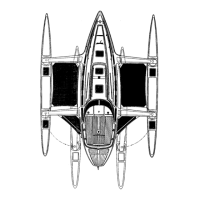
By sailing upwind and if the leeward float is almost pressed down in the water to
almost the deck level, this is a good sign and time to reduce sail area.
IMPORTANT – Make sure that you know you can trust your wind speed device
information and that you are completely certain that this wind device measures
the wind speed in knots and or m/s (meters per second), and carefully check if
you see true (TWS) or apparent (AWS) wind speed on the display. It is the
responsibility of the skipper to make sure the wind system is calibrated and
shows correct information.
IMPORTANT – Asymmetric spinnaker can MAX be used beam reach (like 80-90
degrees TWA) safely up to 5 m/sec or 10 knots of true wind.
CODE-O:
Code-O can MAX be used upwind to max 4 m/sec or 8 knots of true wind – use
upwind in stronger wind, will damage either the boat and or the Code-O. Beam
reach where true wind direction is about 90 degrees, max true windspeed 7
m/sec or 14 knots true wind. Do not exceed these windspeeds and you must
respect this information.
For more information about asymmetric spinnaker and Code-O, see further
instructions for these sails under “Sailing and Trimming Guide”.
AUTOPILOT SAILING:
Sailing by Autopilot, you must be much more conservative in how much sail you
have set compared to windspeed – here you also must take wave conditions into
your judgement – but for sure be much more conservative while sailing with
Autopilot. Always be very careful and watch out well for other boats.
SAILING AND TRIMMING GUIDE:
IMPORTANT – It is of great importance always to keep your sheets and halyards
tidy when sailing, because all lines come back to the cockpit. This is a very
important safety factor and improves the joy and pleasure of sailing for all
aboard.
TRIMMING THE FURLING GENOA:
The luff tension is to be adjusted by the genoa/jib halyard. In light winds, of
course only little tension just to avoid wrinkles along the luff. In stronger wind,



 To Next Page