Need help?
Do you have a question about the Draper 18937 and is the answer not in the manual?
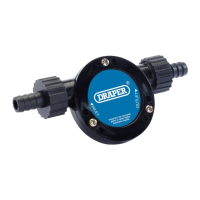
The Draper Drill Powered Pump (Stock No. 18937, Part No. DPP1) is a versatile and portable tool designed for transferring various non-flammable liquids. This pump is powered by a standard electric drill, making it a convenient solution for a range of fluid transfer tasks in workshops, homes, and other environments where a power drill is readily available. Its compact design and reliance on an external power source contribute to its portability and ease of use.
The primary function of this device is to facilitate the movement of liquids from one location to another. It operates by converting the rotational energy from an electric drill into pumping action. The pump is designed to be attached to the chuck of a drill, which then drives an internal impeller to create suction and pressure, thereby drawing fluid in through an inlet hose and expelling it through an outlet hose. This mechanism allows for efficient transfer of liquids, making it suitable for tasks such as draining water from flooded areas, emptying aquariums, transferring water between containers, or even circulating water in small systems.
A key feature of its operation is the ability to prime itself, meaning it can draw fluid into the pump without needing to be manually filled first, provided the input hose is submerged and airtight. The pump's performance, including flow rate, is directly influenced by the speed of the drill it is attached to. Users can adjust the drill speed to control the rate at which fluid is transferred, offering flexibility for different applications.
Operating the Draper Drill Powered Pump is straightforward, but requires adherence to specific guidelines to ensure safety and optimal performance. Before use, it is crucial to inspect both the pump and the hoses for any signs of damage. The pump is designed to be used with a three-core, earth-connected, or double-insulated drill, and for corded drills, an RCD adaptor is recommended for added safety.
To begin operation, a few drops of light lubricating oil should be poured into the input opening to prepare the pump. The input and output hoses are then attached to the pump according to the markings on the product. It is vital to ensure the inlet hose is airtight and as short as possible to facilitate effective priming. For 1/2" bore hoses, the supplied adaptors should be installed. The input hose must be submerged as much as possible to allow the pump to fill with water.
Once the hoses are connected and the input hose is submerged, the drill chuck is closed around the pump spindle. It is imperative to ensure that the drill's rotation is set to a clockwise direction for the pump to function correctly. The drill should be started slowly to allow the pump to prime. If priming does not occur within 10 seconds, the input hose should be checked for airtightness and blockages. Once primed, the drill speed can be increased to achieve the desired flow rate.
The pump is designed for transferring various liquids, but it comes with a critical warning: it must NEVER be used to pump petrol or other highly flammable liquids, nor aggressive chemicals. This restriction is paramount for user safety and to prevent damage to the pump. When pumping oil, it is advised to keep the oil thin to prevent damage.
During operation, users should ensure that hoses are free from kinks and are tidily arranged to prevent trip hazards. While the pump can be held by hand, it is recommended to grip it loosely, or for longer operations, to secure the pump to a board. The drill should not be connected to a power supply until ready to operate, and the pump should never be allowed to run dry, as this can damage the impeller. The output hose must not be obstructed in any way.
Proper maintenance is essential to ensure the longevity and continued efficiency of the Draper Drill Powered Pump. After EVERY use, the pump should be flushed through with clean water. This helps to remove any residual fluids and prevent blockages or corrosion, especially when different types of liquids are transferred.
When not in use, the drill should be removed from the pump. Furthermore, the pump should ALWAYS be removed from the drill before performing any product care or maintenance tasks. This prevents accidental activation and ensures safety during cleaning or inspection.
Regular inspection of the product and hoses for damage is a crucial maintenance step. If any damage is found, the product or hoses should not be used. In case of issues like the pump not priming, low flow rate, or leaking, troubleshooting steps are provided. For instance, if the pump doesn't prime, the input hose fitting should be checked and replaced if necessary, or the hose cleaned if clogged. If the impeller is damaged or charred, or if the pump is leaking due to a damaged seal, the pump itself may need replacement. If the spindle turns but the impeller does not, the pump also needs replacement. Low drill speed can cause low flow rates, which can be remedied by increasing the drill speed. Clogged or restricted hoses, or hoses that are too long or have too great a head height, can also reduce flow rate and should be investigated and adjusted accordingly.
It is important to note that most electric drills are not designed for continuous operation, so users should be mindful of operating times to prevent overheating or damage to the drill. By following these usage and maintenance guidelines, users can ensure safe, effective, and long-lasting performance from their Draper Drill Powered Pump.
 General
| Model | 18937 |
|---|---|
| Type | Submersible Water Pump |
| Power Source | Electric |
| Maximum Head | 8m |
| Voltage | 230V |
| Cable Length | 10m |
| Maximum Particle Size | 35mm |
| Submersible | Yes |

 To Next Page