The Samsoft 175 is a patient lift designed for transferring mobility-impaired patients. It can be used in various settings, including with wheelchairs, shower seats, beds, or toilet seats. This device is intended for indoor use on level, stable, and adherent floors and should be handled by competent and trained personnel. It is not suitable for children under 12, patients with mental disorders, or individuals whose morphology is incompatible with this type of transfer.
Function Description:
The Samsoft 175 facilitates patient transfers through an electric lifting system. It comes in two versions: a manual spacing version of the hoist legs, which uses a foot pedal for leg adjustment, and an electric spacing version, which utilizes an electric actuator for leg adjustment. The lift features a boom that can be raised and lowered, and a hanger bar with non-return hooks for attaching slings. The device is battery-operated, ensuring mobility and independence from direct power outlets during operation.
Important Technical Specifications:
- Maximum Working Load: 175 kg (patient + sling).
- Electric Operation: On battery.
- Battery Charge Duration: 8 hours.
- Battery Life (100 kg load, new and fully charged battery):
- Manual spacing version (M): 42 up/down cycles.
- Electric spacing version (E): 40 up/down cycles with opening/closing of the hoist legs.
- Lifting Time (without any load): 38 seconds.
- Lifting Speed (without any load): 31 mm/s.
- Lifting Time (max working load): 70 seconds.
- Lifting Speed (max working load): 16 mm/s.
- Electric Opening Time of Hoist Legs (max working load): (E) 4.5 seconds.
- Working Life: 10,000 up/down cycles (max working load).
- Structure Materials: Steel with epoxy powder coating (RAL 7005-7004-3020).
- Device Weight (with serial 4-point hanger bar):
- Manual spacing version (M): 38 kg.
- Electric spacing version (E): 38.7 kg.
- Dimensions (unfolded in use): 1350 mm (L) x 630 mm (W) x 1360 mm (H).
- Dimensions (folded for transport/storage): 1310 mm (Lp) x 630 mm (Wp) x 430 mm (Hp).
- Maximum CSP (central suspension point) Height: 1890 mm.
- Minimum CSP (central suspension point) Height: 700 mm.
- Lifting Stroke: 1190 mm.
- Ground Clearance: (M) 22 mm, (E) 17 mm.
- Maximum Internal Width: (M) 810 mm, (E) 965 mm.
- Minimum Internal Width: 520 mm.
- Turning Diameter (closed hoist legs): Ø 1420 mm.
- Maximum Opening Angle of Legs: (M) 20°, (E) 30°.
- Battery Charger: 100-240 V AC, 50/60 Hz, 46VA input; 29 V DC max. 700 mA output.
- Battery Pack: Two 12V/4.5 Ah lead-acid (sealed, maintenance-free) batteries connected in series; 24 V DC output, max 8.5 A current.
- Lift Cylinders Max. Thrust Force: 8,000 N.
- Spacing Cylinders Max. Actuator Power (push/pull): 2,000 N (for electric spacing version only).
- Sound Level: ≤ 60 dB.
- Ingress Protection Rating (mounted assembly): IP X4.
- Duty Cycle: 10%, 2 minutes ON / 18 minutes OFF.
- Warranty: 5 years on structure, actuator, and control box; 24 months on handset and battery.
Usage Features:
- Assembly and Folding: The device is shipped folded and requires assembly. Key steps involve straightening the mast, repositioning safety shafts and pins, unfolding the boom using the handset, and tightening an adjusting screw. Folding is the reverse process.
- Separating Base: For easier transport, the patient lift can be disassembled into two parts by unscrewing a knob and removing a safety shaft.
- Electric System Operation:
- Connections: The power unit (control box + battery pack) connects to the lift cylinder and a 1-function remote control (for manual spacing) or a 2-function remote control and spacing cylinder (for electric spacing). A charger adapter cable is also used.
- Handset: Features boom lifting and lowering keys, and for the electric spacing version, keys for opening and closing the hoist legs. An operating indicator light shows system status (yellow for function pressed, red for relay fault).
- Control Panel: Includes a battery charge status indicator (green for fully charged, yellow/red for low), an electric emergency lowering button, and a maintenance indicator.
- Emergency Stop Button: Located on the power unit, it stops all electric functions when pressed and is reset by turning clockwise.
- Charging: Batteries can be charged directly (charger connected to the patient lift) or indirectly (battery pack removed and connected to charger). The charger has an indicator light (flashing green for charging, constant green for fully charged). Batteries should be charged nightly and every 3 months to preserve service life.
- Manual Functions:
- Manual Emergency Lowering: A red ring at the end of the lift cylinder rod can be lowered and turned to manually lower the boom in case of power failure.
- Manual Hoist Leg Operation (Manual Spacing Version): A foot pedal opens or closes the hoist legs.
- Hanger Bar Hooks: Designed with non-return features; ensure sling loops are securely inside before transfer.
- Patient Transfer:
- Pre-transfer Checks: Verify patient weight compatibility (max 175 kg), battery charge, stable floor, functional brakes, compatible sling, and sling condition.
- Transfer from Bed to Armchair/Armchair to Bed: Involves positioning the patient, placing the sling, checking sling position, positioning the lift, and attaching sling loops to the hanger bar.
- Transfer from Floor: Position the lift so the patient's head and chest are within the hoist legs, lifting gradually.
- Moving the Patient Lift: While not recommended with a suspended patient, short trips are possible using the handles. Do not push/pull slings or hanger bar.
- Slings: Only slings provided by Drive DeVilbiss Healthcare Ltd. should be used. A full range is available.
Maintenance Features:
- General Cleaning (Monthly or as required): Wipe down with mild detergent and warm water, then clean water, and allow to dry. Avoid aggressive detergents and running water.
- Decontamination (Whenever necessary): Mop up fluids, wipe surfaces with cold clean water, then with a 0.1% Chlorine solution (1,000ppm), and finally with clean water and dry. For blood spills, use 1% Chlorine solution (10,000ppm).
- Daily Maintenance: Charge the battery pack every night.
- Routine Maintenance (Monthly or as required):
- Check castors are touching the floor and brakes are functional.
- Ensure boom and hoist legs move smoothly and without noise.
- Check for play between boom, mast, and hoist legs.
- Inspect plastic covers and protective housings for damage.
- Check connecting cables (power, handset, actuator) for wear, cuts, or visible wires; quarantine if damaged.
- Inspect slings for loose seams, fraying, tears, or wear; never use a defective sling.
- Preventive Maintenance (Annually or as required): To be performed by authorized service personnel.
- Mechanical Control: Remove hanger bar cover, inspect axle and hanger bar assembly for wear. If compliant, clean and grease the axle and socket. Replace axle and hanger bar if non-compliant or every 5 years. Disassemble, clean, and lubricate castors, mast hinge, and hanger bar pivots. Check fastening, wheel play, brakes, welds, and alignments. Re-tighten all parts. Replace damaged mechanical parts with original components.
- Electrical Inspection: Check handset, charger, remote control box, actuator, lifting/lowering speed, emergency stop, and lowering function. Inspect electric cables for wear, cuts, or damage; replace if necessary. Do not disassemble protective covers.
- Charging Test: Charge the battery pack and check its power and autonomy.
- Load Test: Perform a load test at 175 kg and check the cut threshold (230 kg ± 10 kg) before returning the lift to service.
- Maintenance Manual: All maintenance operations and interventions must be recorded in the attached maintenance manual.
- Spare Parts: A list of spare parts is available on request.
- Storage: Store in original packaging, clean, dry, dust-free, and moisture-free. Charge batteries every 3 months. Charge battery pack and check operation before commissioning after storage.
- Disposal: Defective parts, packaging, and battery packs must be disposed of at authorized waste treatment centers, not with household waste. The device is subject to Directive 2002/96/EC (WEEE).

 Need help?
 General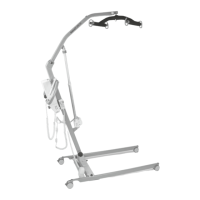

 To Next Page