EasyManua.ls Logo

Dual 1010 - Tonearm - suspension and tracking pressure

Dual 1010
18 pages
Print Icon
To Next Page IconTo Next Page
To Previous Page IconTo Previous Page
Loading...
Fig.
5
Tonearm
bearing
44
58
26
be
70
72
68
17173
170
R3
Fig.
6
Tonearm
bearing
(view
from
below)
125
181140
203179
R3
164165
194
172
L
169 170
Fig.
7
Tonearm
movements
and
record
drop
175
117 147
R1
153
195 140
LH
AK
143
UF
183
KH
164
194
170
L
Tonearm
suspension
and
tracking
pressure
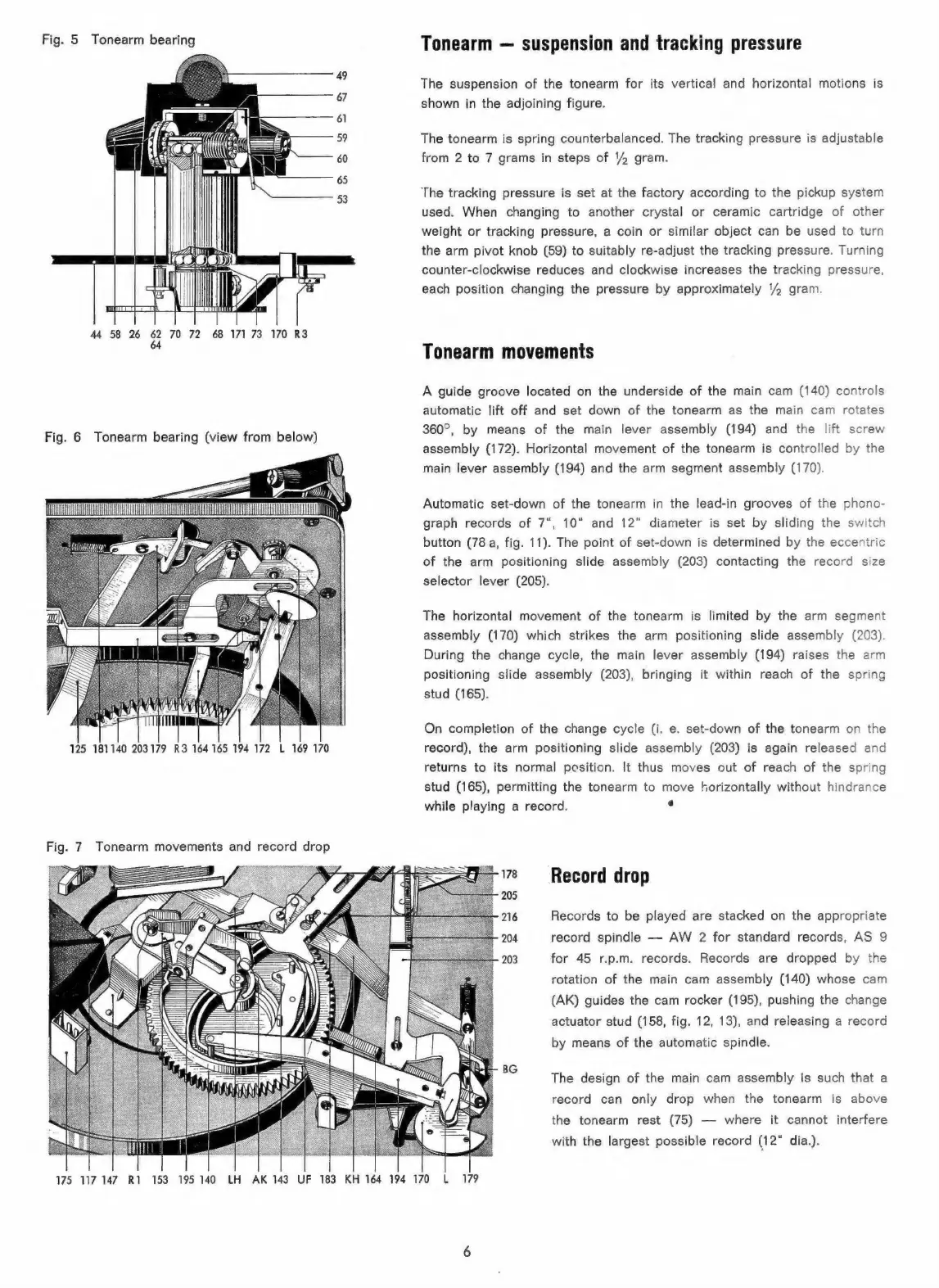
The
suspension
of
the
tonearm
for
its
vertical
and
horizontal
motions
is
shown
in
the
adjoining
figure.
The
tonearm
is
spring
counterbalanced.
The
tracking
pressure
is
adjustable
from
2
to
7
grams
in
steps
of
Y%
gram.
The
tracking
pressure
is
set
at
the
factory
according
to
the
pickup
system
used.
When
changing
to
another
crystal
or
ceramic
cartridge
of
other
weight
or
tracking
pressure,
a
coin
or
similar
object
can
be
used
to
turn
the
arm
pivot
knob
(59)
to
suitably
re-adjust
the
tracking
pressure.
Turning
counter-clockwise
reduces
and
clockwise
increases
the
tracking
pressure,
each
position
changing
the
pressure
by
approximately
1/2
gram.
Tonearm
movements
A
guide
groove
located
on
the
underside
of
the
main
cam
(140)
controls
automatic
lift
off
and
set
down
of
the
tonearm
as
the
main
cam
rotates
360°,
by
means
of
the
main
lever
assembly
(194)
and
the
lift
screw
assembly
(172).
Horizontal
movement
of
the
tonearm
is
controlled
by
the
main
lever
assembly
(194)
and
the
arm
segment
assembly
(170).
Automatic
set-down
of
the
tonearm
in
the
lead-in
grooves
of
the
phono-
graph
records
of
7“,
10“
and
12“
diameter
is
set
by
sliding
the
switch
button
(78a,
fig.
11).
The
point
of
set-down
is
determined
by
the
eccentric
of
the
arm
positioning
slide
assembly
(203)
contacting
the
record
size
selector
lever
(205).
The
horizontal
movement
of
the
tonearm
is
limited
by
the
arm
segment
assembly
(170)
which
strikes
the
arm
positioning
slide
assembly
(203).
During
the
change
cycle,
the
main
lever
assembly
(194)
raises
the
arm
positioning
slide
assembly
(203),
bringing
it
within
reach
of
the
spring
stud
(165).
On
completion
of
the
change
cycle
(i.
e.
set-down
of
the
tonearm
on
the
record),
the
arm
positioning
slide
assembly
(203)
is
again
released
and
returns
to
its
normal
positicn.
It
thus
moves
out
of
reach
of
the
spring
stud
(165),
permitting
the
tonearm
to
move
horizontally
without
hindrance
while
playing
a
record.
¢
178
~—s-
Record
drop
216
Records
to
be
played
are
stacked
on
the
appropriate
204
record
spindle
AW
2
for
standard
records,
AS
9
203
for
45
r.p.m.
records.
Records
are
dropped
by
the
rotation
of
the
main
cam
assembly
(140)
whose
cam
(AK)
guides
the
cam
rocker
(195),
pushing
the
change
actuator
stud
(158,
fig.
12,
13),
and
releasing
a
record
by
means
of
the
automatic
spindle.
The
design
of
the
main
cam
assembly
is
such
that
a
record
can
only
drop
when
the
tonearm
is
above
the
tonearm
rest
(75)
where
it
cannot
interfere
with
the
largest
possible
record
(12"
dia.).

Related product manuals