EasyManua.ls Logo

Dual 1019 - Auto;Manual Cue-Control; Precise Stylus-to-Groove Cueing; Using the Cue-Control

Dual 1019
15 pages
Print Icon
To Next Page IconTo Next Page
To Previous Page IconTo Previous Page
Loading...
Direction
of
Phating
Force
Asti
hating
Civectnon
af
Compensation
Skating
force
a.
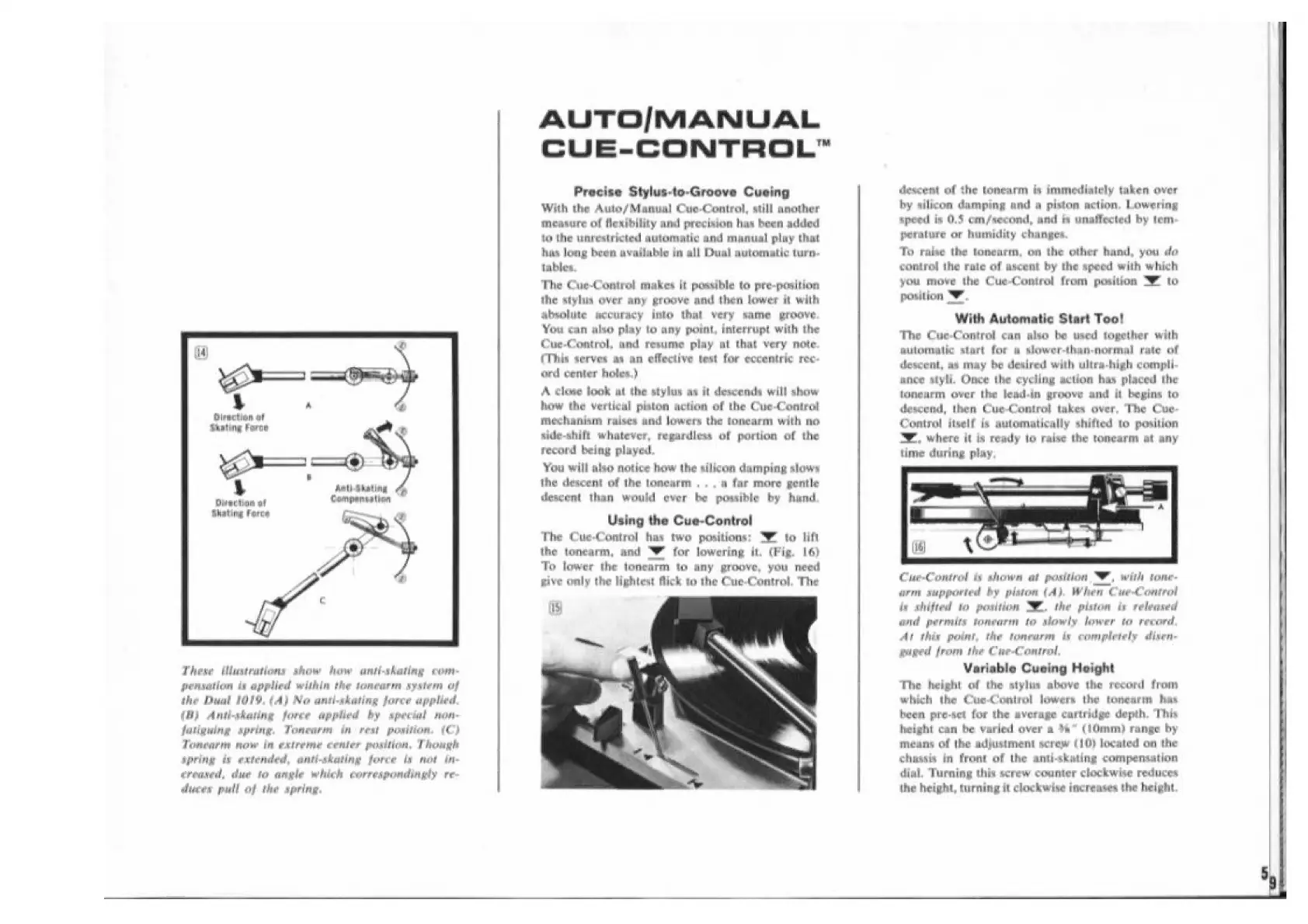
These
Ulwatrations
show
how
anii-akaling
comn-
pensaiion
ip
applied
within
the
tonearm
system
af
the
Dual
10/9,
(A)
Ne
anti-shating
force
applied
(A)
Anti-skating
force
applied
by
special
nen-
fatiguing
apring.
Tonearm
in
reat
position,
(C)
lonewrm
new
in
extreme
center
pastion,
Tihcaigl
ping
if
extended,
anti-skating
force
in
mot
in-
creased,
due
fo
angle
which
correspondingly
re-
ducer
pull
of
the
apring.
AUTO/MANUAL
CUE-CONTROL"
Precise
Stylus-to-Groove
Cueing
With
the
Auto/Manual
Cuc-Control,
still
another
measure
of
flexibility
and
precision
has
been
added
to
the
unrestricted
automatic
and
manual
ploy
that
has
long
been
available
in
all
Dual
automatic
turn-
tables.
The
Cue-Control
makes
it
pousble
to
pre-position
the
stylua
over
any
groove
and
then
lower
it
with
abeoalute
accuracy
into
thal
very
mime
groove
You
can
also
play
to
any
point,
interrupt
with
the
Cue-Control,
and
resume
play
at
that
very
note
(This
serves
os
an
effective
test
for
eccentric
rec-
ord
center
holes.)
A
close
look
af
the
stylus
aa
it
descends
will
show
how
the
vertical
piston
action
of
the
Cue-Control
mechaniom
raises
and
lowers
the
tonearm
with
no
side-shift
whatever,
regardicss
of
portion
of
the
record
being
played,
You
will
also
notice
how
the
silicon
damping
slows
the
descent
of
the
toncarm...
oa
far
more
gentle
descent
than
would
ower
be
posible
by
hand
Using
the
Cue-Control
The
Cue-Control
has
two
positions:
FF
ito
lift
the
tonearm,
and
bl
for
lowering
it.
(Fig.
16)
To
lower
the
tonearm
to
any
groove,
you
need
give
only
the
lightest
flick
to
the
Cuc-Control,
The
descent
of
the
tonearm
is
immediately
taken
over
by
silicon
damping
und
o
piston
action,
Lowering
epeod
is
0.5
om/second,
and
4
unaffected
by
tem
perature
or
humidity
changes
To
rotee
the
tonearm,
on
the
other
hand,
you
da
control
the
rate
of
ascent
by
the
speed
with
which
you
move
the
Cue-Coniral
from
position
IF
to
position
"¥.
With
Automatic
Start
Too!
The
Cue-Control
can
also
be
used
together
with
automatic
start
for
a
slower-than-normal
rate
of
descent,
as
may
be
desired
with
ultra-high
compli-
unce
atyli.
Once
the
cycling
aclion
has
placed
the
loncarm
over
the
lead-in
groove
and
it
begina
to
descend,
then
Cue-Control
takes
over,
The
Cue-
Control
itself
is
automatically
shifted
to
position
=.
where
it
is
ready
to
raise
the
toncarm
at
any
time
during
play,
Cre-Contral
if
shown
af
position
“YW,
with
tone-
orm
supported
by
platen
(A)
When
Cue-Control
de
shifted
to
position
othe
piston
is
released
at!
permins
fonearn
to
slowly
flower
fo
record
At
thir
point,
the
tonearm
is
completely
disen-
fogged
from
the
Cue-Control,
Variable
Cueing
Height
The
height
of
the
stylia
above
the
recon!
from
which
the
CucControl
lowers
the
tonearm
has
been
pre-set
for
the
average
cartridge
depth,
This
height
can
be
Varied
over
4
%e"
(10mm)
range
by
meons
of
(he
adjustment
screw
(10)
located
on
the
Chiossis
in
front
of
the
anti-skaling
compensation
dial,
Turning
this
screw
counter
clockwise
reduces
the
height,
turning
it
clockwise
increases
the
height.

Other manuals for Dual 1019

Related product manuals