Need help?
Do you have a question about the Dual 1226 and is the answer not in the manual?
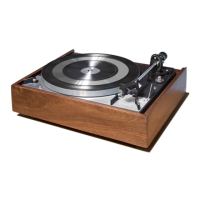
This document is a service manual for the Dual 1226 turntable, providing detailed information for its operation, maintenance, and repair.
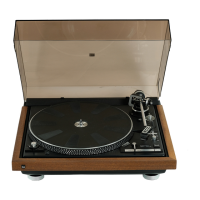
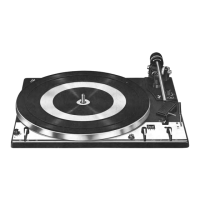
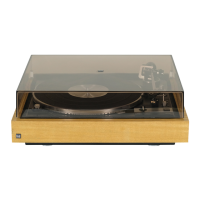
The Dual 1226 is a record player designed for high-fidelity audio reproduction. Its primary function is to play vinyl records at two standard speeds: 33 1/3 and 45 revolutions per minute (rpm). The turntable incorporates an automatic mechanism for setting down the tonearm and changing records, enhancing user convenience. It is driven by a four-pole Dual asynchronous motor, engineered for vibration-free operation and a very low stray magnetic field, which contributes to the purity of the audio signal. The motor's speed is stable despite minor line-voltage variations and is dependent on the line frequency. To accommodate different power grid frequencies (50 or 60 Hz), the unit features interchangeable motor pulleys.
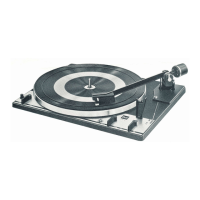
A key usage feature of the Dual 1226 is its automatic operation. When a record is placed on the platter and the start switch is activated, the tonearm automatically moves into position and lowers onto the record. The speed selector is coupled to the tonearm's setdown mechanism, ensuring the correct speed is chosen for the record size. The turntable also includes a pitch control, allowing for fine-tuning of the playback speed by approximately one semi-tone (6%) at both platter speeds. This feature is useful for matching playback speed to other instruments or for personal preference. The tonearm is a torsionally-rigid tubular aluminum arm with vertical and horizontal pivot mounting, designed for precise tracking. It is counterbalanced to provide extremely favorable tracking characteristics and can accept a wide range of cartridges with standard 1/2" mounting and a dead-weight of 2-10 grams. Stylus pressure is continuously adjustable from 0 to 8 p, with reliable performance from 0.5 p.
The anti-skating device is another important usage feature, designed to counteract the inward pull on the tonearm caused by the record groove's geometry. This ensures equal forces on both groove walls, preventing undesirable tonearm jumping and improving sound quality. The anti-skating force can be adjusted via a knob on the cover, with different settings for spherical and elliptical styli, as well as for CD 4 cartridges. The unit also features a muting switch that silences disturbing noises during the change cycle and automatic tonearm operation, ensuring a clean audio experience. For record drop, the appropriate spindle (AW 3 for standard 7" records or AS 12 for 45 rpm 38mm center hole records) is inserted, and the main cam initiates the record drop mechanism. The record drop cam is positioned to ensure that records only drop when the tonearm is over its rest, preventing accidental drops onto the platter.
Maintenance features are extensively covered in the manual to ensure the longevity and optimal performance of the Dual 1226. Lubrication is a critical aspect, with all bearings and friction surfaces adequately lubricated at the factory. Replenishment of oil and grease is recommended approximately every two years with normal use, particularly for motor bearings which are fitted with sintered metal bushes. The manual provides specific lubrication points, both above and below the chassis, and lists recommended lubricants such as Renotac No. 342 adhesive oil, BP Super Viscostatic 10 W/30, Shell Alvania No. 2, Isoflex PDP 40, Silicone oil AK 500 000, and Molykote. It emphasizes applying lubricants sparingly and avoiding contact with the idler wheel, motor pulley, and platter friction faces to prevent slip.
Troubleshooting guides are provided for common issues, such as the platter not running, incorrect speed, rumble, stylus skips, and tonearm malfunctions. For instance, if the platter does not run, the manual suggests checking the connection at the switch plate and voltage selector, tightening the motor pulley, or changing the motor pulley. If the tonearm skips, remedies include balancing the tonearm, setting the correct stylus force, replacing a worn stylus, or checking for excessive friction in the tonearm bearing. The manual also details how to adjust the tonearm set-down point for different record sizes and how to address issues with record dropping. For tonearm bearing assembly replacement, a step-by-step procedure is outlined, including tightening the unit in a repair jig, setting the stylus force scale to zero, locking the tonearm, and carefully disassembling and reassembling components. The anti-skating device adjustment is also detailed, noting that precise readjustment should ideally be performed by an authorized Dual service station using specialized tools. The manual also addresses issues like noise during change operations, lack of sound, and the motor not shutting off, providing specific remedies like adjusting muting switch contacts or replacing the suppression capacitor.
 General
| Drive Type | Idler wheel |
|---|---|
| Speeds | 33 1/3, 45, 78 RPM |
| Weight | 6.5 kg |
| Tonearm Type | Tubular |
| Cartridge Compatibility | 1/2 inch mount |
| Automatic Operation | Semi-automatic |
| Wow and Flutter | < 0.15% |


 To Next Page