EasyManua.ls Logo

Dual 1219 - Advanced Features and Adaptations; Tracking Angle and Mode Selector Functionality; Pitch Control and Cue Control Operation; Adapting for Different Power Frequencies

Dual 1219
8 pages
Print Icon
To Next Page IconTo Next Page
To Previous Page IconTo Previous Page
Loading...
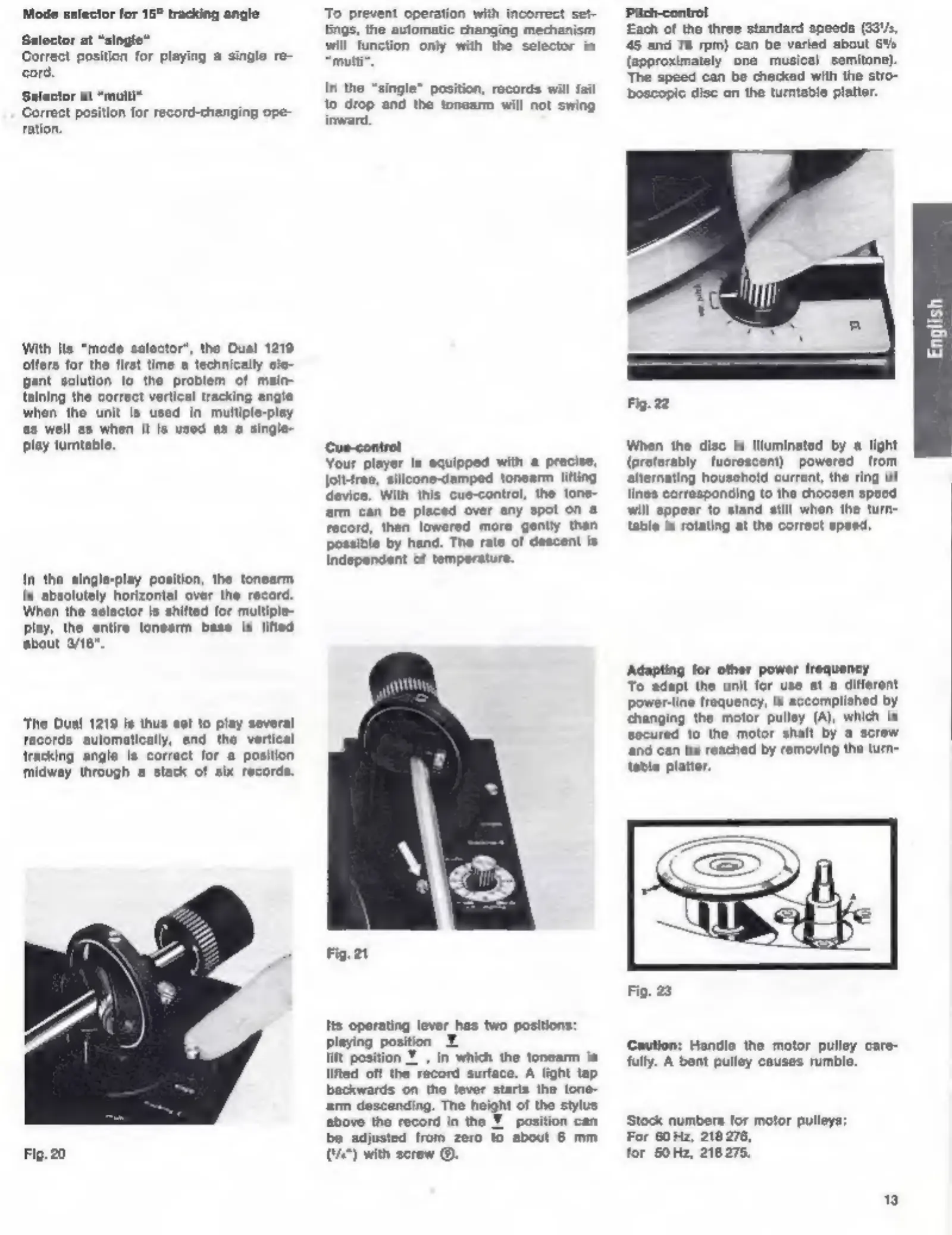
Mode
selector
for
15°
tracking
angle
Selector
at
“single*
Correct
position
for
playing
a
single
re-
cord.
Selector
at
“multi*
Correct
position
for
record-changing
ope-
ration,
With
its
*mode
selector*,
the
Dual
1219
offers
for
the
first
time
a
technically
ele-
gant
solution
to
the
problem
of
main-
taining
the
correct
vertical
tracking
when
the
unit
is
used
in
multiple-
‘a5
woll
as
when
it
is
used
as
a
single-
play
turntable
{In
the
single-play
position,
the
tonearm
{s
absolutely
horizontal
ovar
the
record,
When
the
selector
is
shifted
for
multiple-
play,
the
entire
tonearm
base
is
lifted
about
9/16".
‘Tho
Dual
1219
Is
thus
set
to
play
several
records
automatically,
and
the
vertical
tracking
angle
is
correct
for
a
position
midway
through
a
stack
of
six
records.
Fig.
20,
To
prevent
operation
with
incorrect
set-
tings,
the
automatic
changing
mechanism
il
function
only
with
the
selector
in
“multi
In
the
“single”
position,
records
will
fait
to
drop
and
the
tonearm
will
not
swing
inward.
Cue-controt
Your
player
Is
equipped
with
a
precise,
jolt-free,
silicone-damped
tonearm
lifting
device.
With
this
cue-control,
the
tone-
‘arm
can
be
placed
over
any
spot
on
record,
then
lowered
more
gently
than
possible
by
hand.
The
rate
of
descent
Independent
of
temperature.
itt,
Its
operating
lever
has two
positions:
playing
position
¥
lift
position
¥,
in
which
the
tonearm
is
lifted
off
the
record
surface.
A
light
tap
backwards
on
the
lever
starts
the
tone-
arm
descending.
The
height
of
the
stylus
above
the
record
in
the
¥
position
can
be
adjusted
from
zero
io
about
6
mm
(ve)
with
screw
©.
Pitch-control
Each
of
the
three
standard
speeds
(33'/s,
45
and
78
rpm)
can
be
varied
about
6%
(epproximately
one
musical
semitone).
‘The
speed
can
be
checked
with
the
stro-
boscopic
disc
on
the
turntable
platter.
Fig.
22
When
the
disc
is
illuminated
by
a
light
(preferably
fuorescent)
powered
from
alternating
household
current,
the
ring
of
lines
corresponding
to
the
choosen
speed
will
appear
to
stand
still
when
the
turn~
table
is
rotating
at
the
correct
speed.
‘Adapting
for
other
power
frequency
To
adapt
the
unit
for
use
at
a
different
power-line
frequency,
is
accomplished
by
‘changing
the
motor
pulley
(A),
which
is
secured
to
the
motor
shaft
by
a
screw
1nd
can
be
reached
by
removing
the
turn-
table
platter.
ig.
23
Caution:
Handle
the
motor
pulley
car
fully.
A
bent
pulley
causes
rumble.
‘Stock
numbers
for
motor
pulleys:
For
60
Hz,
218276,
for
50
Hz,
218275.
8

Related product manuals