Need help?
Do you have a question about the Dual 510 and is the answer not in the manual?
Procedure for replacing the motor pulley on the turntable.
Steps for adjusting the tonearm's vertical and horizontal bearings.
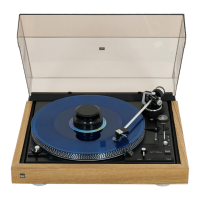
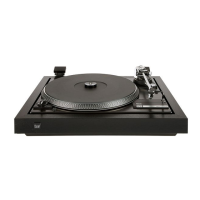
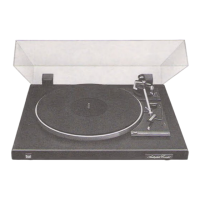
The Dual 510 is a belt-drive turntable designed for playing records, featuring a sophisticated tonearm and a range of user-adjustable controls for optimal playback. Its primary function is to accurately reproduce audio from vinyl records, offering both standard and fine-tuned speed adjustments.
The turntable operates using an eight-pole synchronous motor with a belt-drive system. The motor, suspended by elastic mounts, is designed to minimize stray magnetic fields and vibrations, ensuring a clean audio signal. The platter, a non-magnetic, dynamically-balanced component, is driven by a precision-ground flat belt. This belt connects the motor pulley to the flywheel rotor beneath the platter, ensuring smooth and consistent rotation.
Speed selection is managed by a lever that positions the changeover lever to the appropriate nominal speed (33 1/3 or 45 rpm). When the unit is switched on and the platter begins to turn, the changeover lever disengages, guiding the flat belt to the correct step on the motor pulley.
A key feature is the adjustable pitch control, which allows for fine-tuning of the two standard speeds by approximately 6% (one semitone). This adjustment is achieved by turning a knob that moves a toothed belt pulley, which in turn slides a counter bearing and a tapered bush on the drive pulley. This mechanism effectively varies the diameter of the drive pulley, thereby altering the platter's speed.
The tonearm is a feather-light, torsion-resistant, all-metal design, suspended in a four-point gimbal system. This suspension utilizes hardened, precision-polished steel points resting in precision ball bearings, minimizing bearing friction for both vertical and horizontal movement. This low friction ensures extremely favorable pick-up conditions.
The pick-up head is detachable and suitable for various cartridges with Dual catch mounting or 1/2" mounting, accommodating cartridges with a deadweight of 5.5 to 10 grams (including mounting material). The tonearm's balance weight is designed to work with these cartridges.
Tracking force is continuously variable from 0 to 3 grams, with 1/10 gram calibration in the 0 to 1.5 gram range, ensuring reliable tracking from 0.5 grams upwards. This adjustment is made by turning a graduated spring housing, which tensions or releases an internal coil spring.
An anti-skating device is integrated to counteract the geometrical skating force that acts on every tonearm. This precision mechanism is crucial for preventing the stylus from skipping out of the playing groove and for ensuring even flank loading of the sound groove. The anti-skating force is dependent on the tonearm's geometry, tracking force, and stylus tip curvature. Turning a knurled ring on the mounting plate moves an asymmetrical plate cam, which, through a skating lever and tension spring, applies a counter-force to the tonearm.
The unit also incorporates a tonearm set-down mechanism. When a specific knob is turned, recesses on a slide bar align with a spring pin on the tonearm's segment. Moving the tonearm with the cue control then arrests the spring pin in these recesses, defining the set-down point for 30 cm and 17 cm records. This mechanism can be disengaged to allow set-down within the arresting point's range.
The cue control provides gentle set-down of the tonearm at any desired point on the record, outside the shut-off range. Moving the cue lever raises the tonearm via a lift pin. Once the tonearm is positioned, releasing the lever allows the tonearm to lower slowly, damped by silicone oil in the lift pin. The height of the stylus above the record can be adjusted by turning an adjusting screw.
The starting and shut-off mechanism is initiated by turning the tonearm, which rotates a segment, actuating the power switch, shift arm, and starting the motor and platter. The shut-off cycle, after a record has played, is triggered by a dog on the platter and a shut-off lever. The shut-off lever is guided by the tonearm's movement during playback. In the run-out groove, the increased lead guides the shut-off lever onto the dog at a higher rate, causing it to be picked up and moved. This action brings the shift arm to its neutral position, interrupting the power supply, and simultaneously lifts the tonearm.
The Dual 510 offers several features to enhance the user experience. The detachable pick-up head allows for easy cartridge changes and maintenance. The continuously variable tracking force and anti-skating adjustments provide precise control over playback, accommodating different cartridges and record types.
The pitch control, with its approximate 6% adjustment range, allows users to fine-tune playback speed, which can be useful for matching pitch or correcting minor speed variations. The stroboscope, with markings for both 50 and 60 Hz, provides a visual check for accurate platter speeds, ensuring that records are played at their intended rate.
The cue control is a practical feature for manually lowering and raising the tonearm gently, preventing accidental drops and potential damage to records or the stylus. The ability to adjust the stylus height above the record further refines this control.
The automatic start and shut-off functions simplify operation, allowing the user to initiate playback by simply moving the tonearm and relying on the system to stop playback at the end of the record.
Maintenance of the Dual 510 involves several key areas to ensure its longevity and optimal performance.
Regular checks of the motor pulley and flat belt are important. If the platter does not run or reach its required speed, the flat belt may need to be properly installed, cleaned, or renewed. Slippage between the flat belt and the drive pulley or flywheel rotor can be resolved by cleaning their friction surfaces. The motor pulley itself can be replaced if it's incorrect for the local line frequency.
Tonearm bearing friction should be checked and adjusted if excessive. Both vertical and horizontal bearings should have slight, just perceptible play. Adjustments are made via specific grub screws, with the horizontal bearing correctly adjusted when the tonearm slides in without resistance at an anti-skating setting of "0.5" (with the tonearm balanced).
The pick-up head's parallelism to the platter should be checked, especially after transport. If it's not parallel, the screw on the pick-up head can be slackened through a hole in the chassis plate, allowing for alignment before retightening.
The anti-skating device requires correct setting to prevent the stylus from skipping or uneven groove loading. If the stylus slips out of the playing groove, the tonearm balance, tracking force, or anti-skating setting should be checked.
The lift tube assembly, responsible for the cue control's damping, may require cleaning or replacement if the tonearm lowers too quickly or shows resistance. This involves disassembling the lift tube, cleaning its components, and reapplying silicone oil.
The tonearm set-down mechanism's adjustment is crucial for accurate set-down points. If the tonearm does not set down correctly, the set-down point screw needs adjustment.
Lubrication is vital for all bearing and friction points. The manual specifies that lubrication is typically needed only after approximately two years of normal use. It's crucial to use the recommended original lubricants and to apply them sparingly, avoiding contact with the friction surfaces of the flat belt, drive pulley, and flywheel rotor to prevent slippage. Bearings and friction faces should be lubricated carefully.
Electrical components, such as the glow lamp for the stroboscope, power supply connections, and capacitor-type suppressors in the power switch, should be checked if the stroboscope doesn't work or if acoustic feedback occurs.
The horizontal tonearm movement should be free of resistance. If resistance is observed, the segment's position and the catch setting need adjustment. This involves precise alignment and tightening of nuts to ensure proper play between components.
 General
| Drive Type | Belt Drive |
|---|---|
| Speeds | 33 1/3, 45 RPM |
| Effective length | 221 mm |
| Platter | Non-magnetic |
| Output | Phono |


 To Next Page