EasyManua.ls Logo

Dual C 844 - Page 6

Dual C 844
50 pages
Print Icon
To Next Page IconTo Next Page
To Previous Page IconTo Previous Page
Loading...
amp)
is
active
HIGH
and
is
routed
from
the
device
control
via
connec-
tor
C
(board
A)
Pin
2
to
Q
602
which
connects
the
input
of
the
recor-
ding
amplifier
IC
602
to
0
V
via
Q
508.
Also
during
recording
and
when
AUTO
SPACE
is
operated,
this
control
signal
creates
the
music
space
lasting
approximately
4
s.
Muting
of
LINE
OUT
and
MONITOR
is
realized
by
the
forward-bias
of
transistor
0
271
(HIGH
signal
at
the
base).
The
processor
routes
the
control
signal
MUTING
playback
to
board
A,
connector
C,
Pin
5
as
a
LOW
active
signal
during
the
following
functions:
stop,
rewind,
fast
for-
ward,
music
finder
>I>
and
44
and
pause.
DIN
output
switched
off
=
relay
RY
1
idle,
the
contacts
are
open,
tran-
sistor
Q
355
is
reverse-biased,
as
Q
354
becomes
forward-biased
due
to
the
RECORD
command
(HIGH
active).
CLEAR
MUTING
playback
=
enabling
of
muting
during
the
following
functions:
play,
record
SB
(standby)
and
record.
The
control
signal
CLEAR
MUTING
playback
(HIGH
active)
produced
by
the
processor
is
routed
through
connector
C
(board
A)
Pin
5
to
IC
603,
the
output
Pin
10
of
which
changes
to
HIGH
with
a
delay
(C
601)
and
transistor
Q
351
becomes
forward-biased.
Due
to
AND
gating
with
Q
352,
the
muting
transistor
Q
271
cannot
become
reverse-biased
via
0
353
until
Q
352
is
forward-biased.
Q
352
is
always
forward-biased
when
the
vol-
tage
of
the
power
supply
unit
is
at
its
correct
level,
HIGH
signal
at
con-
nector
C
(board
A)
Pin
7.
The
output
Pin
11
of
IC
603
applies
a
HIGH
level
to
the
base
of
Q
352.
This
control
signal
is
also
routed
to
the
base
of
Q
355,
This
becomes
forward-biased
and
switches
on
the
relay
and
the
DIN
output
is
connected
into
the
AF
signal.
If
the
RECORD
com-
mand
is
issued
(HIGH
active),
Q
354
becomes
forward-biased
and
thus
renders
0355
reverse-biased.
The
DIN
output
is
disconnected.
Recording
level
indications
VU:
The
LINE
OUT
output
signal
is
amplified
with
the
display
ampli-
fier
Q 273
via
R
284
and
routed
to
the
VU
meter
via
the
full
wave
recti-
fier.
The
full
wave
rectifier
ensures
a
precise
indication
and
the
VU
me-
ter
operates
with
damped
return.
VU
is
set
for
the
0
dB
reference
level
with
VR
271.
The
transistor
Q
274
mutes
the
instrument
during
all
LINE
OUT
muting
functions.
Peak
level:
The
tape
type-dependent
and
treble
equalized
signal
is
de-
coupled
from
the
output
of
the
recording
amplifier
IC
602
Pin
4
with
C
545
and
routed
via
the
control
VR
503
to
the
input
Pin
2
of
the
inte-
grated
display
amplifier
IC
605
which
directly
drives
the
LED's
with
its
outputs.
With
transistor
Q
507
(forward-biased),
the
se
n
sitivity
is
swit-
ched
over
when
the
tape
type
selector
switch
S
21-3
is
set
to
MET.
The
display
is
inertialess
with
5
LED's
which
indicate
the
magnetization
of
the
tape
as
a
percentage.
Device
control
Processor
All
device
and
drive
functions
are
controlled
by
a
4
-bit
microcomputer
with
integrated
2
kbyte
program
memory.
The
clock
frequency
is
ap-
proximately
500
kHz
with
CF
401
at
Pins
24
and
25
of
the
processor
IC
409.
Reset
When
the
deck
is
switched
on,
the
supply
voltages
stabil
ize
to
their
no-
minal
values.
With
this
LOW-HIGH
edge
at
the
reset
input
Pin
23
of
IC
409,
the
program
counter
of
the
precessor
is
set
to
itsstart
address
and
the
processor
is
enabled
for
its
functional
sequences.
Via
D
418
and
C
417,
a
clear
pulse
is
routed
to
the
D
flipflop
IC
408
Pin
1.
Inputs
The
drive
and
memory
control
buttons
are
interrogated
and
processed
by
the
processor
in
the
form
of
a
clocked switch
matrix.
The
positive
pulses
of
IC
409
produced
at
Pin
7
(decade
2)
to
Pin
9
(decade
4),
which
are
inverted
with
IC
406,
serve
as
the
working
clocks.
These
pulses
have
a
mutual
offset
of
3
ms
(see
pulse
diagram).
When
a
drive
control
button
is
operated,
the
signal
is
applied
as
a
HIGH
active
pulse
(inverter
IC
405)
to
the
processor
IC
409.
The
contact
sensor
S
13
RECORD
SAFETY
(erasure
block)
is
open
when
a
musicassette
is
inserted
=
HIGH
signal.
In
thiscase,
the
proces-
sor
ignores
operation
of
the
RECORD
button.
The
timer
switch
S
1
routes
its
inputs
PLAY
or
REC
as
LOW
active
signals
to
the
processor.
OLL
The
no-contact
infrared
light
barrier
system
is
applied.
The
infrared
emitter
LED
406
is
driven
by
the
free
oscillating
oscillator
IC
404
from
Pin
1
via
0415.
The
clock
frequency
is
1050
Hz
and
can
be
varied
with
VR
401.
This
frequency
is
also
routed
to
Pin
22
of
the
processor
as
the
reference
frequency
(see
also
end
of
tape
switch-off).
This
clocking
principle
ensures
perfect
resistance
to
constant
light
and
interfering
re-
flections.
The
light
pulses
are
converted
to
electrical
pulses
by
the
pho-
totransistor
Q
420
and
these
are
processed
by
the
comparator
IC
404.
If
the
light
barrier
is
obstructed
(DLL
ON),
a
wave-shaped
HIGH
level
is
applied
to
the
output
of
IC
404
Pin
7
for
the
duration
of
the
obstruc-
tion
and
this
is
converted
to
LOW
level
with
R
443,
C
411
and
D
410.
This
LOW
signal
also
occurs
when
the
cassette
sensor
S
12
is
closed
(cassette
removed).
Due
to
the
LOW
signal
at
Pin
41
(IC
409),
the
pro-
ce
ssor
recognizes
DLL
ON
=
cassette
removed.
The
stop
function
is
executed,
the
LED
STOP
flashes
and,
in
recording
mode,
the
RECORD
function
is
cancelled.
When
the
deck
is
set
to
PLAY,
this
operating
sta-
te
is
stored
after
removal
of
the
cassette.
End
of
tape
switch-off
The
information
that
the
tape
is
running
is
passed
on
to
IC
412
by
a
multiple
magnetic
disc
secured
to
the
drive
wheel
of
the
take-up
wheel.
This
IC
converts
the
alternating
magnetic
fields
into
electrical
pulses.
These
pulses
are
routed
through
C
414
to
transistor
0418
which
opera-
tes
as
a
flipflop
together
with
IC
406
Pins
7/10.
The
signals
shaped
in
this
way
are
routed
through
R
457
to
Pin
37
of
IC
409.
This
tape-run-
ning
frequency
is
compared
by
the
processor
with
the
1050
Hz
fre-
quency
of
the
oscillator
IC
404
which
is
applied
to
Pin
22
(IC
409).
If
the
tape-running
pulses
fail
within
a
period
of
1
s,
e.g.
due
to
a
tape
jam,
STOP
is
triggered
off.
In
the
event
of
tape-running
malfunctions,
the
1050
Hz
(-±
5
%)
frequency
should
also
be
checked,
as
this
serves
as
the
reference
frequency
for
switching
off
at
the
end
of
the
tape.
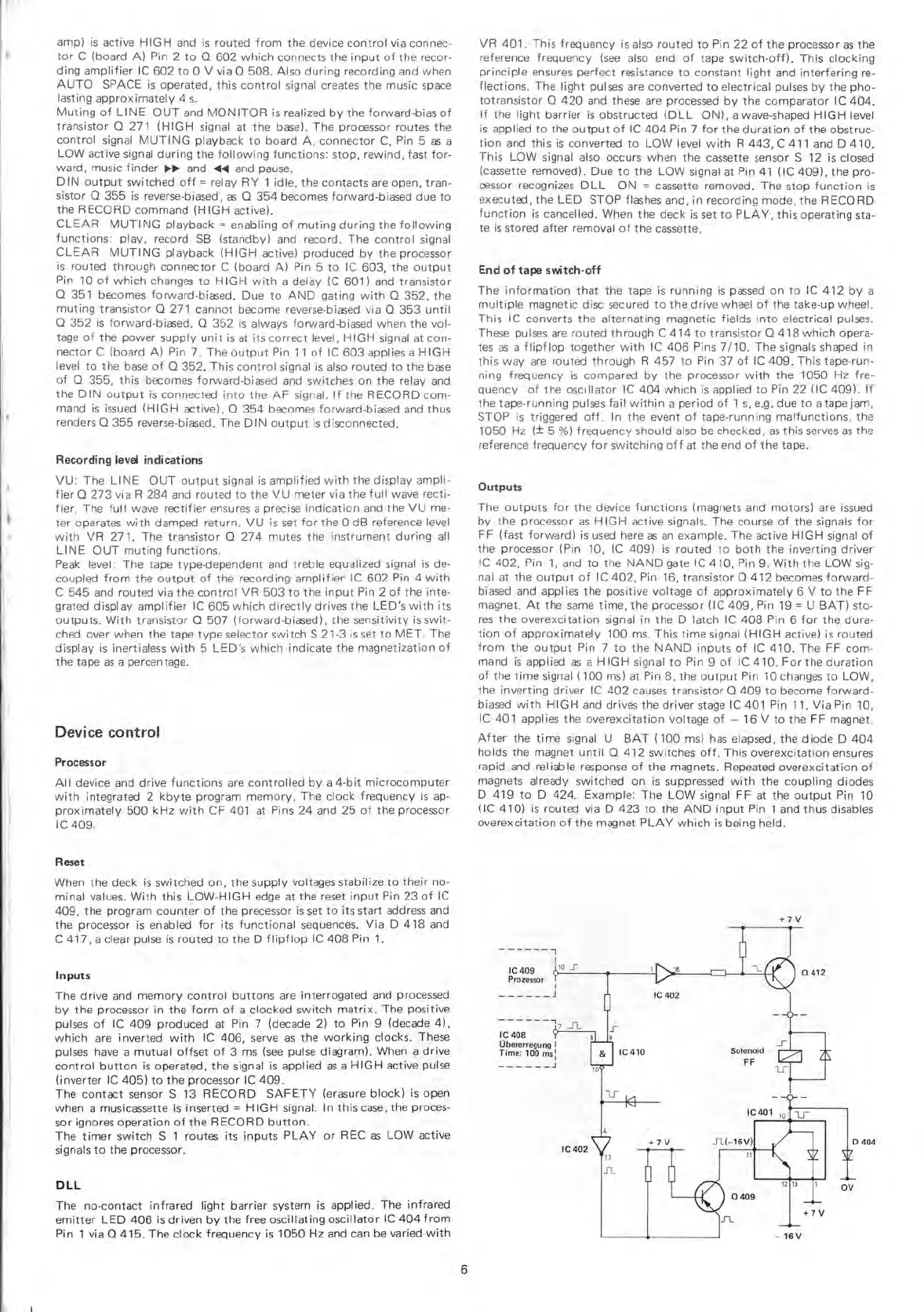
Outputs
The
outputs
for
the
device
functions
(magnets
and
motors)
are
issued
by
the
processor
as
HIGH
active
signals.
The
course
of
the
signals
for
FF
(fast
forward)
is
used
here
as
an
example.
The
active
HIGH
signal
of
the
processor
(Pin
10,
IC
409)
is
routed
to
both
the
inverting
driver
IC
402,
Pin
1,
and
to
the
NAND
gate
IC
410,
Pin
9.
With
the
LOW
sig-
nal
at
the
output
of
IC
402,
Pin
16,
transistor
0412
becomes
forward-
biased
and
applies
the
positive
voltage
of
approximately
6
V
to
the
FF
magnet.
At
the
same
time,
the
processor
(IC
409,
Pin
19
=
U
BAT)
sto-
res
the
overexcitation
signal
in
the
D
latch
IC
408
Pin
6
for
the
dura-
tion
of
approximately
100
ms.
This
time
signal
(HIGH
active)
is
routed
from
the
output
Pin
7
to
the
NAND
inputs
of
IC
410.
The
FF
com-
mand
is
applied
as
a
HIGH
signal
to
Pin
9
of
1C410.
For
the
duration
of
the
time
signal
(100
ms)
at
Pin
8,
the
output
Pin
10
changes
to
LOW,
the
inverting
driver
IC
402
causes
transistor
Q
409
to
become
forward-
biased
with
HIGH
and
drives
the
driver
stage
IC
401
Pin
11.
Via
Pin
10,
IC
401
applies
the
overexcitation
voltage
of
16
V
to
the
FF
magnet.
After
the
time
signal
U
BAT
(100
ms)
has
elapsed,
the
diode
D
404
holds
the
magnet
until
Q
412
switches
off.
This
overexcitation
ensures
rapid
and
reliable
response
of
the
magnets.
Repeated
overexcitation
of
magnets
already
switched
on
is
suppressed
with
the
coupling
diodes
D
419
to
D
424.
Example:
The
LOW
signal
FF
at
the
output
Pin
10
(IC
410)
is
routed
via
D
423
to
the
AND
input
Pin
1
and
thus
disables
overexcitation
of
the
magnet
PLAY
which
is
being
held.
IC
409
Prozessor
IC
408
Übererregung
1
Time:
100
ms
+
7
V
6