EasyManua.ls Logo

Dual C 844 - Page 7

Dual C 844
50 pages
Print Icon
To Next Page IconTo Next Page
To Previous Page IconTo Previous Page
Loading...
The
dynamic
HIGH
pulses
produced
by
Pin
14
to
Pin
20
(IC
409)
are
converted
to
static
HIGH
signals
by
the
D-latch
IC
408.
The
informa-
tion
pending
at
the
D
input
is
written
into
the
clock
input
Pin
9
(IC
408)
by
a
HIGH
pulse
(approximately
10
ps)
and
is
available
in
static
form
at
the
Q
output
until
new
information
is
stored.
Capstan
motor,
reel
motor
With
a
HIGH
signal
from
the
processor
(IC
409,
Pin
16),
which
is
stored
in
the
D-latch
IC
408,
Q
403
causes
the
transistor
Q
402
to
become
forward-biased
and
this
applies
the
operating
voltage
of
—
16
V
to
the
Capstan
motor
and
reel
motor,
connector
A
(board
C)
Pin
10.
The
refe-
rence
voltage
for
the
tape
speed
is
set
with
VR
403
(9.5
cm/s)
and
VR
402
(4.75
cm/s).
The
phototransistor
in
IC
411
is
always
forward-
biased
and
only
functions
when
the
rewind
speed
REW
is
regulated.
The
flyvvheel
of
the
Capstan
drive
is
implied
via
an
intermediate
linkage
for
the
FF
or
REW
function.
In
order
to
prevent
excessive
stressing
of
the
tape
at
the
end
of
the
reel,
—
during
the
function
REPEAT
=
REW
and
9.5
cm/s
—
the
rewinding
speed
is
slowed
down
towards
the
end
of
the
reel
via
the
optocoupler
IC
411.
The
signals
of
the
tape
run
sensor
IC
412
are
evaluated
by
the
processor.
If
the
pulse
frequency
rises
abo-
ve
75
Hz,
LOW
active
regulation
pulses
are
routed
from
Pin
33
(IC
409)
through
D
415
to
the
inverter
IC
406,
Pin
2.
The
HIGH
pulses
from
the
output
Pin
15
control
the
photodiode
in
the
optocoupler
IC
411.
With
each
positive
pulse,
the
integrated
phototransistor
becomes
reverse-bia-
sed
and
increases
the
reference
voltage
via
R
465.
The
Capstan
motor
is
slowed
down
accordingly.
In
order
to
ensure
that
the
tape
reaches
a
high
rewinding
speed
in
FF
mode,
this
regulation
function
is
cancelled
by
a
HIGH
signal
via
D
414
and
the
phototransistor
is
forward-biased.
Music
finder
Pf
the
buttons
FF
or
REW
are
operated
during
the
play
function,
the
processor
recognizes
the
music
finder
function
and
routes
a
LOW
signal
=
SCAN
to
Pin
31
(IC
409).
This
signal
is
routed
to
transistor
Q
414
in
order
to
enable
the
finder
amplifier.
The
magnets
FF
and
MF
(music
finder)
are
energized
and,
in
this
way,
the
double-head
only
just
tou-
dies
the
tape
in
order
to
guarantee
reliable
recognition
of
the
music
gap.
Wear
of
the
audio
head
is
reduced
to
a
minimum,
thanks
to
this
bare
touching.
Pf
a
music
gap
is
now
recognized
(SPACE
=
LOW
active,
see
also
analog
section),
this
LOW
signal
is
routed
to
the
processor
in-
put
Pin
38
which
initiates
the
play
function.
Auto-space
When
the
AUTO
SPACE
button
is
operated
during
RECORD
mode,
the
recording
amplifier
is
muted
—
HIGH
signal
from
Pin
32
(IC
409)
to
Q
419
—
and
the
tape
runs
approximately
4
s
more
until
the
processor
stops
the
tape
and
triggers
off
RECORD
STANDBY.
With
the
com-
mand
PAUSE
(HIGH
active
Pin
20
of
IC
409),
Q
419
becomes
reverse-
biased
=
clear
muting
playback
by
a
LOW
signal
via
IC
408
and
inverter
IC
406.
Record
st
andby
Pf
the
button
RECORD
is
operated
and
the
contact
RECORD
SAFETY
S
13
is
closed
(LOW
at
Pin
36,
IC
409),
the
deck
changes
over
to
the
function
RECORD
STANDBY
which
is
indicated
by
flashing
of
the
green
LED
PLAY.
The
magnet
PLAY
is
energized,
muting
of
the
playback
branch
is
cancelled
(clear
muting
playback),
the
Capstan
mo-
tor
is
switched
on,
the
recording
amplifier
is
enabled
(clear
muting
RA,
419
reverse-biased),
the
LED
PLAY
flashes
and
the
LED
RECORD
lights
up.
Pf
the
button
PLAY
is
now
operated,
the
deck
changes
over
to
the
record
function.
LED
display
The
functions
STOP,
PLAY,
RECORD,
REPEAT
and
DOUBLE
SPEED
(9.5
cm/s)
are
each
indicated
by
one
LED.
With
the
exception
of
DOUBLE
SPEED,
the
LED's
are
driven
on
their
cathode
sides
with
the
LOW
active
decade
pulses
(inverter
IC
406).
The
positive
operating
vol-
tage
is
connected
es
pulses
with
the
transistors
0416
and
0417.
Pf,
for
example,
the
LED
RECORD
is
activated,
the
processor
produces
the
activation
pulses
for
0
416
in
phase
with
the
pulses
of
decade
2.
Pf,
on
the
other
hand,
the
LED
REPEAT
is
to
light
up,
the
activation
pulses
for
0416
are
synchronous
with
the
pulses
of
decade
4.
Counter
The
4-digit
display
is
driven
in
multiplex
mode
via
inverter
IC
406
(de-
cade
pulses
LOW
aktive)
and
inverter
IC
407
(segment
pulses
LOW
ac-
tive).
Display
of
the
dots
for
MEMORY
and
SET
is
controlled
by
0416
and
Q
417.
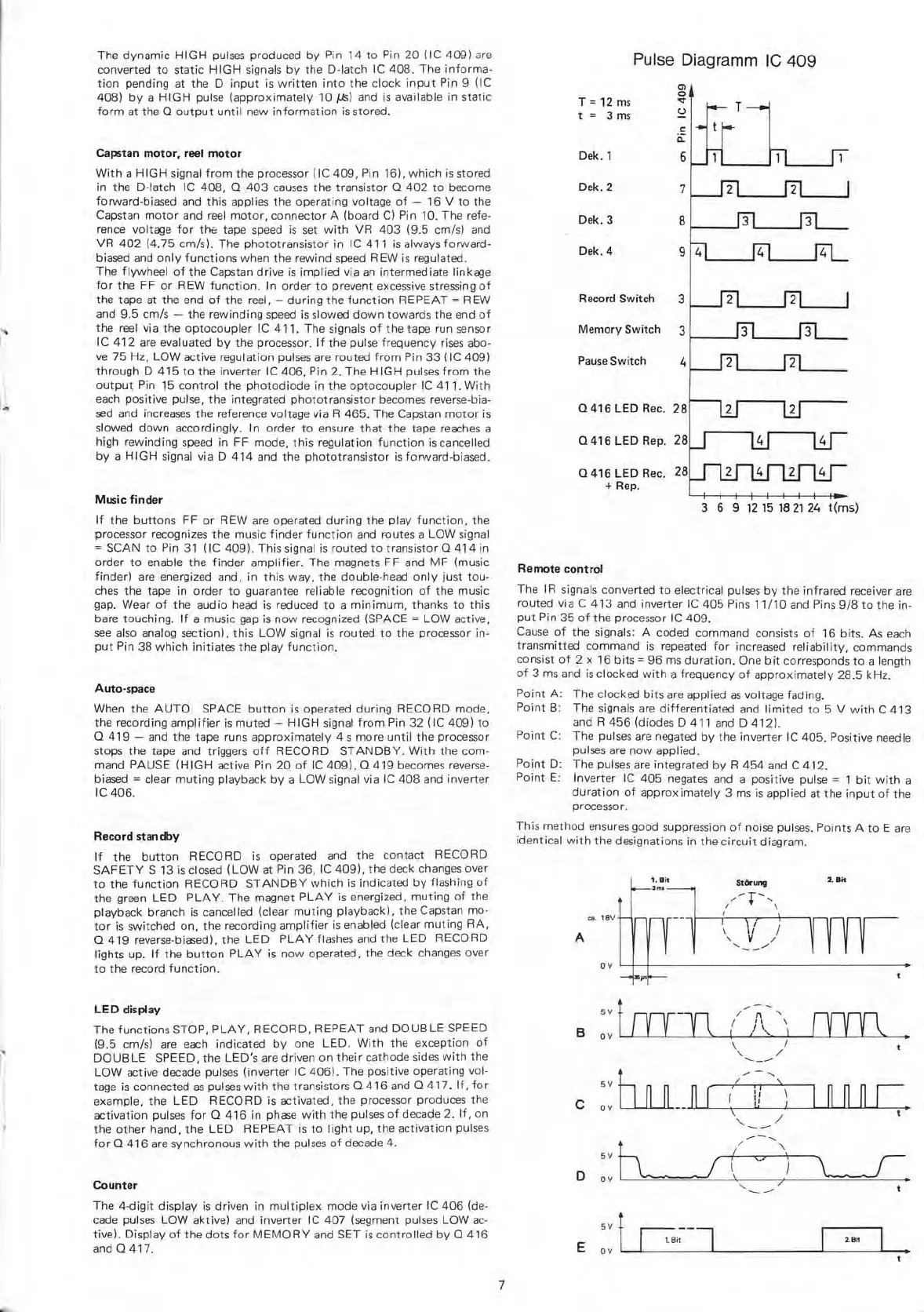
T
=
12
ms
t
=
3
ms
Pulse
Diagramm
IC
409
Pin
IC
409
--..-
Dek.
1
6
Dek.
2
7
Dek.
3
Dek.
4
9
Record
Switch
3
Memory
Switch
3
Pause
Switch
4
Q416
LED
Rec.
28
0416
LED
Rep.
28
Q
416
LED
Rec,
28
+
Rep.
T
131
I
L
3
zi rzi
4
21
12
2 2
4l
14
21
141
2
4
i
I I I I
3
6
9
12
15
1821
24
t(ms)
Remote
control
The
IR
signals
converted
to
electrical
pulses
by
the
infrared
receiver
are
routed
via
C
413
and
inverter
IC
405
Pins
11/10
and
Pins
9/8
to
the
in-
put
Pin
35
of
the
processor
IC
409.
Cause
of
the
signals:
A
coded
command
consists
of
16
bits.
As
each
transmitted
command
is
repeated
for
increased
reliability,
commands
consist
of
2
x
16
bits
=
96
ms
duration.
One
bit
corresponds
to
a
length
of
3
ms
and
isclocked
with
a
frequency
of
approximately
28.5
kHz.
Point
A:
Point
B:
Point
C:
Point
D:
Point
E:
The
clocked
bits
are
applied
es
voltage
fading.
The
signals
are
differentiated
and
limited
to
5
V
with
C
413
and
R
456
(diodes
D
411
and
D412).
The
pulses
are
negated
by
the
inverter
IC
405.
Positive
needle
pulses
are
now
applied.
The
pulses
are
integrated
by
R
454
and
C
412.
Inverter
IC
405
negates
and
a
positive
pulse
=
1
bit
with
a
duration
of
approximately
3
ms
is
applied
at
the
input
of
the
processor.
This
method
ensures
good
suppression
of
noise
pulses.
Points
A
to
E
are
identical
with
the
designations
in
the
circuit
diagram.
ca.
18V
A
OV
5V
B
o
V
5V
C
OV
5V
D
OV
5V
E
ov
1.
Bit
Störung
\
2.
Bit
\ 11
/
V
I
I
fl 11
FT.
Bit
1
/7.
2.Bit
nds
7