EasyManua.ls Logo

Dubreq Stylophone Gen X-1 - User Manual

Dubreq Stylophone Gen X-1
2 pages
Print Icon
To Next Page IconTo Next Page
Loading...
5. DELAY
A repeating, decaying echo. When switched on,
this creates a repetition of your sound.
This adds space to your sound as it mimics
dierent environments. Think of the dierence
you hear between clapping in a small room
(short delay time as the sound bounces o the
close wall and then is quiet) and clapping in a
big cave (big delay and more feedback as you
hear echo several times as it bounces around),
This is delay!
Congure your Gen X-1 to these settings and play
with the Delay. ..
4. FILTER
This is a Low Pass Filter that cuts o high
frequencies.
This does not control anything, but simply
applies a lter to the GEN X-1.
Think about how physical barriers aect
sounds in the world around us, like hearing
loud music through a wall (mued, low bass
frequencies but high notes cut out), and then
how it changes when you open the door (all
frequencies heard). This is a primitive real world
Low Pass Filter,
Congure your Gen X-1 to these settings and play
with the lter...
QUICK
START
GUIDE
DETAILED GUIDE
1. INTRODUCTION
Welcome to the world of
the Stylophone Gen X-1
portable analog synthesizer
TM
2. ENVELOPE
Attack and no decay = sustain (by leaving the
lter open).
The envelope controls two parameters on the
Gen X-1, the pitch and the lter, When the
pitch dial is set to zero the attack and decay
will eect only the lter, When the pitch dial is
turned, the attack and decay will also eect the
pitch of the Gen X-1.
The attack dial is used to adjust the amount of
time it takes for either the lter/ pitch to fade
in, The decay control adjusts the amount of
time it takes for the lter/ pitch to fade out.
Think about the sound of a bell, it starts o
abruptly (low attack) and fades out slowly
(high decay),
Congure your Gen X-1 to these settings and play
with the envelope...
3. LOW FREQUENCY
OSCILLATOR
Low-Frequency Oscillator that modulates the
pitch of the sound. You can change it in the
following ways:
WAVE PATTERN Changes the shape (and so
sound) of the wave pattern,
Square (jumps between pitch levels)
Triangle (rises and falls smoothly between
pitch levels)
RATE OF WAVES Eects the number of waves
you hear per second.
DEPTH OF WAVE Changes the depth of the
wave pattern creating peaks and troughs,
The LFO is a very slow oscillator that controls
other parameters on the Gen X-1.
It can eect the pitch of the oscillator and
the frequency of the Pulse Width Modulation
(X button). The switch allows you to choose
between square and triangle wave patterns.
Congure your Gen X-1 to these settings and play
with the LFO...
PITCH ADJUST
This handy control on the underside of the
GEN X-1 allows you to ne tune the pitch
of your sound exactly.
KEYBOARD AND SOUNDSTRIP
You have two ways to make sounds with the stylus:
The keyboard to play distinct notes
The soundstrip above the keyboard to slide
between notes on a scale. The soundstrip can
also be played with your nger – this will override
any playing of the keyboard.
When no pitch is engaged,
the Attack and Decay
control the lter.
A Low Pass Filter that cuts
o high frequencies.
A 3.5mm mini jack socket
allows you to apply the LFO
dials, lter, cut o, resonance
and all delay dials, to incoming
audio of your choice. Why not
put your guitar or even voice
through the GEN X-1 !
This mini jack socket
is your audio out and
is also suitable for
headphones.
A repeating, decaying echo.
Three options to enrich
the sound:
Low-Frequency Oscillator
that modulates the sound.
You can change it in the
following ways:
ATTACK how quickly the
frequency fades in
CUT OFF the point to cut
o the high
frequencies
D-TIME time between
the signal and
the echo
DELAY ON activates eect
X adds Pulse Width
Modulation
WAVE select square
or triangle
PITCH controls the
oscillator pitch
RESONANCE the frequency
of the peak point
where you set
the cut o
No sound? Try turning Cut
O to the centre position.
F-BACK creates multiple
echoes
-1 adds a frequency one
octave lower
RATE the number of
waves per second
DEC AY how quickly
the frequency fades
out
ATTACK how quickly the frequency fades in
PITCH how much of the envelope is ALSO
controlling the pitch,
DEC AY how quickly the frequency fades out
CUT OFF The point to cut o the high
frequencies
RESONANCE The frequency of the peak point
to set the cut o.
NO SOUND? Try turning Cut O to the middle.
D TIME This increases the time between the
initial signal and the echo,
F-BACK This creates multiple echoes,
LEVEL This controls the amount of echo
you hear,
E-LEVEL sets how much
echo you hear
-2 adds a frequency two
octaves lower
DEPTH changes peaks
and troughs of
the wave
TUNING
As your Stylophone Gen X-1 is an analog
instrument, the tuning can sometimes drift
depending on temperature and humidity. If
this happens, please see the Users’ Guide.
Insert 4
AA batteries
Switch on
Pick up the stylus and play!
For more tips join the
GEN X-1 community online
www.stylophonegenx1.com
X
-1
-2
POWER
SWITCH
TRIM DIAL
(SCREWDRIVER REQUIRED)
PITCH DIAL
(REAR)
LINE-IN
LINE-OUT
ENVELOPE
DELAY
LFO
FILTER
PWM &
SUB-OCTAVE
LINE-IN
LINE-OUT
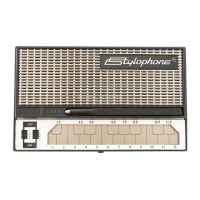
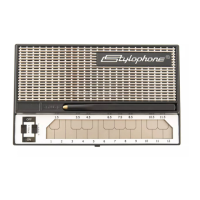
The keyboard is set out in the same way as a piano keyboard, with
the bottom row of notes representing the white keys and the top
row the black keys.
You play by touching the tip of the stylus on to a note or your
nger/stylus on the sound strip.
To remove the stylus simply press on the right end and lift gently
to release, TAKE CARE not to damage the connection wire!
The sound strip above the keyboard can be played with either the stylus
or your nger. When played, it will override any playing of the keyboard.
PLEASE NOTE: You need to press down on the sound strip for it to work.
Question and Answer IconNeed help?

Do you have a question about the Dubreq Stylophone Gen X-1 and is the answer not in the manual?

Summary

Envelope Controls Explained

Envelope Attack

Controls how quickly the frequency fades in for pitch or filter.

Envelope Pitch Modulation

Determines how much the envelope affects the oscillator's pitch.

Envelope Decay

Controls how quickly the frequency fades out after the attack.

Low Frequency Oscillator (LFO)

Filter Controls Explained

Delay Effect Controls

Additional Controls and Features

Side Controls and Tuning

Tuning Procedure

Steps to re-tune the analog instrument using pitch and trim dials.

Pitch Adjust Control

Fine-tunes the overall pitch of the sound on the underside.

Safety and Operating Information

Battery Handling and Disposal

Guidelines for safe battery insertion, usage, and proper disposal.

General Precautions

Advice on protecting the unit from liquids, dust, and mechanical stress.

Hearing Damage Warning

Caution against listening at high volumes for extended periods.

Overview

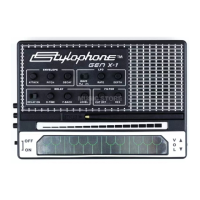
The Stylophone Gen X-1 is a portable analog synthesizer, a modern iteration of the classic Stylophone, designed for both beginners and experienced musicians. Its compact size and battery operation (4x AA batteries) make it highly portable. The device features a unique playing interface: a metal keyboard and a soundstrip, both played with a stylus or a finger. The keyboard allows for distinct notes, similar to a piano, while the soundstrip enables smooth glissandos between notes. A fine-tuning dial on the underside of the unit allows for precise pitch adjustment, addressing the analog nature of the instrument which can be susceptible to temperature and humidity changes.

The Gen X-1 offers a rich set of sound-shaping controls, categorized into several modules:

Envelope: This module controls the amplitude and pitch evolution of the sound.

  • ATTACK: Determines how quickly the frequency (and optionally pitch) fades in.
  • PITCH: Controls how much the envelope also influences the oscillator's pitch. When set to zero, attack and decay only affect the filter.
  • DECAY: Determines how quickly the frequency (and optionally pitch) fades out. By manipulating these controls, users can create sounds ranging from abrupt, percussive tones to slow, evolving pads.

Low-Frequency Oscillator (LFO): This module introduces modulation to the sound, affecting the pitch and other parameters.

  • WAVE: Selects the LFO waveform, either square (for abrupt jumps in pitch) or triangle (for smooth rises and falls in pitch).
  • RATE: Controls the speed of the LFO, determining how many waves are heard per second.
  • DEPTH: Adjusts the intensity of the LFO effect, creating more pronounced peaks and troughs in the modulated sound. The LFO can be applied to the oscillator's pitch and the frequency of Pulse Width Modulation (PWM).

Filter: A Low Pass Filter (LPF) is included to shape the tonal characteristics of the sound.

  • CUT OFF: Determines the frequency point above which higher frequencies are attenuated.
  • RESONANCE: Boosts the frequencies around the cut-off point, creating a more pronounced, sometimes "wah-like" effect. This filter allows users to sculpt the timbre, from bright and open sounds to dark and muffled tones, mimicking how physical barriers affect sound in the real world. If no sound is heard, turning the Cut Off knob to the middle is recommended.

Delay: This module adds a repeating, decaying echo to the sound, creating a sense of space and atmosphere.

  • DELAY ON: Activates or deactivates the delay effect.
  • D-TIME: Controls the time interval between the initial signal and subsequent echoes.
  • F-BACK (Feedback): Determines the number of echoes, creating multiple repetitions.
  • E-LEVEL (Echo Level): Adjusts the volume of the echo relative to the dry signal. This feature can simulate various environments, from small rooms with short, quick echoes to large caves with long, reverberating tails.

PWM & Sub-Octave: These options enrich the sound by adding additional harmonic content.

  • X (PWM): Adds Pulse Width Modulation, creating a chorus-like effect where two oscillators appear to play together. The LFO controls the frequency of the PWM.
  • -1 (Sub-Octave): Adds a frequency one octave lower than the source sound.
  • -2 (Sub-Octave): Adds a frequency two octaves lower than the source sound. These features allow for thicker, more complex, and deeper sounds.

Connectivity:

  • LINE-IN (3.5mm mini jack): Allows external audio sources (e.g., guitar, voice) to be processed through the Gen X-1's LFO, filter, and delay effects.
  • LINE-OUT (3.5mm mini jack): Provides an audio output for connecting to headphones or external recording devices, enabling users to record their analog sounds digitally.

Maintenance and Safety:

The device requires 4x AA batteries. Proper battery handling is crucial: use only recommended battery types, observe polarity, remove exhausted batteries, and dispose of them correctly according to national and regional legislation. Do not mix old and new batteries or different types. The unit should not be exposed to liquids, excessive smoke, dust, mechanical vibration, or shock. Users are advised not to open the product beyond the battery compartment or tamper with internal components, as this will void the warranty. In case of damage, contact customer service. When using headphones, avoid high volume levels for extended periods to prevent hearing damage. The stylus cable should be handled with care to avoid damage. Cleaning should be done with a dry, soft cloth, avoiding liquids, alcohol, or solvents.

The Stylophone Gen X-1 is a versatile and fun instrument that builds on the legacy of the original Stylophone, offering a wide range of sound design possibilities in a portable package. Its intuitive controls and unique playing style make it accessible for experimentation and creative expression.

Dubreq Stylophone Gen X-1 Specifications

General IconGeneral
BrandDubreq
ModelStylophone Gen X-1
CategorySynthesizer
LanguageEnglish

Related product manuals