The Duplomatic EDM-M*/30 Digital Card is a versatile amplifier designed for controlling proportional valves, suitable for DIN EN 50022 rail mounting. It comes in three main versions: M1 for a single proportional valve with one solenoid, M2 for a single proportional valve with two solenoids, and M3 for two independent proportional valves, each with one solenoid. The M3 version is capable of managing two different types of valves. This digital card ensures that the current supplied to the solenoid is consistent, regardless of temperature fluctuations or load impedance, by adjusting parameters like maximum current, PWM, and dither.
Function Description:
The EDM-M*/30 card processes reference signals to generate a proportional current output for the solenoids. It supports both unipolar voltage (0-10V) and current (4-20mA) signals for the M1 version, and bipolar voltage (±10V) or current (4-20mA) signals for the M2 version, which controls two solenoids for a single valve. The M3 version requires both analog inputs to be used for its two independent channels.
Key functionalities include:
- Ramps: Configurable ramp-up and ramp-down times for smooth valve operation, with separate settings for each quadrant in the M2 version and for each channel in the M3 version.
- Deadband Compensation: The card can compensate for the valve's deadband using the 'MIN' value, and the 'TRIGGER' parameter sets the activation point for this function, defining a non-sensitive range around the zero-point.
- Scaling of Analog Inputs: Input signals can be scaled using 'SIGNAL_OFFSET' and 'SIGNAL_GAIN' parameters to match application requirements.
- PWM and Dither Settings: Separate PWM and dither settings are available for each channel in the EDM-M3 version, allowing fine-tuning of valve response. Dither amplitude is defined as a percentage of the nominal current, and its frequency has an upper limit of half the selected PWM frequency.
- Enable Signal: Version A cards feature an external enable input (PIN 12) to activate the power stage, while version B cards have an internal enable logic.
- Fault Recognition: The card monitors for cable breaks, short-circuits, and out-of-range signals, deactivating the power stage or output in case of a fault.
Important Technical Specifications:
- Power Supply (Ub): 9 ÷ 36 V DC (ripple included).
- External Fuse: 6A medium time lag.
- Power Consumption: Max 60 W.
- Output Current: Max 4.5 A.
- PWM Output Current: 200 ÷ 4000 mA (step less).
- PWM Frequency: 100-500 Hz.
- Analog Input: 4 ÷ 20 mA (Ri = 56 ohm), ±10 differential signal (Ri = 11 kohm), 0 ÷ 10 V (Ri = 11 kohm).
- Input Resistance: 17 kohm.
- Digital Input: Logic 0: <5 V, Logic 1: >8 V.
- Digital Output: Logic 0: <2 V, Logic 1: max Ub.
- Auxiliary Voltage Output: +10 V, -10 V, 0 V reference (for potentiometers).
- Control Time: 2-10 ms (according to PWM used).
- Interface: Micro USB-B.
- Electromagnetic Compatibility (EMC): According to 2014/30/EU.
- Housing Material: ABS.
- Connections: Plug-in terminal block with tightening screws (15 poles).
- Operating Temperature Range: -20 / +70 °C.
- Protection Degree: IP 20.
Usage Features:
- Software Configuration: The card's parameters are configured via the EBC software on a PC or the EBC app on Android devices. This allows for comprehensive parameterization, diagnostic tasks, and advanced oscilloscope functions.
- Micro USB Connector: Eliminates the need for a serial converter, simplifying connectivity. The board can be powered directly via USB for programming, though a separate power supply is needed to energize the valve simultaneously.
- Parameter Access Levels: Parameters are initially in read-only mode. Accessing "User" level configuration requires specific credentials (Login: USR, Pwd: Dol732).
- Diagnostic LEDs: Front panel LEDs provide a quick visual check of card operation, indicating power status, signal presence, coil status (open/short circuit), and overall card health.
- Compatibility: 100% compatible with the previous EDM-M/20 version, particularly the EDM-M*/30E*-B model with internal enable management.
Maintenance Features:
- EBC Software/App: Facilitates immediate diagnostic and configuration activities, allowing users to save and import parameter sets for quick card replacement and reduced start-up times.
- Fault Monitoring (DIAGNOSTICS): The module's monitoring functions can be set to ENABLE (active with manual reset), AUTO (active with automatic reset), or DISABLE (no monitoring). This helps in troubleshooting and ensuring reliable operation.
- Process Data Monitoring: Variables like command values, output currents, current errors, PWM duty cycles, and board temperatures can be continuously observed on the monitor or oscilloscope for detailed analysis and maintenance.
- Read-Only Parameters: Parameters like 'OEM_INFO', 'BOARD_CONFIGURATION', 'RESIST', and 'CURRENT_LIM' are read-only, providing essential information about the card and coil characteristics as set by the manufacturer.

 Need help?
 General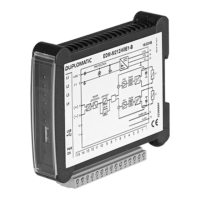

 To Next Page