The LPR-200 is an in-motion belt scale system designed for weighing bulk materials transported on conveyor systems. It is used for weighing, recording, and controlling the amount of instantaneous flow and total amount of bulk material in powder, granule, particle, and part structure, especially in Mining, Building Materials and Chemicals, Food and Energy sectors.
Technical Specifications:
- Display: 1.8" 160x128 pixel graphic color LCD
- Encoder Input: 0-3 kHz, 1kHz signal range
- Loadcell Input: 0-350 Ohm (Maximum 10 Loadcells)
- Resolution: 24bit
- Weighing Speed: 3840 samples/second
- Loadcell Excitation: 5VDC
- Digital Inputs: 8 optically isolated digital inputs, 8pcs 24V/1A max.
- Analog Outputs: 0-10V, 4-20mA
- Communication: 1xRS232, 1xRS485, 1xRS232 Tx only (Standard Modbus RTU/ASCII)
- Operating Temperature: -20 to 70°C
- Power Supply: 24VDC +/- %20
- Case: Ray mount 104x100mm metal case, Din-Rail mount 104x100mm metal case
Function Description:
The LPR-200 offers comprehensive functionality for belt scale operations. It supports up to 3 different totalizers (Total1, Total2 and Total3) with +/- 0.5% (20-100% flowrate) US accuracy. It can handle up to 1kHz encoder inputs and 1kHz loadcell inputs, providing accurate measurements of flowrate (t/h), spreading load (kg/m), and totalized weight. The device performs 3840 measurements per second and supports Modbus RTU/ASCII or ModbusTCP-PROFINET options for data communication. Batching with specified quantities of material is possible, along with adjustable periodic pulse output and 0-10V/4-20mA analog output. Remote display output and PID control output (WF Only) are also available.
Usage Features:
- Calibration: The LPR-200 supports various calibration methods, including belt revolution time, zero calibration, and load calibration. The belt revolution time is crucial for accurate measurements, and the system allows for up to 3 full revolutions for calibration. Zero calibration ensures the belt's empty weight is accounted for, and load calibration involves placing known weights on the belt to verify accuracy.
- Device Settings: The device offers extensive settings for customization. Users can select the language (Turkish/English), set the decimal point position, adjust the backlight intensity (0-99%), and configure the screen timeout. Password protection is available for menu access, with default passwords for Total1, Total2, and Total3.
- Loadcell Settings: The system allows for configuration of the loadcell's mV/V value, maximum capacity, and minimum/maximum flowrate. It also includes features for checking loadcell status (mV/V) to ensure proper operation and detect potential issues like over-tensioned or mechanically contacted belts.
- Encoder Settings: The encoder step value can be adjusted to match the mechanical position of the encoder to the belt. This ensures accurate speed measurements, which are critical for flowrate calculations.
- Digital Inputs/Outputs: The LPR-200 has configurable digital inputs for functions like encoder input, batch control, totalizing, and automatic control. Digital outputs can be configured for mechanical counter, batching output, error output, and warning output.
- Analog Inputs/Outputs: Analog inputs can be used for 0-10V or 4-20mA signals, while analog outputs provide 0-10V or 4-20mA signals for external control or monitoring.
- Communication: The device supports RS232 and RS485 serial communication, with configurable baud rates (1200-115200bps) and functions (t/h, m/s, kg/m, Modbus).
Maintenance Features:
- Periodic Maintenance: Regular periodic maintenance is crucial for optimal performance. This includes checking the height of the weighing roller and ensuring the belt is centered. The system provides guidance on how to perform these checks and adjustments.
- Zero Calibration: Periodic zero calibration is essential to maintain accuracy. This involves ensuring the belt is empty and performing a calibration to account for any changes in the belt's empty weight. The device allows for multiple zero calibrations and provides feedback on the calibration status.
- Coefficient Calculation & Entry: The LPR-200 calculates coefficients (Coefficient1 and Coefficient2) based on the total amount of material measured during calibration. These coefficients are used to convert raw sensor data into accurate weight and flowrate measurements. The device allows for manual entry of these coefficients if needed.
- Service Menu: A dedicated service menu provides access to test functions for the loadcell, encoder, and outputs. This allows for quick diagnostics and troubleshooting of the system's components.
- Firmware Updates: The device supports firmware updates via a PC connection, ensuring that the system can be kept up-to-date with the latest features and improvements.

 Need help?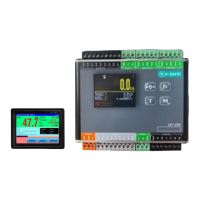

 To Next Page
 General