
 Need help?
Do you have a question about the Eastwood 30551 and is the answer not in the manual?
Thoroughly read and understand this instruction manual before using.
Highlights hazards like weight, pinch points, surface requirements, and load limits.
Steps for preparing the hydraulic wheel dollies for use, including purging air.
Instructions for positioning and lifting a vehicle using the hydraulic wheel dollies.
Procedure for safely lowering a vehicle supported by the hydraulic wheel dollies.
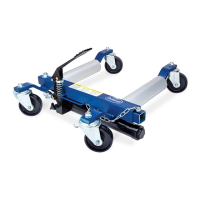
The Eastwood Hydraulic Wheel Dollies are a pair of robust tools designed to facilitate the safe, convenient, and secure maneuvering of vehicles. Their primary function is to allow a vehicle to be moved around on a flat, clean, and level floor in any direction, making them particularly useful for vehicle storage in confined or limited space areas. The foot-pedal operated hydraulic lifting design is a key feature, as it virtually eliminates the effort typically required for jacking a vehicle.
The core function of these dollies is to lift a vehicle's wheels off the ground and enable omnidirectional movement. Each dolly is equipped with rollers that spread apart to accommodate a tire, and a hydraulic mechanism, activated by a foot pedal, then lifts the tire. Once lifted, the vehicle can be easily pushed or pulled to its desired location. The dollies are designed to work in pairs, with best results achieved when using four dollies to lift all four wheels of a vehicle. A release valve allows for controlled lowering of the vehicle. The hydraulic system can be purged of air and refilled with hydraulic oil, ensuring consistent performance.
Before initial use, or if performance is diminished, the dollies may need to be purged of air. This involves turning the release valve counter-clockwise to open it, removing the lock pin, and carefully pushing the rollers to their fully open position. It's crucial not to allow the rollers to move inward with the release valve open. The foot pedal should then be slightly depressed to release the foot pedal lock, being mindful of the spring tension. Operating the foot pedal through 5 to 10 full strokes helps to purge air. Finally, the release valve is closed by rotating it clockwise.
When lifting a vehicle, the rollers should be spread apart, and the dolly rolled into place so that the rollers are positioned at the tire tread, both ahead of and behind the wheel. A critical caution is to ensure that no part of the wheel dolly frame contacts the tire sidewall, maintaining a minimum of 1 inch (25mm) between the sidewall and frame to allow for tire flex under load. The release valve must be securely closed before lifting. The foot pedal is then repeatedly depressed until the rollers begin to apply pressure to the tire. It's important to re-check for tire sidewall contact with the frame at this point. Continued depression of the foot pedal will lift the tire tread from the floor. Once lifted, the foot pedal lock is engaged, and the lock pin is placed in the nearest open retaining hole to secure the jack in the raised position. This process is repeated for all remaining wheel dollies. With the vehicle lifted, it can then be pushed to the desired location.
To lower the vehicle, the foot pedal is slightly depressed to release the foot pedal lock, and the lock pin is removed. If necessary, the foot pedal may need to be pumped slightly to release pressure on the lock pin. The release valve knob is then slowly turned counter-clockwise to open it. The vehicle's weight will cause the rollers to spread apart, allowing the vehicle to lower until the tire tread contacts the floor. After lowering, the dolly is pulled away from the wheel, and the foot pedal lock is replaced to keep the foot pedal in place.
Regular maintenance is essential to ensure the longevity and optimal performance of the hydraulic wheel dollies. Pivot points should receive several drops of oil periodically to prevent binding. The sliding components require lubrication with a heavy-bodied chassis or wheel bearing grease. It's important to keep all areas of the dolly clean, with particular attention to the hydraulic ram and sliding frame components. Before each use, a thorough check of all hardware for tightness is recommended. Additionally, all components should be inspected for damage, hydraulic fluid leaks, and any rust or dirt on moving parts. When not in use, the dollies should be stored in a clean and dry environment. To prevent rust formation, all machined surfaces should be coated with a light lubricant film of oil or a suitable protectant.
Troubleshooting for common issues like failure to lift when jacking often points to air in the hydraulic system or a low hydraulic fluid level. To remove air, the process is similar to the initial setup: open the release valve, spread the rollers fully apart (without allowing them to move inward), and operate the foot pedal through 5 to 10 full strokes before closing the release valve. For low hydraulic fluid, with the dolly on a level surface and rollers fully apart, the oil fill plug (Phillips Head) on the side of the cylinder should be removed. The oil level should be even with the bottom of the fill hole. Only a high-quality hydraulic jack oil should be used, as other types can seriously damage the pump seals. A small funnel can be used to fill the oil to the correct level. If binding of moving parts occurs, cleaning any grit or debris and lubricating all moving parts is necessary. An inspection for broken, bent, rusted, or otherwise damaged components of the dolly is also advised.
 General
| Product Name | Eastwood 30551 |
|---|---|
| Category | Outdoor Cart |
| Material | Steel |
| Wheel Type | Pneumatic |
| Number of Wheels | 4 |

 To Next Page