EasyManua.ls Logo

EasyLine RM-208 CB.13.01 - User Manual

Default Icon
16 pages
Print Icon
To Next Page IconTo Next Page
Loading...
Operating and Installation Instructions
Filter control system
RM-208 CB.13.01
EasyLine
Supply voltage 110 V AC

Questions and Answers

Summary

Safety Instructions

Equipment Specification

Assembly

Step-by-Step Installation

Supply Voltage Connection

Details the wiring diagram for connecting the 110 V AC supply voltage to the RM-208 CB.

Solenoid Valve Connection

Illustrates the terminal connections for solenoid valves (-Y1 to -Y8) on the RM-208 CB.

Expansion Module Connection

Shows how to connect RM-LV8 or RM-LV16 expansion modules to the RM-208 CB for additional valve control.

Other Connections

Details connections for alarm output, extractor element control, down-time cleaning input, and start/stop input.

Connection Guidelines

Guidelines for power disconnection device, cable suitability, shielding, signal/power cable routing, and cable gland usage.

Step-by-Step Settings

Function When Shipped

Explains the default factory settings, including bridged down time cleaning input and automatic valve control sequence.

Setting Parameters

Provides a step-by-step guide on how to access, view, change, and store parameters using the device buttons.

Parameter List

Operating Modes

Test Mode

Describes different test modes (Valve test, Input test, Test mode off) for checking system functions.

Down Time Cleaning

Explains how to activate and configure down time cleaning using inputs and parameter settings.

Cleaning via Start;Stop Input

Details how to connect and use an external Ap switch for controlling the cleaning process via a start/stop input.

Troubleshooting

Device Fuse Replacement

Step-by-step instructions for safely replacing the device fuse, including precautions and visual aids.

Cleaning the Controller

Manufacturing Information

Display Text Messages

Equipment Function Details

Cleaning Sequence

Explains the cleaning sequence, interruption handling, and restart behavior after mains voltage failure.

Extractor Element Relay Output

Describes the use of relay outputs 8 and 9 for controlling extractor elements during cleaning cycles.

Alarm Relay Output

Details the behavior of the 'Alarm' relay outputs (5, 6, 7) under different fault or operational conditions.

Glossary

Technical Specifications

Overview

The RM-208 CB.13.01 EasyLine is a filter control system designed to manage 24 V DC solenoid valves in filtering separators that utilize compressed air pulse cleaning. Once connected to the supply voltage, the system operates fully automatically without requiring further activation.

Function Description:

The primary function of the RM-208 CB is to control the cleaning process of filter elements using compressed air pulses. It can detect and control up to 128 valves, either directly or through expansion modules. The system supports various operating modes, including a standard operation mode where solenoid valves are controlled consecutively, and a test mode for checking system functions.

Operating Modes:

  • Standard Operation: When the supply voltage is applied and the down-time cleaning input (terminals 10, 11) is bridged, the system automatically detects connected valves and controls them in sequence.
  • Test Mode: This mode allows for checking critical functions.
    • Valve Test (Test mode 1): Each connected valve is activated sequentially, and its status is displayed.
    • Input Test (Test mode 2): The signal statuses of the inputs are displayed.
    • Test modes 3-5: Reserved for manufacturer purposes.
    • Test mode 0: Disables test mode.
  • Down-time Cleaning: This feature activates cleaning cycles when the fan is switched off. To enable it, the factory-fitted wire jumper on input 10, 11 must be removed, and a free auxiliary contact of the fan contactor connected to these terminals. The number of cleaning cycles can be set via parameter P05.
  • Cleaning via Start/Stop Input (External Δp switch): If cleaning is controlled by an external differential pressure (Δp) switch, its isolated contact must be connected to the start/stop input 12, 13. This input is inactive during down-time cleaning.

Important Technical Specifications:

  • Supply Voltage: 110 V AC, 50-60 Hz.
  • Power Consumption: Max. 53 VA.
  • Back-up Fuse: Max. 4 A.
  • Signal Inputs: 24 V DC, ensuring isolation.
  • Signal Output (Relay): Max. 2 A, 250 V or 1 A, 30 V DC.
  • Control Outputs for Valves: For valves with a rated voltage of 24 V DC. Can be expanded to 120 outputs. Output power in pulse mode 42 Watt.
  • Device Fuse: 0.3 A / M, 5 x 20 mm, 250 V (Type Bell 5MT 300 mA, ESKA UL 521.012).
  • Temperature Range: -20°C to +50°C.
  • Protection Class: Housing IP-66 (not evaluated by UL / Type 5).
  • Installation Torque of Cover Screws: 1.5 Nm.
  • Weight: Approx. 0.8 kg.
  • Installation Height: Max. 2000 m above M.S.L.
  • Electrical Connections: Tension spring terminals.
    • Permissible Wire Gauge: Single-wire: 22...16 AWG / 0.5...1.5 mm². Flexible: 22...16 AWG / 0.5...1.5 mm².
  • Cable Glands:
    • M16x1.5: Sealing range 5...10 mm, Cord diameter range 5.6...10 mm, Installation torque 2.0 Nm.
    • M20x1.5: Sealing range 8...13 mm, Cord diameter range 9...13 mm, Installation torque 2.7 Nm.
    • M25x1.5: Sealing range 11...17 mm, Cord diameter range 13...17 mm, Installation torque 5.0 Nm.

Usage Features:

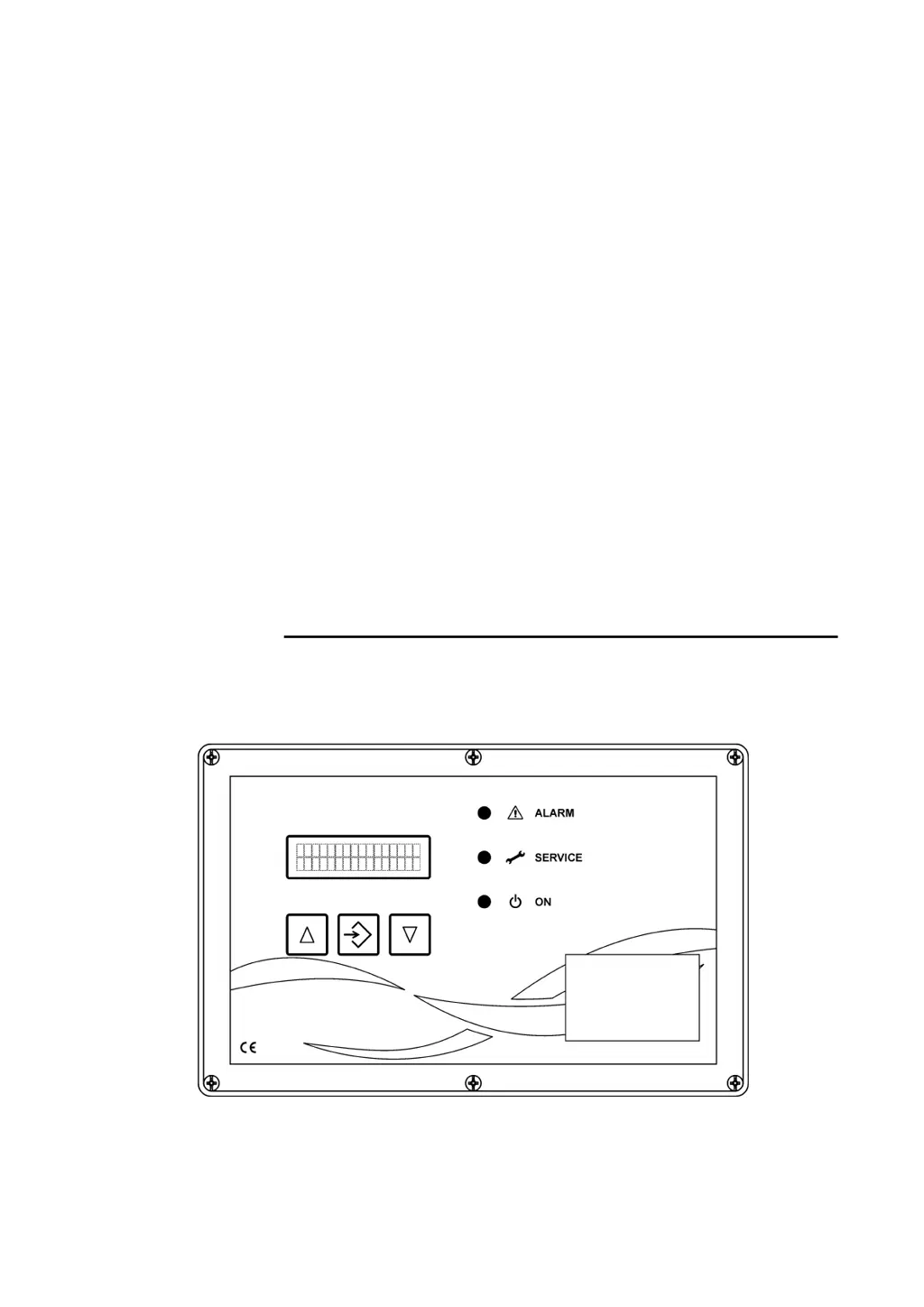
  • Display and Navigation: The device features a two-line text display and buttons for navigation (▲, ▼, ENTER).
  • Parameter Setting: Parameters like pulse time (P01), interval (P02), down-time interval time (P03), total number of valves (P04), down-time cleaning cycles (P05), operating hours (P06), and language (P07) can be adjusted.
  • Alarm Relay Output (5, 6, 7): This relay closes (5, 6) and opens (6, 7) under normal conditions. It reverses in case of supply voltage failure, internal voltage failure, fault in a connected I/O module, or incorrect total number of valves (P04).
  • Extractor Element Control (Relay output 8, 9): Provides an isolated output to control drive units for automatic dust removal components (e.g., cellular wheel sluice, trough conveyor worm) during cleaning and down-time cleaning.
  • Expansion Modules: For systems with more than 8 valves, RM-LV8 (8 valves) or RM-LV16 (16 valves) expansion modules can be connected, allowing for a maximum of 120 valve outputs.

Maintenance Features:

  • Troubleshooting: The manual provides a table of common errors (e.g., "ON" LED not lit, no valve activity, cleaning ineffective, "Alarm" LED on) and their possible causes and recommended actions.
  • Fuse Replacement: Detailed instructions are provided for replacing the device fuse, emphasizing safety precautions like switching off the supply voltage and using only UL listed fuses specified in the technical specifications.
  • Cleaning the Controller: The device should only be wiped with a damp cloth if its exterior is soiled.
  • Service Operating Hours Alarm (P10): An alarm can be configured to trigger when the set operating hours for maintenance are exceeded. This parameter is only displayed if a specific service operating hours code (P11) is entered.
  • Internal Monitoring: The system monitors the total number of valves. If the set value (P04) differs from the actual number of controlled valves, an alarm message is issued.

EasyLine RM-208 CB.13.01 Specifications

General IconGeneral
BrandEasyLine
ModelRM-208 CB.13.01
CategoryControl Systems
LanguageEnglish