EasyManua.ls Logo

Eberline RO-2 - Theory of Operation; General Operation Overview; Functional Theory: Ion Chamber

Default Icon
22 pages
Print Icon
To Next Page IconTo Next Page
To Previous Page IconTo Previous Page
Loading...
-
==
=
`
au
ш
A
MODEL
RO-2
SECTION
HI
THEORY
OF
A.
GENERAL
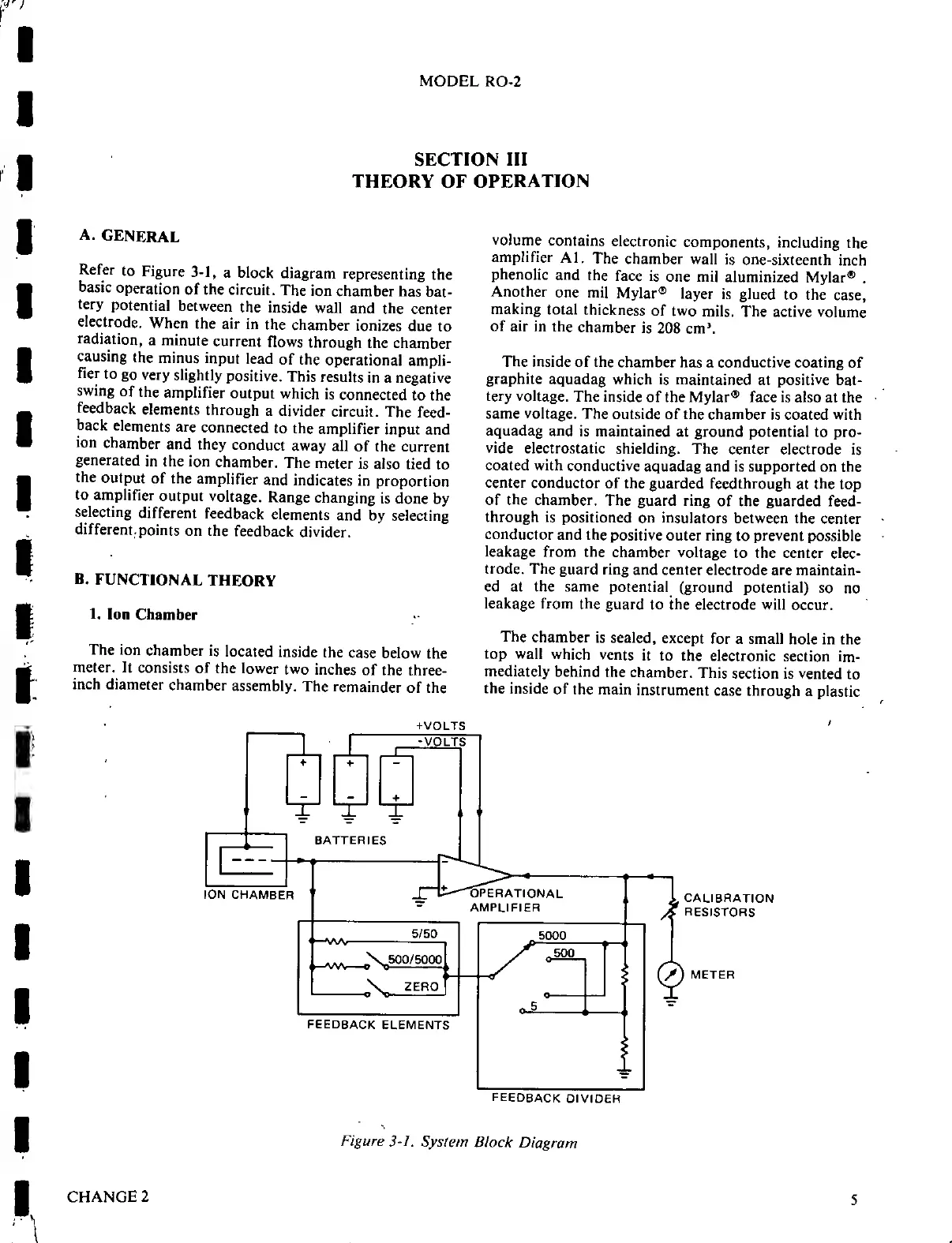
Refer
to
Figure
3-1,
a
block
diagram
representing
the
basic
operation
of
the
circuit.
The
ion
chamber
has
bat-
tery
potential
between
the
inside
wall
and
the
center
electrode.
When
the
air
in
the
chamber
ionizes
due
to
radiation,
a
minute
current
flows
through
the
chamber
causing
the
minus
input
lead
of
the
operational
ampli-
fier
to
go
very
slightly
positive.
This
results
in
a
negative
swing
of
the
amplifier
output
which
is
connected
to
the
feedback
elements
through
a
divider
circuit.
The
feed-
back
elements
are
connected
to
the
amplifier
input
and
ion
chamber
and
they
conduct
away
all
of
the
current
generated
in
the
ion
chamber.
The
meter
is
also
tied
to
the
output
of
the
amplifier
and
indicates
in
proportion
to
amplifier
output
voltage.
Range
changing
is
done
by
selecting
different
feedback
elements
and
by
selecting
different.points
on
the
feedback
divider.
B.
FUNCTIONAL
THEORY
1.
Ion
Chamber
The
ion
chamber
is
located
inside
the
case
below
the
meter.
It
consists
of
the
lower
two
inches
of
the
three-
inch
diameter
chamber
assembly.
The
remainder
of
the
*VOLTS
ION
CHAMBER
FEEDBACK
ELEMENTS
|
OPERATIONAL
OPERATION
volume
contains
electronic
components,
including
the
amplifier
A1.
The
chamber
wall
is
one-sixteenth
inch
phenolic
and
the
face
is
one
mil
aluminized
Mylar®
,
Another
one
mil
Mylar?
layer
is
glued
to
the
case,
making
total
thickness
of
two
mils.
The
active
volume
of
air
in
the
chamber
is
208
ст.
The
inside
of
the
chamber
has
a
conductive
coating
of
graphite
aquadag
which
is
maintained
at
positive
bat-
tery
voltage.
The
inside
of
the
Mylar?
face
is
also
at
the
``
same
voltage.
The
outside
of
the
chamber
is
coated
with
aquadag
and
is
maintained
at
ground
potential
to
pro-
vide
electrostatic
shielding.
The
center
electrode
is
coated
with
conductive
aquadag
and
is
supported
on
the
center
conductor
of
the
guarded
feedthrough
at
the
top
of
the
chamber.
The
guard
ring
of
the
guarded
feed-
through
is
positioned
on
insulators
between
the
center
conductor
and
the
positive
outer
ring
to
prevent
possible
leakage
from
the
chamber
voltage
to
the
center
elec-
trode.
The
guard
ring
and
center
electrode
are
maintain-
ed
at
the
same
potential
(ground
potential)
so
no
leakage
from
the
guard
to
the
electrode
will
occur.
The
chamber
is
sealed,
except
for
a
small
hole
iri
the
.
top
wall
which
vents
it
to
the
electronic
section
im-
mediately
behind
the
chamber.
This
section
is
vented
to
the
inside
of
the
main
instrument
case
through
a
plastic
Й
CALIBRATION
AMPLIFIER RESISTORS
FEEDBACK
DIVIDER
Figure
3-1.
System
Block
Diagram
CHANGE
2
r

Related product manuals