EasyManua.ls Logo

Eberline RO-2 - Functional Theory: Amplifier, Meter, and Range Switching

Default Icon
22 pages
Print Icon
To Next Page IconTo Next Page
To Previous Page IconTo Previous Page
Loading...
MODEL
КО-2
hose
connected
to
а
drying
box
filled
with
silica
gel
`
desiccant.
In
this
way,
any
air
drawn
into
the
chamber
(caused
by
atmospheric
pressure
changes,
temperature
changes,
transporting
RO-2
by
air,
etc.)
must
first
pass
over
the
drying
desiccant.
Dry
air
in
the
chamber
is
necessary
to
help
prevent
leakage.
An
idealized
air
chamber,
the
size
of
the
one
used
on
the
Model
RO-2,
produces
approximately
1.93
x
1071
A
-
per
mR/h
at
standard
temperature
and
pressure.
(STP
is
0
°С
and
sea
level
pressure
of
760
mm
of
Hg.)
At
5
mR/h
it
should
produce
9.65
x
10“
A
and
at
5000
mR/h
it
should
produce
9.65
x
107"
A.
It
is
seen
that
at
full
scale
on
the
most
sensitive
range
(5
mR/h),
less
than
one-tenth
of
а
micro-microamp
is
produced
in
the
chamber,
which
makes
protection
against
leakage
current
paramount.
The
silica
gel
desiccant
should
be
changed
as
soon
as
it
shows
any
clear
or
pink
crystals.
The
positive
voltage
supplied
to
the
inside
chamber
wall
is
provided
by
a
separate
battery,
BT3.
This
battery
does
not
power
any
other
circuit
but
the
chamber
and,
therefore,
its
current
drain
is
insignificant
and
its
life
is
indefinitely
long
(shelf
life).
For
this
reason,
it
is
not
checked
by
the
battery
checking
circuits.
2.
Operational
Amplifier
(See
Figure
6-1)
Operational
amplifier
A1
is
contained
in
a
single
TO-5
size
transistor
package
located
in
the
top
of
the
chamber
assembly.
It
has
dual
MOS
FET
inputs
which
result
in
a
very.
high
input
impedance
on
the
order
of
10"
Q.
Noninverting
input
pin
3
is
connected
to
ground
and
the
other
input,
pin
2,
is
connected
to
the ion
chamber
center
electrode
and
the
feedback
elements.
The
output
of
amplifier
pin
6
feeds
the
meter
circuit
and
the
feed-
back
circuit.
When
ion
chamber
current
flows
toward
the
amplifier
input
at
pin
2,
the
input
becomes
slightly
more
positive
which
causes
the
output
to
go
more
negative,
This
negative
output
of
the
amplifier
draws
a
current
from
one
of
the
feedback
elements
to
exactly
match
the
amount
of
current
the ion
chamber
is
contributing.
If
a
higher
ion
chamber
current
occurs,
the
amplifier
must
produce
a
higher
voltage
across
the
feedback
element
to
draw
off
the
current.
In
this
way,
the
amplifier
voltage
output
is
proportional
to
the
rate
of
radiation
in
the
chamber.
3.
Meter
Circuit
The
meter
is
driven
directly
from
the
output.
of
amplifier
pin
6,
through
dropping
resistor
R8
and
one
of
four
calibrating
resistors
R9
through
R12.
Nominal-
ly,
the
meter
reaches
full
scale
on
all
ranges
at
approx-
imately
the
same
voltage
output
from
the
amplifier.
The
four
calibrating
resistors
allow
for
manufacturing
tolerances
in
various
components
and
provide
for
calibration
at
various
elevations
and
temperatures.
Function
switch
51,
section
C,
determines
which
calibration
resistor
is
in
the
circuit.
Capacitor
C4
sets
the
time
constant
for
the
meter
circuit.
4.
Range
Switching
The
range
that
the
Model
RO-2
is
operating
on
depends
entirely
on
the
feedback
circuitry
between
the
output
of
the
amplifier
and
the
amplifier
input,
pin
2,
which
is
connected
to
the
ion
chamber.
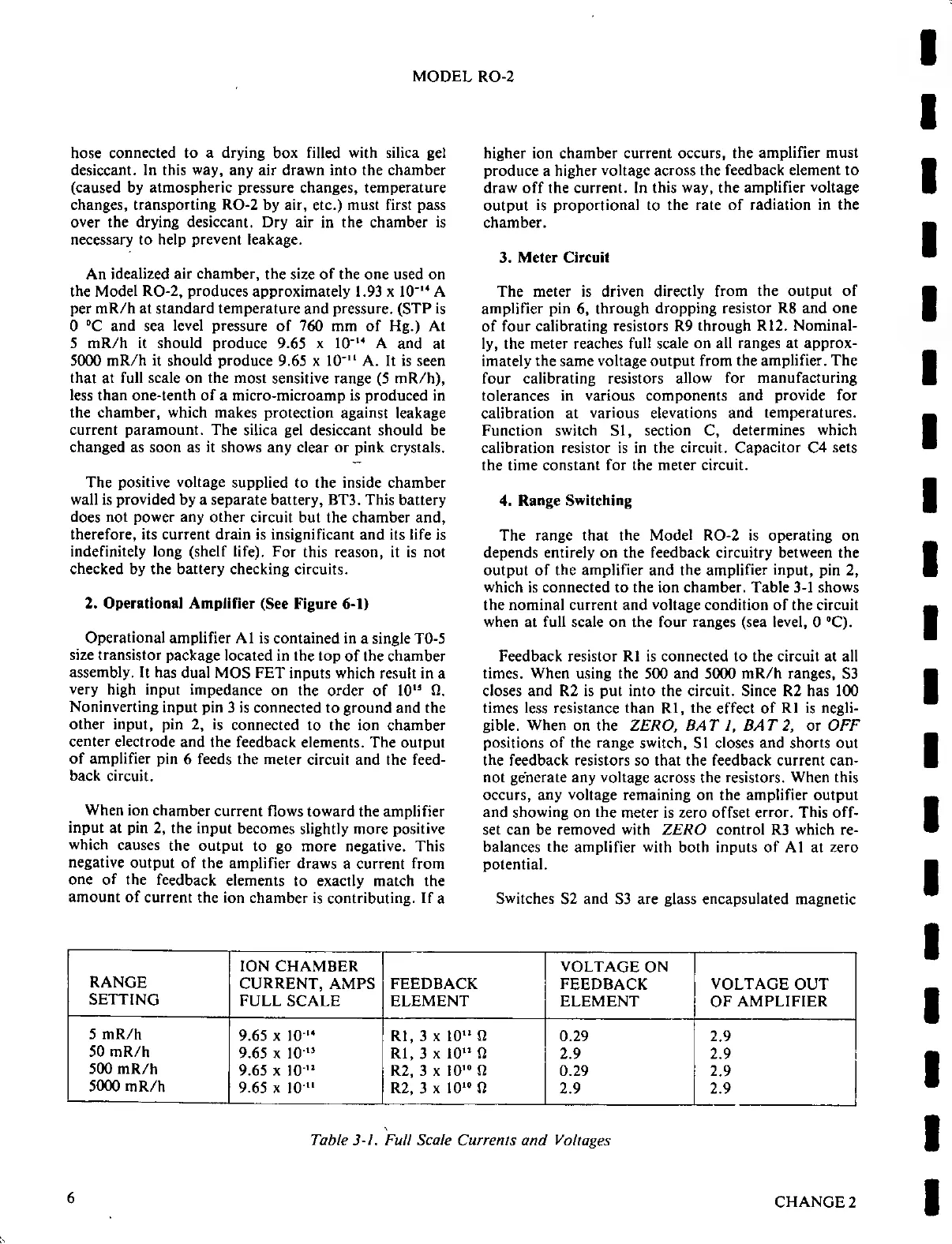
Table
3-1
shows
the
nominal
current
and
voltage
condition
of
the
circuit
`
when
at
full
scale
on
the
four
ranges
(sea
level,
0
°С).
Feedback
resistor
КІ
is
connected
to
the
circuit
at
all
times.
When
using
the
500
and
5000
mR/h
ranges,
S3
closes
and
R2
is
put
into
the
circuit.
Since
R2
has 100
`
times
less
resistance
than
КІ,
the
effect
of
КІ
is
negli-
gible.
When
on
the
ZERO,
BAT
1,
BAT
2,
or
OFF
positions
of
the
range
switch,
S1
closes
and
shorts
out
the
feedback
resistors
so
that
the
feedback
current
can-
not
generate
any
voltage
across
the
resistors,
When
this
occurs,
any
voltage
remaining
on
the
amplifier
output
and
showing
on
the
meter
is
zero
offset
error.
This
off-
set
can
be
removed
with
ZERO
control
R3
which
re-
balances
the
amplifier
with
both
inputs
of
Al
at
zero
potential.
Switches
S2
and
S3
are
glass
encapsulated
magnetic
ION
CHAMBER
VOLTAGE
ON
RANGE
CURRENT,
AMPS
|
FEEDBACK
FEEDBACK
VOLTAGE
OUT
SETTING
FULL
SCALE
ELEMENT ELEMENT
OF
AMPLIFIER
5
mR/h
9.65
х
10:45
КІ,
3
x
10
Q
2.9
50
mR/h
9.65
x
1075
R1,
3
x
10”
Q
2.9 2.9
i
500
mR/h
9.65
x
107:
R2,
3
x
10
Q
0.29
2.9
5000
mR/h
9.65
x
10!
R2,3x
10"
Q
2.9 2.9
Table
3-1.
Full
Scale
Currents
and
Voltages
CHANGE
2

Related product manuals