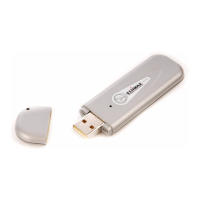
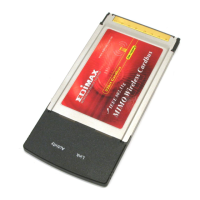
This document describes the 802.11g Wireless LAN PCI Card, a device designed to provide high-speed wireless network connectivity for desktop computers. The card adheres to the IEEE 802.11g standard, enabling wireless network connections at speeds up to 54Mbps. It also maintains compatibility with older IEEE 802.11b devices, allowing for connections at speeds up to 11Mbps when interacting with such hardware.
The primary function of this PCI card is to facilitate wireless communication for a desktop computer, integrating it into a Wireless Local Area Network (WLAN). It supports various security protocols to ensure data privacy and network integrity.
Usage Features:
The card is designed for straightforward installation and configuration, making it accessible for users to establish wireless connectivity.
- Wireless Connectivity: The core function is to connect a desktop computer to a wireless network, whether it's an infrastructure network (connecting to an Access Point or Router) or an Ad-Hoc network (connecting directly to other wireless stations).
- High-Speed Data Transfer: With support for up to 54Mbps, the card is suitable for applications requiring significant data bandwidth, including multimedia streaming.
- Security Protocols: The card incorporates robust security features to protect wireless communications from unauthorized access and eavesdropping.
- WEP (Wired Equivalent Privacy): It supports both 64-bit and 128-bit WEP data encryption, a foundational security mechanism for wireless networks.
- WPA (Wi-Fi Protected Access): This advanced security feature combines IEEE 802.1x authentication and TKIP (Temporal Key Integrity Protocol) technologies. WPA requires client users to authorize before accessing APs or AP Routers, and it dynamically changes encryption keys for enhanced data security.
- WPA-PSK (Pre-Shared Key): For home and small business users without dedicated authentication servers, WPA-PSK allows manual entry of a shared password on the access point/gateway and all wireless stations. This ensures that only devices with the matching password can join the network, with data encrypted using TKIP or AES.
- AES (Advanced Encryption Standard): The card features a built-in AES engine, representing the highest degree of security and authenticity for digital information, as defined by IEEE 802.11i.
- Detachable Antenna: The inclusion of an external detachable dipole antenna with a long cable offers flexibility in antenna placement, allowing users to optimize signal reception and transmission.
- Automatic Fallback: This feature enhances data security and reliability by automatically adjusting the data rate to maintain a stable connection, even in challenging wireless environments.
- Power Saving Modes: The card offers several power-saving modes, which can be customized by the user. This is particularly beneficial for reducing power consumption when the card is idle, or for automatically switching to active mode when the desktop computer is powered by AC.
- Configuration Utility (RaConfig): A powerful software application is provided to manage and monitor the PCI card.
- Site Survey: This utility scans all available wireless networks within range, displaying their SSID, BSSID, signal strength, channel, encryption, authentication, and network type. Users can connect to any listed network or add them to a profile list.
- Profile Management: Users can create, edit, delete, and activate profiles for frequently accessed networks, storing settings like profile name, SSID, channel, and security configurations.
- Link Status Monitoring: The utility provides real-time information about the current network connection, including the SSID, MAC ID, radio channel, frequency, current transmission rate, throughput (Tx/Rx Kbits/sec), link quality, and signal strength (with an option to display in dBm).
- Statistics Tracking: Detailed statistics on transmitted and received frames are available, including successful transmissions, retries, errors, and duplicate frames. These counters can be reset.
- Advanced Settings: Users can configure advanced parameters such as:
- Wireless Mode: Options include "802.11 B/G mix" (default, recommended for mixed networks) and "802.11 B only" (for networks with only 802.11b devices).
- Tx Burst: Enables improved throughput performance.
- B/G Protection: A mechanism to reduce data collision rates in mixed 802.11b/g networks, with "Auto," "On," and "Off" options.
- ADHOC_OFDM: Allows for 54Mbps data rates in Ad Hoc mode, which is typically limited to 11b data rates.
- Tx Rate: Manual selection of transmission rates (Auto, 1/2/5.5/11/6/9/12/18/24/36/48/54Mbps) or automatic selection for optimal performance.
- Turn Off RF Button: Temporarily disables the card's radio.
- About Section: Provides information about the wireless chipset vendor, driver version, utility version, EEPROM version, and the card's MAC address.
- Operating System Support: The card is compatible with popular Windows operating systems, including Windows 98SE, Me, 2000, and XP.
Maintenance Features:
The manual outlines several aspects related to maintaining optimal performance and troubleshooting common issues.
- Driver and Utility Management: Users are advised to uninstall older versions of the driver and utility before installing new ones to prevent conflicts and ensure proper operation.
- Troubleshooting Guide: The manual includes a section dedicated to common questions and solutions, addressing topics such as:
- IEEE 802.11g/b Standards: Explanations of the standards, including data rates, modulation techniques (OFDM, CCK, Barker code), and interoperability mechanisms like RTS/CTS.
- IEEE 802.11 Features: Details on supported functions like CSMA/CA, Multi-Channel Roaming, Automatic Rate Selection, RTS/CTS, Fragmentation, and Power Management.
- Network Types: Clarification on Ad-Hoc and Infrastructure network configurations.
- Security Explanations: Definitions of BSS ID, WEP, TKIP, and AES, helping users understand and configure security settings correctly.
- Printer/File Sharing: Confirmation that wireless products support printer and file sharing, similar to wired LAN products.
- Data Interception: Explanation of the two-fold security protection (scrambling and encryption) to prevent information interception.
- Spread Spectrum Technologies: Descriptions of DSSS (Direct Sequence Spread Spectrum) and FHSS (Frequency Hopping Spread Spectrum), and their differences.
- FCC and R&TTE Compliance: The manual includes statements regarding compliance with regulatory bodies, ensuring the device operates within established guidelines and limits. This includes instructions for minimizing interference and maintaining safe radiation exposure levels (e.g., minimum 20 cm spacing from the antenna).
- Safety Guidelines: Emphasizes the importance of adhering to safety guidelines during installation and use, particularly concerning electric shock and static electricity, and recommends following both the device's and the computer manufacturer's instructions.
- Country Channel Selection: During installation, users are prompted to select the correct country channel to ensure compliance with local regulations and optimal network performance.
- WPA Enablement in Windows XP: Specific instructions are provided for enabling WPA functionality in Windows XP, including the requirement for Service Pack 1 and a Wi-Fi Protected Access support patch, and how to configure it using the Wireless Zero Configuration utility.
Overall, the 802.11g Wireless LAN PCI Card is presented as a versatile and secure solution for integrating desktop computers into wireless networks, with a strong emphasis on user-friendly configuration and robust security.

 Need help?
 General

 To Next Page