Need help?
Do you have a question about the Edwards Signaling 517TCSB Series and is the answer not in the manual?
Explains the photoelectric light scatter principle and how smoke triggers the alarm.
Describes how to test the alarm's horn, LED, and strobe functions.
Outlines additional fire safety measures beyond smoke alarms, including prevention.
Details what smoke alarms cannot detect, such as gas, heat, or fires behind closed doors.
Provides guidance on smoke detector placement in existing residential buildings based on NFPA 72.
Outlines smoke detector placement requirements for new residential construction, including in bedrooms.
Recommends additional smoke detector locations for enhanced early warning protection.
Illustrates correct ceiling and wall mounting positions for optimal smoke detection.
Provides placement guidance for rooms with non-flat ceilings to ensure effective smoke detection.
Specific placement advice for smoke alarms in mobile homes, considering insulation levels.
Specifies the types of outlet boxes suitable for mounting the smoke alarm.
Step-by-step instructions for wiring a single smoke alarm unit.
Instructions for interconnecting multiple smoke alarms for simultaneous alarming.
Details the steps for testing the alarm's functions using the test knob and checking indicators.
Provides detailed instructions for washing and drying the smoke alarm to restore sensitivity.
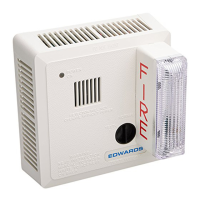
The Edwards 517TCSB Series Photoelectric Type Residential Smoke Alarm with Strobe is an AC-powered device with a 9V battery backup, designed to provide early warning of developing fires for the hearing impaired. Its primary function is to detect smoke and alert occupants through both an audible temporal 3 signal and a visual strobe light. This dual alert system is particularly beneficial for individuals with hearing impairments, ensuring they are notified in the event of a fire.
The alarm operates on the photoelectric light scatter principle. Within its sensing chamber, an infrared (invisible) LED pulses every 8 seconds. A photodiode light sensor, matched to the LED's frequency, is positioned out of the direct path of the light beam under normal conditions. When smoke particles enter the chamber, they reflect light from the pulsing LED onto the photodiode sensor. Upon the first detection of smoke, the alarm enters a pre-alarm mode, indicated by a rapidly flashing red LED. If the light sensor confirms smoke for two consecutive pulses, the alarm triggers, sounding the horn and activating the strobe. This verification technique, combined with a 5-to-1 signal-to-noise ratio, significantly reduces the likelihood of nuisance alarms caused by common household smoke from cooking or cigarettes.
For proper usage, the alarm features an alarm horn, a pulsating red Light Emitting Diode (LED) that flashes every 15-30 seconds, and a green AC power-on LED. When the test knob is turned to "test 1," the red light flashes rapidly, the horn sounds, and the strobe activates. It's important to note that the strobe will not operate without AC power. A low battery is indicated by a chirp that sounds concurrently with the red LED flash. If the alarm malfunctions or the battery is missing, a chirp will sound without the red LED flashing. An AC power failure is indicated by the green LED turning off. The test knob simulates actual smoke conditions, allowing users to verify the alarm's functionality. In tandem interconnect models, activating the test on one alarm will cause its red indicator light to flash and its horn to sound, while other interconnected units will sound their horns with their red indicator lights remaining off.
The smoke alarm is a crucial component of a comprehensive fire protection plan. While it provides quick alerts, it cannot prevent fires. Users are advised to minimize fire hazards by avoiding improper storage of flammable liquids and not leaving small children unattended. Closing bedroom doors at night can act as a barrier against heat and smoke. Establishing and practicing an escape plan is vital, including posting a detailed floor plan with chosen escape routes, ensuring children know what to do, agreeing on an outside meeting place, and conducting fire drills at least twice a year. In the event of an alarm, occupants should prioritize immediate evacuation, check doors for heat before opening, stay low to the floor if smoke is present, cover their nose and mouth, and call the fire department from a neighbor's house after safely exiting.
Placement of the smoke alarm is critical for optimal fire detection. It can be mounted on a ceiling or wall. For ceiling mounting, it should be as close to the center of the room or hallway as possible, with the edge at least 4 inches from any wall. For wall mounting, the top of the alarm should be between 4 and 12 inches from the ceiling. In rooms with sloped, gabled, or peaked ceilings, the alarm should be placed at the center of the ceiling for maximum speed of fire detection.
Smoke alarms should be installed in accordance with NFPA 72 standards. In existing construction, alarms should be outside each separate sleeping area, in the immediate vicinity of bedrooms, and on each additional story, including basements. In new construction, a smoke detector is required in each sleeping room. For mobile homes, especially older ones with poor insulation, alarms should be placed on inside walls, between 4 and 12 inches from the ceiling, to avoid temperature variations near uninsulated exterior surfaces that can impede smoke detection.
Certain locations should be avoided to prevent nuisance alarms and ensure proper operation. These include areas with combustion particles, such as kitchens, garages, near furnaces, hot water heaters, or gas space heaters; alarms should be at least 20 feet away from such areas. They should also be kept away from air streams passing by kitchens, damp or humid areas (at least 10 feet from bathrooms), very cold or hot environments (outside the operating range of 40° to 100°F), dusty or dirty areas, fresh air inlets or returns, dead air spaces (at the top of peaked roofs or corners between ceilings and walls), insect-infested areas, and near fluorescent light fixtures (at least 5 feet away).
Maintenance is crucial for the alarm's longevity and reliability. Edwards recommends replacing alarms every ten years, as dust, dirt, and environmental contaminants can affect performance over time. Regular cleaning is necessary, especially if the alarm becomes overly sensitive or triggers false alarms due to dirt buildup in the optic sensing chamber. To clean, first turn off electrical power, twist the alarm counter-clockwise to remove it from its mounting plate, unplug the connector, and remove the battery. Prepare three buckets: one with a mixture of normal tap water and 1/8 cup of Ivory dishwashing liquid, and two with clear water (distilled or de-ionized treated water is recommended for final rinse in hard water areas). Submerge the dirty alarm in the soap water for about 10 minutes, then agitate for 5-10 seconds. Transfer it to the first clear water bucket, submerge, and agitate again. Repeat this process in the second clear water bucket. Finally, remove the alarm and allow it to air dry thoroughly for 48 hours in a clean, dry area. Do not use ovens, microwaves, or hot air blowers to accelerate drying, as this can damage the alarm. It is recommended to change the wash and rinse water after cleaning five alarms, or more frequently if they are exceptionally dirty.
Regular testing is also essential. The alarm should be tested weekly by turning the test knob to the "NORMAL" position and ensuring the red indicator light flashes every 15-30 seconds, and the green LED is on. If not, check the battery and AC connection. For a full test, rotate the knob counter-clockwise to "TEST 1" and wait up to 20 seconds for the alarm to sound. To test for high sensitivity, turn the knob clockwise to "TEST 2"; the alarm should remain silent in this position. If it sounds, the alarm may be too sensitive due to dirt and requires cleaning. Edwards recommends using Home Safeguard Smoke Alarm spray once a year to check for proper smoke entry, spraying from a distance no closer than 12 inches. Never use an open flame to test the alarm, as this can damage it or your home. Do not cover, tape, or block the alarm's openings, as these are designed for air sampling. Failure to regularly clean the alarm can lead to false alarms due to dust buildup simulating smoke.
 General
| Model | 517TCSB Series |
|---|---|
| Mounting Type | Ceiling or Wall |
| Operating Voltage | 120 VAC |
| Frequency | 60 Hz |
| Voltage | 120 VAC |
| Color | White |
| Material | Plastic |
| Type | Smoke Alarm |
| Power Source | 120V AC |
| Operating Temperature | 32°F to 100°F (0°C to 38°C) |
| Humidity Range | 10% to 93% non-condensing |
| Alarm Sound Level | 85dB at 10 feet |
| Standards | UL 217, NFPA 72 |
| Sound Level | 85dB at 10 feet |

 To Next Page