EasyManua.ls Logo

EHX MICRO SYNTH - User Manual

EHX MICRO SYNTH
2 pages
Print Icon
To Next Page IconTo Next Page
Loading...
FCC COMPLIANCE
Note:
This equipment has been tested and found to comply with the limits for a Class B digital
device, pursuant to part 15 of the FCC Rules. These limits are designed to provide reasonable
protection against harmful interference in a residential installation. This equipment generates,
uses and can radiate radio frequency energy and, if not installed and used in accordance with
the instructions, may cause harmful interference to radio communications. However, there is no
guarantee that interference will not occur in a particular installation. If this equipment does
cause harmful interference to radio or television reception, which can be determined by turning
the equipment off and on, the user is encouraged to try to correct the interference by one or
more of the following measures:
Reorient or relocate the receiving antenna.
Increase the separation between the equipment and receiver.
Connect the equipment into an outlet on a circuit different from that to which the
receiver is connected.
Consult the dealer or an experienced radio/TV technician for help.
Modifications not expressly approved by the manufacturer could void the user's authority to
operate the equipment under FCC rules.
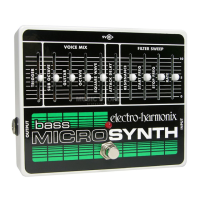
MICRO SYNTH
Analog Guitar Synthesizer
Congratulations on your purchase of the Electro-Harmonix XO Micro Synth for guitar. This is a
very powerful tool for musical expression. Please take a few minutes to familiarize yourself with
the Micro Synth’s controls to learn how to get the best out of this special instrument.
The Micro Synth can create some of the most popular synthesizer textures at a fraction of the
cost for such capabilities. Its four voices: GUITAR, OCTAVE, SUB OCTAVE AND SQUARE
WAVE are completely independent and fully mixable. The MICRO SYNTH can modify these
signals with envelope control for a variety of “bowed” or blown” sounds. In addition, a
sophisticated swept filter control allows highly variable frequency adjustments to be applied to
the overall output signal. When combined, these controls offer the user a creative capability that
is virtually limitless.
PREAMP GAIN ADJUSTMENT: The preamp gain in the Micro Synth has been set at the
factory for use with a guitar equipped with single-coil pickups. If you will be using another
instrument with higher or lower output, it may be necessary to readjust this setting. A
screwdriver or alignment tool with a tip width of no more than 1/16" is required. To access the
preamp gain adjustment, remove the bottom plate from the Micro Synth. Look for the small trim
pot in the lower left corner of the circuit board, it is labeled TRIM1 GAIN TRIM. Turning the trim
pot clockwise will increase the preamp gain. Turning it counter-clockwise will decrease preamp
gain. Please do not touch any other components when the bottom plate is removed or you risk
damaging the circuit board or the components.
OPERATION: The Micro Synth’s controls operate as described below. In all cases, high-
numbered control settings increase the level of the given effect.
FOOTSWITCH and Status LED The Footswitch selects either effect mode or True Bypass.
When the Status LED is lit, the Micro Synthesizer is in effect mode. When the Status LED is off,
the Micro Synth is in True Bypass mode.
TRIGGER – Determines the input volume at which the filter circuits will “turn on.” It does not
affect any other circuitry. If the TRIGGER is set too high, the filter may “stutter” due to multiple
triggering. This is especially true if full chords are played. It is best to set the TRIGGER at
exactly the sensitivity needed for your playing.
WARNING:
Your
Micro Synth
comes equipped with
an Electro-Harmonix
9.6DC-200BI power
supply
(same as used by Boss™ & Ibanez™ 9.6 Volts DC 200mA). The Micro Synth requires 55mA at
9VDC with a center negative plug.
The Micro Synth does not take batteries. Using the wrong
adapter may damage your unit and void the warranty.
Question and Answer IconNeed help?

Do you have a question about the EHX MICRO SYNTH and is the answer not in the manual?

Summary

Micro Synth Operation and Controls

Preamp Gain Adjustment

Instructions for adjusting preamp gain using a trim pot on the circuit board. Requires opening the unit.

FootSwitch and Status LED

Footswitch selects effect mode or True Bypass. Status LED indicates when the unit is in effect mode.

Trigger Control

Determines input volume for filter circuit activation. Setting too high may cause 'stutter' with chords.

Voice Mixing Controls

Guitar

Controls the output volume of the input signal through the filter.

Sub Octave

Controls the output volume of the Sub-Octave voice, which tracks single notes.

Octave

Controls the output volume of the Octave voice, tracking single notes with added harmonic distortion.

Square Wave

Controls the output volume of the Square wave, intensity affected by instrument attack/volume.

Filter Sweep Controls

Attack Delay

Determines time for voice signals to reach full volume, affecting initial attack.

Resonance

Affects filter sharpness ('Q') and adds a slight signal boost at higher settings.

Start Frequency

Sets the starting frequency for the filter sweep.

Stop Frequency

Sets the ending frequency for the filter sweep, also the resting frequency.

Rate

Determines the speed at which the filter sweeps between START and STOP frequencies.

Power and Warranty Information

Power Requirements

Details the 9VDC power jack, center negative polarity, and maximum current requirement.

Warranty Registration and Service

Information on product registration, warranty period, and contact details for service in the US, Canada, and Europe.

Overview

The Electro-Harmonix XO Micro Synth is an analog guitar synthesizer designed to provide a wide range of musical expression through its unique sound-shaping capabilities. It's a powerful tool that allows guitarists to create popular synthesizer textures at a fraction of the cost of dedicated synthesizer equipment.

Function Description

The Micro Synth features four independent and fully mixable voices: GUITAR, OCTAVE, SUB OCTAVE, and SQUARE WAVE. These voices can be combined in various degrees to create a diverse palette of sounds. The device also incorporates envelope control to modify signals for "bowed" or "blown" effects, and a sophisticated swept filter control for highly variable frequency adjustments to the overall output signal. This combination of controls offers virtually limitless creative possibilities.

Voice Characteristics:

  • GUITAR: Controls the output volume of the input signal as it passes through the filter.
  • SUB OCTAVE: Controls the output volume of the Sub-Octave effect, which tracks only single notes.
  • OCTAVE: Controls the output volume of the Octave effect, also tracking only single notes. This voice includes a small amount of harmonic distortion for added tonal richness.
  • SQUARE WAVE: Controls the output volume of the Square wave. Its intensity is influenced by instrument attack or volume, and it operates similarly to a standard distortion device in other respects.

Filter Sweep Section:

  • RESONANCE: Adjusts the sharpness or "Q" of the filter. Higher settings produce a more emphasized filter sound and a slight signal boost.
  • START FREQUENCY: Determines the initial frequency at which the filter sweep begins.
  • STOP FREQUENCY: Determines the final frequency at which the filter sweep ends. This also serves as the filter's "resting frequency." If START and STOP controls are set to the same level, no sweep occurs, but the filter will emphasize that particular frequency band. These controls can simulate attack, decay, and harmonic content of acoustic instruments, in addition to creating lead synthesizer sounds.
  • RATE: Determines the speed at which the filter sweeps from START FREQUENCY to STOP FREQUENCY. It is recommended to synchronize the RATE with your playing speed.

Important Technical Specifications

  • Power Supply: The Micro Synth requires an Electro-Harmonix 9.6DC-200BI power supply (9.6 Volts DC 200mA, center negative plug).
  • Current Requirement: 55mA at 9VDC.
  • Maximum Allowable Power Supply Voltage: 12VDC.
  • Battery Operation: The Micro Synth does not take batteries.
  • FCC Compliance: The device complies with part 15 of the FCC Rules for Class B digital devices, designed to provide reasonable protection against harmful interference in residential installations.

Usage Features

  • FOOTSWITCH and Status LED: The Footswitch toggles between effect mode and True Bypass. The Status LED illuminates when the Micro Synthesizer is in effect mode and is off when in True Bypass mode.
  • TRIGGER: This control determines the input volume threshold at which the filter circuits activate. It does not affect other circuitry. Setting the TRIGGER too high can cause the filter to "stutter" due to multiple triggering, especially when playing full chords. It is best to set the TRIGGER to the exact sensitivity required for your playing style.
  • ATTACK DELAY: This control determines the time required for the voice signals to reach full volume. Higher settings can completely remove the initial attack of the instrument, and different delay times contribute significantly to the characteristic sounds of various instruments. It is recommended to synchronize playing with the ATTACK DELAY speed setting.
  • Sound Templates: The manual includes sample settings to help users familiarize themselves with the MICRO SYNTH and its controls, encouraging experimentation to develop unique sounds. Blank templates are provided for recording new settings.

Maintenance Features

  • Preamp Gain Adjustment: The preamp gain is factory-set for guitars with single-coil pickups. If using an instrument with higher or lower output, the gain may need adjustment. To access the adjustment, the bottom plate of the Micro Synth must be removed. A screwdriver or alignment tool with a tip width of no more than 1/16" is required. The small trim pot, labeled TRIM1 GAIN TRIM, is located in the lower left corner of the circuit board. Turning the trim pot clockwise increases preamp gain, while turning it counter-clockwise decreases preamp gain. Users are advised not to touch any other components when the bottom plate is removed to avoid damaging the circuit board or components.
  • FCC Compliance: Users are advised to reorient or relocate the receiving antenna, increase separation between equipment and receiver, connect the equipment to an outlet on a different circuit, or consult a dealer or experienced radio/TV technician if harmful interference to radio or television reception occurs.
  • Warranty Information: Electro-Harmonix offers a one-year warranty from the date of purchase for defects in materials or workmanship. This applies to original purchasers from authorized retailers. Online product registration is available at http://www.ehx.com/product-registration. For service under warranty, customers in the USA and Canada must obtain a Return Authorization Number (RA#) from EHX Customer Service before returning the product. The returned unit must include a written description of the problem, contact information, RA#, and a copy of the purchase receipt. Using the wrong power adapter may damage the unit and void the warranty.

EHX MICRO SYNTH Specifications

General IconGeneral
BrandEHX
ModelMICRO SYNTH
CategoryRecording Equipment
LanguageEnglish