EasyManua.ls Logo

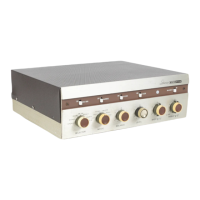
Eico HF-20 - General Installation Factors; Electrical Connections

Eico HF-20
29 pages
Print Icon
To Next Page IconTo Next Page
To Previous Page IconTo Previous Page
Loading...
i*
b
useful
to
understand
the
process
of
convection where-
'
by
heat
Is
removed
In
fudging
the suitability
of
a
location.
Air
heated
by
the
heat-producing
elements expands
and
rises;
cool
air
Is
drawn
from
beneath
to
take
the
place
of
the heated
air.
In this manner,
a stream of atr
Is set
In
motion
which
continually
removes
heat
from
the ampli-
fier.
(In
particular,
we are
mainly
concerned with
the
mafor
heat-producing
elements; the
two
6L6GB output
tubes and
the
5U4GB
rectifier
tube.) If there
Is
any
Im-
pediment to or
constriction of
the air flow,
the essential
process of
heat
removal will
be adversely
affected.
Adequate
venttlatlon
will
be
provided If the
amplifier
Is
Installed
In an
open-back
console
provided
that the top
of
the amplifier
ts
spaced
at least
two
Inches
below
any
shelf
mounted
above
It. If
the
cabinet
ts
enclosed at the
rear,
provide
several large
holes or slots
as
low
down
and
as
high
up
In the cabinet
back
as possible. As an alter-
nate,
holes may
be
provided
In
the
sides, bottom,
or
top
of
the
cabinet.
The
Important
thing
to
remember
Is
that
effective
ventilation
requires
provision for
cool atr to en-
ter at
the
bottom and
hot air to
leave
at the top.
If
the amplifier
ts
not
Installed
In a
console.
It should be
situated
preferably
on an open
surface,
not
on a
shelf of
a
bookcase.
An attractively
finished
matching
cover
for
the
Model
20
Is
available which
will
provide
a "finished
11
appearance as
well
as
protection
when the
amplifier
Is
not
Installed
In
a
console.
Four
rubber feet
are also pro-
vided
so
that
the amplifier
will
not
mar
the surface
of
furniture
on which
It
Is
placed.
b)
EASY ACCESS
TO
CONTROLS:
Mount the
amplifier
at a
height
which
will
permit
easy
manipulation of
the
controls.
Tuner
controls
should
be located
nearby.
c)
ACCESSIBILITY
TO
PARTS:
Tubes are the
most
fre-
quently replaced
Items
In electronic
equipment. If the
amplifier
ts
Installed
tna
console,
sufficient
space
should
be
alloted
to
reach
and
remove any
tube
In the amplifier.
Furthermore,
Input
and
output
terminals
of
the amplifier
should be
accessible to
permit
easy interchanging of
sys-
tem
components
for comparlsonjand
connection
or
discon-
nection
of a
portable tape
recorder
which Is
stored
away
when not
In
use.
If
antennas
are strung around
the back
of
the consoletn
which the amplifier
is
Installed,
arrange
them
so
they
will
not
Interfere
with access to the
amplifier.
d)
ACOUSTICAL
ISOLATION:
If
amplifier and
speaker
are installed
In
the
same cabinet (not
recomemnded),
pro-
vide sufficient
separation to
minimize mechanical
speaker
vibration reaching
theampllfler.
The
minimum separation
Is
about one
foot.
1.
CHASSIS
MOUNTING
IN
CONSOLE
a)
Operation,
on
contole front panel
preliminary to am-
plifier mounting—
-
M
)
Tape
the panel
template
provided
to
the face
of
the console
so
that
the top of the
mounting
surface
line on
the
template
Is
level
with
the
top of
the
amplifier
mounting shelf.
(2)
Use an awl
or a nail to
.
•
4
4
pierce
the
centers
of the
five
5/9"
diameter
holes
for
the
controls
and
the two
small
holes
for
mounting
the
control
plate,
to
transfer
their
locations
'to the
console
panel
be-
neath.
(3)
Remove
the
panel
template.
(4)
Drill
the
holes
for
the
panel controls
only
(the
two small
holes
which
have
been
marked
are for wood
screws).
b)
Amplifier
mounting In
console:
(1)
Pull
off
the con-
trol
knobs
(a
second set of knobs with
long
shanks
has
been
provided for
console
Installation).
(2)
Remove the
control
plate,
which
Is
attached
to
the
chassis apron by
two
screws.
(These may
be
discarded since
they are
un-
suitable
for attaching the
control
plat,
to
the console
panel and
two^4 X
3/Bwood screws
have
been
supplied
for
this purpose.)
(3)
Fasten
the
control plate
to the con-
sole
panel with
the
2
^4
X
3/3
wood screws.
(4)
If the
rubber
feet
have been
Inserted
In
the bottom plate,
re-
move them.
(They
may be pried
out
with a
thin screw-
driver.)
(5)
Place
the unit on the mounting shelf and
slide
It
as
far forward
as possible,
so
that
the controls
penetrate
the
panel holesas
far
as possible.
(6).
Place
a
long
shank knob
on
each
control,
pressing each knob
toward
the
chants
firmly
so
that each control
shaft
enters
fully
Into Its
knob.
(7)
Draw
the chanls back
evenly
and
carefully until the back
rims
of
all
the
knobs
are
equally
spaced
from the
control plate about
1/8".
(B)
With
a
sharp
pencil,
placed with
Its
point directly
against
the
edge of the
lower
surface
of
the bottom plate, draw
the
outline
of the bottom
plate
on the
chanls
shelf.
(9)
New
remove the
knobs
and take the
chants
off the shelf.
(10)
Remove the 8
screws
which
fasten
the
bottom plate
to the
chanls.
(11)
Place the bottom
plate exactly
In
theoutllnedrawn
on
the shelf
(bumps
facing
up)
and
marie
the
positions of
the two holes
on
the left
side
and the
two
holes
on the right
side.
(12)
Remove
the
bottom
plate
and drill
each of
the
marked holes on
the shelf
to
a
diameter
of 1/4".
(13)
Refasten
the bottom plate
to
the
chanls, with
the
4
*8
X 3/B screws
prevlousljiip-
moved,
using the
2 holes
at
the rear and
the
2
horns
at
the
front of
the
chanls.
(14)
Replace the chassis
on
the
shelf,
positioning
It
exactly
In
the outline previously
drawn,
and restore the knobs.
This
time
make
sure
that
the
Indicator
dot
on
each
knob agrees
with the control
position.
(15)
From
the
bottom
side
of the
shelf.
Insert
a
*8
X
1"
screw
with a
1/2"
flat
washer against
the head
through
each
of
the
four
left and
right
side holes.. These
screws
engage the stamped nut
over
each
hole
on
the
chanls
flange
and when tightened secure
the
chanls
to
the shelf.
2. ELECTRICAL
CONNECTIONS
a) SPEAKER
CONNECTIONS:
To
connect your
speaker
to
the amplifier' properly,
you must
know Its
rated
Im-
pedance.
This
may be
read
off
the
speaker nameplate.
Connectone
speaker
lead
to
the
terminal on
the rear
apron
marked
n
G"and
the
otherspeaker
lead
to
the nearby
ter-
minal
designated
by
the rated speaker
Impedance
(4,
8,
or
16 ohms). Plastic-covered
lamp
cord may
be used
for
distances
up
to
50 ft.
with
little power Ion.
For
shorter
distances,
TV antenna
lead
can be
used,
particularly
If
It Is desired
to
run
the
speaker
lead
under
a
rug.

Related product manuals