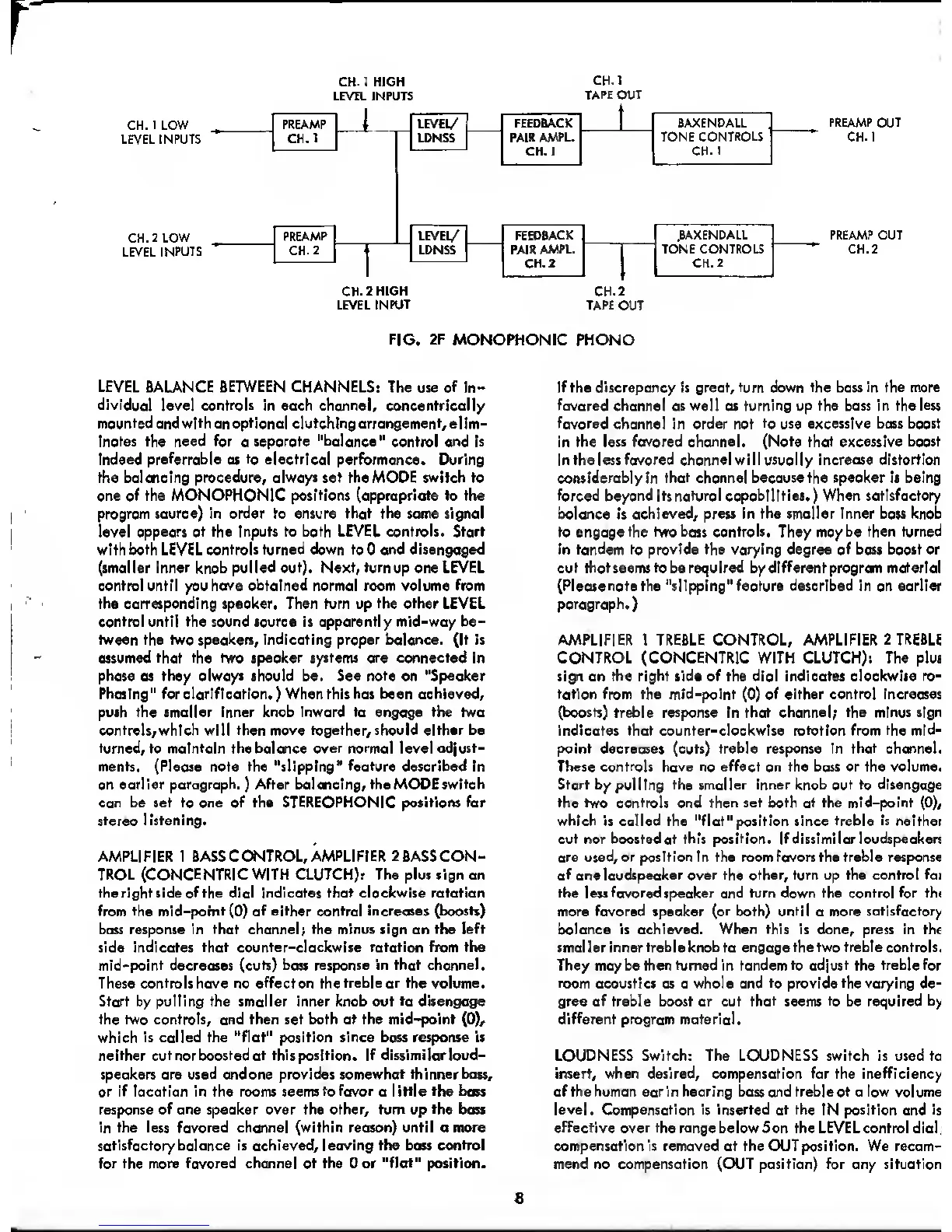
PREAMP OUT
FIG. 2F
MONOPHONIC PHONO
LEVEL
BAUNCE
BETWEEN CHANNELS;
The use
of
in-
divlduol
level
conTroU in
each channel, concentrically
mounted
and
with
an
optional clutching arrangement,
elim-
inates the need
for
a
separate "balance"
control and
is
indeed
preferrable
os
to electrical
performemce. During
the balancing procedure, alwoys set the MODE switch to
one
of
the MONOPHONIC positions (appropriate to
the
program source)
in
order
to
ensure that
the
some
signal
level
appears
at
the
Inputs to both LEVEL controls.
Start
with both
LEVEL
controls turned down to
0
and disengaged
(smaller
inner
knob
pulled out). Next, turnup
one LEVEL
control until you
have obtained
normal room volume
from
the corresponding speaker. Then turn up
the other
LEVEL
control until the sound source is apparently mid>way be-
tween the two speakers, indicating proper balance. (It is
ossumed that the two speaker systems are connected
in
phase os they olwoyt should
be.
See
note
on "Speoker
Phasing" for clarification.) When this has been achieved,
push the smaller inner knob inward to engage the two
controls,
which will
then move together, should either be
turned,
to
maintain
the balance
over normal level adjust-
ments. (Please note the "slipping"
feature
described in
an earlier paragraph.)
After
balancing,
theMODEswitch
can be set to one of the STEREOPHONIC positions for
stereo listening.
AMPLIFIER 1
BASSCONTROL,AMPLiFIER2BASSCON-
TROL (CONCENTRIC WITH CLUTCH): The plus sign on
therightsideofthe dial indicates that cloctcwise rotation
from
the mid-point
(0)
of either control increases Qroosis)
boss response in
that
chonnel;
the minus sign
on
the left
side indicates
that counter-clockwise rotation from the
mid-point
decreoses
(cuts) bass response in that channel.
These
controls
hove no
effect
on the
trebleor the volume.
Start by pulling the smaller inner knob out
to disengage
the two controls, and then set both at the mid-point
(0),
which
is called the “flat" position since bass response is
neither cut
nor
boosted at thlsposltion. If dissimilar loud-
speakers are used undone provides
somewhat thinner bass,
or if location In the rooms seems
to Favor
a
little the bass
response of one speaker over the other, turn up
the
boss
in the less favored channel (within reason) until a more
satisfactory balance is achieved, leaving the bass
control
for the more favored channel at the Oor "flat" position.
If
the
discrepancy is great,
turn
down
the bass in the more
favored channel as well os turning up
the
bass In
the less
favored channel In order not
to
use excessive bass
boost
in
the less fovored channel. (Note
that
excessive boost
in
the less favored channel will usually increase distortion
considerably In
that channel because the speaker is being
forced beyond its
natural capabilities.
)
When satisfactory
balance
is
achieved, press in the
smoller Inner bass
knob
to engage the two boss controls. They maybe then turned
In tandem to provide the varying
degree
of boss boost or
cut thot seems to be required by
different
program
material
(Please note the "slIpping"feoture described in on earlier
paragraph.
)
AMPLIFIER 1 TREBLE CONTROL, AMPLIFIER
2 TREBLE
CONTROL (CONCENTRIC WITH CLUTCH): The plus
sign on the right side of the dial indicates clockwise ro-
tation from the mid-point
(0)
of either control increases
(boosts)
treble
response
In that
channel; the minus sign
indicates that counter-clockwise rotation from
the mid-
point decreases (cuts) treble response in
that
channel.
These controls have no effect on the bass or the volume.
Start by
pulling
the smaller inner knob out to disengage
the two controls
and
then set both at the mid-point
(0),
which is called the "flat" position since
treble Is
neither
cut nor boostedat this
position.
Ifdissimilar loudspeakers
ore used, or position in the room favors the treble response
of
one
loudspeaker over the other, turn up the control for
the less favored speaker and turn down the control for ths
more favored speaker
(or
both)
until
a
more satisfactory
balance is achieved.
When this
Is done, press in the
smaller Inner
treble knob
to engage
the two treble controls.
They may be then
turned
in tandem
to odjust
the
treblefor
room
acoustics as a whole and
to
provide
the
varying de-
gree of treble boost or cut
that
seems
to
be required
by
different
program material.
LOUDNESS Switch: The LOUDNESS switch is used to
insert, when desired, compensation for the inefficiency
of the human ear In hearing bass and treble at a low volume
level. Compensation is inserted at the
IN
position
and
Is
effective over the range
below Son the LEVELcontrol dial;
compensation Is removed at the OUT position. We recom-
mend no compensation (OUT position) for any situation


 To Next Page
 Loading...