EasyManua.ls Logo

Eico HF-89 - Maintenance; Bias and Balance Adjustments; Bias and Balance Adjustment Schedule; Trouble-Shooting Procedures

Eico HF-89
25 pages
Print Icon
To Next Page IconTo Next Page
To Previous Page IconTo Previous Page
Loading...
maintenance
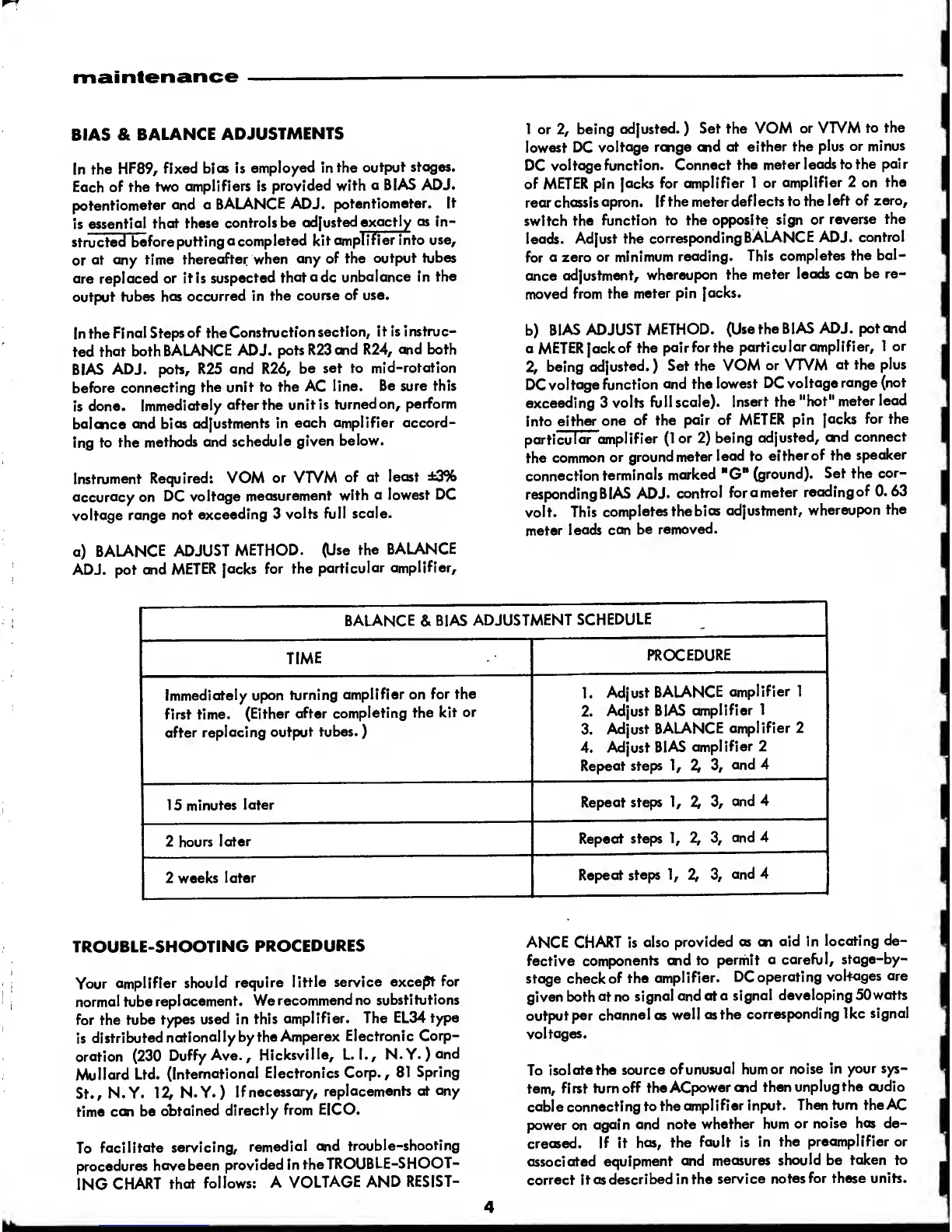
BIAS &
BALANCE
ADJUSTMENTS
In
the
HF89,
fixed
bias
Is
employed In
the output
stages.
Each
of the two
amplifiers is
provided
with
a BIAS
ADJ.
potentiometer
and a
BALANCE ADJ.
potentiometer.
It
is
essential
that
these
controls be
adjusted
exactly
as
in-
structed
before putting
a completed kit
amplifier into
use,
or
at any
time
thereafter when
any of the
output
tubes
are replaced or
itis suspected
thatadc
unbalance in
the
output
tubes has
occurred in
the
course
of use.
In
the
Final Steps
of
the
Construction
section,
it is
instruc-
ted
that both
BALANCE
ADJ.
pots
R23
end R24,
and both
BIAS
ADJ.
pots,
R25 and R26,
be
set to
mid-rotation
before
connecting
the unit
to the
AC
line.
Be sure this
is
done.
Immediately
afterthe unit
is
turnedon,
perform
balance and
bias ad]ustments
in
each
amplifier accord-
ing
to
the
methods
and schedule
given
below.
Instrument
Required: VOM
or
VTVM
of at
least ±3%
accuracy on
DC voltage
measurement
with
a
lowest
DC
voltage
range
not
exceeding 3
volts
full
scale.
a)
BALANCE
ADJUST
METHOD.
(Use
the
BALANCE
ADJ.
pot
and
METER jacks
for the
particular
amplifier.
1 or
2,
being adjusted.
)
Set the VOM
or
VTVM
to the
lowest DC
voltage raige
end at
either the plus
or minus
DC
voltage function.
Connect the
meter
leads to
the pair
of METER pin
jacks
for amplifier
1 or
amplifier
2
on
the
rear chassis
apron. If
the
meter
deflects
to the
left of
zero,
switch
the
function to
the
opposite sign
or
reverse the
leads. Adjust
the
corresponding
BALANCE
ADJ.
control
for
a zero
or minimum
reading.
This
completes
the
bal-
ance
adjustment,
whereupon
the
meter
leads can
be re-
moved
from
the meter pin
jacks.
b)
BIAS ADJUST
METHOD. (Use
the BIAS
ADJ. pot
and
a METERjackof
the
pairforthe
particular
amplifier,
1
or
2,
being
adjusted.)
Set
the VOM
or VTVM
at the plus
DC
voltage function
and the
lowest
DC voltage
range (not
exceeding
3
volts
full scale).
Insert
the
"hot" meter
lead
into
either
one
of the
pair of
METER pin
jacks
for the
particular
amplifier
(1
or
2)
being
adjusted,
and
connect
the
common
or ground
meter
lead to
either
of the
speaker
connection
terminals
marked "G"
(ground).
Set the
cor-
responding
BIAS
ADJ.
control
forameter
readingof
0.63
volt.
This
completes
the
bias
adjustment,
whereupon
the
meter
leads can
be
removed.
BALANCE
&
BIAS
ADJUSTMENT
SCHEDULE
TIME
PROCEDURE
Immediately upon
turning
amplifier
on
for the
first time.
(Either
after completing
the
kit or
after
replacing
output
tubes.
)
1.
Adjust
BALANCE
amplifier
1
2.
Adjust
BIAS
amplifier
1
3.
Adjust
BALANCE
amplifier
2
4. Adjust
BIAS
amplifier
2
Repeat
steps
1, 2, 3,
and 4
15 minutes
later
Repeat steps
1, 2, 3,
and 4
2 hours
later
Repeat steps
1,
2, 3,
and 4
2 weeks
later
Repeat steps
1, 2, 3,
and 4
TROUBLE-SHOOTING
PROCEDURES
Your
amplifier
should
require
little service
except
for
normal
tube
replacement.
We
recommend
no substitutions
for the
tube
types used in
this
amplifier. The
EL34 type
is
distributed
nationally
by the
Amperex
Electronic
Corp-
oration
(230
Duffy Ave.
,
Hicksville, L. I., N.Y.
)
and
Mu
Hard Ltd.
(International
Electronics
Corp.,
81
Spring
St.,
N.Y.
12,
N.Y.)
If
necessary,
replacements
at any
time
can be
obtained
directly
from EICO.
To
facilitate
servicing,
remedial
and
trouble-shooting
procedures
have
been
provided in
the
TROUBLE-SHOOT-
ING
CHART
that
follows:
A
VOLTAGE
AND
RESIST-
ANCE CHART
is also
provided
as an
aid in
locating
de-
fective
components
and to
permit
a
careful,
stage-by-
stage check
of the
amplifier.
DC operating
voltages
are
given both
at
no
signal and
ata
signal
developing
50watts
output
per channel
as well
as the
corresponding
lkc
signal
voltages.
To
isolate the
source
ofunusual
humor
noise in
your sys-
tem,
first
turnoff
theACpowerand
thenunplugthe
audio
cable
connecting
to the
amplifier
input.
Then turn the AC
power
on
again and note
whether
hum
or noise
has
de-
creased.
If it
has, the
fault is
in
the
preamplifier
or
associated
equipment
and
measures
should be
taken to
correct
it as
described in the
service notes
for these units.
4

Related product manuals