
 Need help?
Do you have a question about the EKKO EP18LI Series and is the answer not in the manual?
Company production model EP type 4000lb/4400lb Series Lithium Iron Walkie Electric Pallet Truck description.
Guidelines regarding unauthorized modifications and their impact on warranty and specifications.
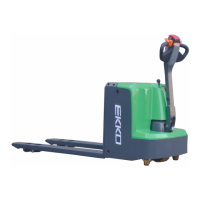
Provides an overview of the EP18LI/EP20LI series tramp type electric pallet truck.
Illustrates the physical dimensions and layout of the electric pallet truck model.
Details the power source, speed control, and gear box maintenance of the truck's running system.
Explains the mechanism by which the operating handle controls the truck's steering.
Describes how the brake function is activated and its dependence on road and load conditions, including working principle.
Explains the main working body, cargo forks, cylinder expansion, and control handle.
Covers the electrical system, battery indicator, and motor operation, including special notes.
Details the hydraulic system, oil pump motor, lifting cylinder, and pressure adjustment warnings.
Step-by-step guide for initiating, operating, and safely parking the electric pallet truck.
Instructions on how to properly use and activate the emergency safety switch for immediate power cutoff.
Guidance on operating the horn button located on the handle to alert nearby personnel.
Explains the function and display of the battery capacity indicator on the stacker.
Provides instructions on how to safely transport and stack goods using the pallet truck.
Outlines essential safety protocols for technicians performing repair and maintenance on the vehicle.
Lists the essential daily checks to ensure the truck is in proper working condition.
Details the importance of professional maintenance and lists maintenance periods based on work hours.
Covers procedures for accumulator maintenance, recharging, replacement, and safety precautions.
General rules for operators, including qualifications, understanding the manual, and carrying limitations.
Guidelines for safely transporting and storing the electric pallet truck, including precautions.
Procedures for inspecting the vehicle before use to ensure it is in safe working condition.
Comprehensive rules and guidelines for operating the vehicle safely and responsibly.
Provides a table detailing common faults, their causes, and recommended processing methods.
Outlines essential preparations and safety measures to be taken before commencing repair work.
Instructions for checking the hydraulic oil level and fork/frame position during inspection.
Details the necessary checks and operations after maintenance before the vehicle can be used again.
This document outlines the specifications, operation, and maintenance procedures for the EKKO EP18LI/EP20LI Series Lithium Iron Walkie Pallet Jack. This electric pallet truck is designed for efficient material handling in various industrial settings.
The EKKO EP18LI/EP20LI Series is a tramp-type electric pallet truck that utilizes a lithium-ion battery as its power source. It is controlled by an advanced AC controller and a high-quality motor, enabling it to perform essential material handling actions such as walking, turning, and pallet fork lifting. The truck is designed to reduce industrial pollution and improve productivity, making it suitable for cargo loading and unloading, handling, and stacking in environments like food processing facilities, banks, light textile industries, stations, ports, logistics centers, and other enterprises.
The main working body of the truck is a cargo fork, which relies on hydraulic power to lift and lower pallets or cargo for transport and short-distance movement. The expansion and retraction of the cylinder are controlled by the operating handle, with pressure oil supplied by the pumping station. The electrical system manages both walking and operation control, utilizing an AC electric control assembly. A battery indicator on the meter displays the remaining power. When the battery power is too low, the electric meter will cut off the starting control line of the oil pump motor, allowing the truck to walk but not lift the fork, signaling an immediate need for charging. The oil pump motor is a DC motor designed for short bursts of operation (up to 5 minutes), emphasizing the need for time intervals between lifting movements to prevent overheating and potential damage.
The braking system is electromagnetic and can be activated in several ways: by turning the travel switch to the "0" position or releasing it, by moving the driving switch directly from one direction to the opposite to initiate regenerative braking, or by moving the handle up and down to the braking area. The handle automatically returns to the upper braking area when released, causing the vehicle to stop. A belly switch is incorporated as a safety feature to prevent the operator from being squeezed; if the vehicle encounters an obstacle while driving forward and the operator's body touches the belly switch, the truck will slow down or stop.
The EP18LI/EP20LI Series pallet truck is intended for use on firm, flat, and intact surfaces, specifically designed for indoor operation within a temperature range of -10°C to +40°C. While operating, the relative humidity should not exceed 50% at +40°C, though higher humidity is permissible at lower temperatures. The ground must be hard and flat. It is strictly forbidden to use the truck in corrosive, flammable, explosive, or acid-base environments. The truck should not be operated under light loads with permanent barriers or pits, nor on slopes. When carrying goods, the load must be placed approximately at the center of the truck's load center. Lifting or carrying people is strictly prohibited.
Before operation, operators must familiarize themselves with all switches and buttons on the instrument panel. To start, insert the key into the key switch, turn it right, and pull up the emergency power safety switch to open the control circuit. The forks should be raised approximately 3.93 inches above the ground. The travel switch should be opened slowly to reach the desired speed. In case of any fault during operation, the power must be immediately cut off by pressing down the red emergency power switch. Sudden turns should be avoided. When climbing a slope with a full load, operators should be aware of the slope conditions and press the travel switch as much as possible to achieve maximum grade ability. To stop, lower the fork to the bottom, press the emergency switch down, and remove the key. The emergency safety switch, made of plastic, should not be subjected to excessive pressure to avoid damage. The horn button, located in the center of the handle, is used to alert people nearby.
Operators must be trained and qualified, and must read and fully understand the user manual before operating the truck. The truck is not designed to carry passengers. Operators should always be aware of their surroundings, including other personnel and fixed objects. Any modifications to the moving parts without manufacturer approval are prohibited. During transportation, the front and rear wheels must be fixed with wedges to prevent sliding. When using a lasso, care must be taken not to damage fragile structures. The center of gravity of the truck should be kept in the middle of the fork, or between the two forks, during use. When not in use, the truck should be parked in a dry, ventilated garage, away from direct sunlight and rain. The electric lock should be turned off, power cut, and the power plug unplugged. The front and rear wheels should be well padded after pulling up the stationary truck. For long-term disuse, the battery should be replenished every 15 days.
Maintenance and service should only be performed by personnel specially trained by the manufacturer. After service, the technician should sign the service log. Flammable liquids are not to be used for cleaning. Before cleaning, safety precautions must be taken to prevent electric sparks, and accumulator connectors must be disconnected. Soft air suction or compressed air, along with non-conductive and anti-static brushes, should be used to clean electrical and electronic components. Operations on the electric system require trained personnel and precautions against electric shock, including disconnecting accumulator connectors. When repairing or replacing hydraulic, electric, or electronic components, ensure they are reinstalled in their original positions. The quality of wheels significantly impacts stability and driving performance, and modifications require manufacturer approval. Wheels must be replaced in pairs (right with left). Lifting chains and rollers require periodic lubrication to prevent wear.
The hydraulic oil pipe must be changed every 6 years, and when hydraulic assembled parts are changed, the oil pipe should also be replaced. Daily maintenance includes checking all poles, cables, and their covers, ensuring the accumulator box is secured, checking for oil leakage, inspecting the chain, rollers, fork, oil pipes, and horn, checking the brake, and inspecting the drive and loading wheels for wear.
Professional maintenance is crucial for safe operation. Maintenance periods are categorized: W1 (Every 50 work hours/weekly), M3 (Every 500 work hours/quarterly), M6 (Every 1000 work hours/biannually), and M12 (Every 2000 work hours/annually). These periods apply to single-shift operation under normal conditions; in dusty environments, varying ambient temperatures, or multi-shift situations, maintenance periods must be shortened. Additional operations during the trial run period (initial 50-100 working hours or after two months) include checking and tightening wheel nuts and checking hydraulic components for leakage. The hydraulic filter should be replaced.
Before repair, the vehicle must be safely parked, and the emergency stop switch pressed to unplug the battery connector. To check hydraulic oil content, prepare the vehicle for repair, open the electrical box cover, and check the oil amount in the tank, ensuring the fork and frame are lowered to the minimum. After maintenance, the vehicle can only be used after it has been cleaned, and the brake, emergency stop switch, and horn functions have been checked for normal operation. Several electromagnetic brake tests will be conducted immediately after maintenance.
Battery charging, maintenance, and replacement must be performed by qualified professionals who have read the user manual and charging requirements. Smoking and open flames are strictly prohibited near the battery, and storage/charging areas must be well-ventilated, at least 2 meters away from combustible materials, and equipped with fire protection facilities. The battery is a 24V lithium-ion battery, an environmentally friendly type without chemical mercury and cadmium. It should be used in temperatures between 5°C and 45°C. For long periods of suspension, the battery should be charged and discharged once every three months. New batteries or those stored for the first time should be recharged before use. Short-circuiting, burning, destroying, or directly welding the battery is prohibited. The battery should not be exposed to hostile environments, extreme temperatures, deep cycles, or frequent overcharge/discharge. If the battery is hot, do not touch it until it cools. When removing the battery pack, hold the plug, not the cord. After use, if the battery is hot, allow it to cool in a ventilated environment before recharging. Do not immerse batteries in water or seawater. Do not attempt to separate, squeeze, or impact the battery, as this can cause heat, fire, or release harmful lye. Keep batteries away from children. Worn-out accumulators must be recycled according to local regulations by qualified specialized companies. The battery's non-insulated terminal must be protected by an insulating cover. When connecting the battery, the vehicle must be cut off and the switch in the closed position. The battery must be securely fixed in its box during replacement or assembly.
The battery power indicator displays battery capacity, with ten glowing articles representing 100%. As capacity decreases, the articles disappear from top to bottom. Green indicates 70-100% power, orange 30-60%, and red blinking 0-20%. A red blinking lamp at 70% indicates "Energy storage," while two blinking lamps at 80% indicate "run out of battery," requiring immediate charging. The electric truck is supplied with a special charger, and its instruction manual should be read carefully before recharging. Batteries should be recharged in well-ventilated areas, free of metal objects on the accumulator. All cable connections and connectors should be checked for defects. All safety instructions regarding accumulator replenishment and recharging preparation must be strictly observed. A protective cover should be added to the truck for safety during working.
 General
| Model | EP18LI Series |
|---|---|
| Category | Jacks |
| Material | Steel |
| Pump Type | Hydraulic |
| Lifting Capacity | 18000 lbs (18T) |
| Capacity | 18T |

 To Next Page
