Need help?
Do you have a question about the elco ELK 38 and is the answer not in the manual?
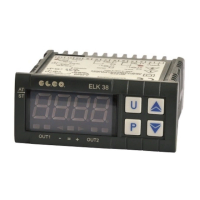
The ELK 38 is a single-loop, digital microprocessor-based electronic controller designed for various control applications. It offers ON/OFF, Neutral Zone ON/OFF, single-action PID, and dual-action PID (direct and reverse) control, incorporating AUTO-TUNING FAST and SELF-TUNING functions, along with automatic calculation of the FUZZY OVERSHOOT CONTROL parameter for PID control. The PID control algorithm features two degrees of freedom, optimizing the instrument's performance independently of process disturbances and Set Point variations.
The ELK 38 provides comprehensive control functionalities. It measures and visualizes process values on a 4-digit red display, with output status indicated by two LED displays. Three programmable shift index LEDs offer additional visual feedback. The instrument can store up to four Set Points and supports up to two outputs, which can be relay type or solid-state relay (SSR) drivers. Input options vary by model and include thermocouples (J, K, S, and ELCO IRS Infrared sensors), mV signals (0-50/60 mV, 12-60 mV), and Thermoresistances PT100. Other available functions include Loop-Break Alarm, controlled-speed Set Point reaching, ramp and dwell functions, Soft-Start, compressor protection for neutral zone control, and multi-level parameter protection.
The controller operates in three main states: automatic control (rEG), control off (OFF), and manual control (OPLO). It can transition between these states via the keyboard or automatically. In automatic control, the instrument resumes its last state upon power-up. Manual control allows programming of the output power percentage. The OFF state deactivates control and outputs, while alarm outputs remain active.
The AUTO-TUNING function enables fast calculation of PID parameters, which are then stored in memory. The SELF-TUNING function continuously monitors and calculates parameters during control. Both functions determine Proportional Band (Pb), Cycle time of output 1rEG (tcr1), Integral Time (Int), Derivative Time (dEr), and Fuzzy Overshoot Control (FuOC). For dual-action PID, Cycle time of output 2rEG (tcr2) and Power ratio 2rEG/1rEG (Prat) are also calculated.
The Soft-Start function, available for PID control, limits control power during instrument start-up for a programmable period. This is useful for protecting actuators from excessive power when the application is not at its normal rating. The ramp and dwell functions allow the Set Point to be reached at a controlled speed over a predetermined time, and enable automatic switching between two Set Points (SP1 and SP2) after a set duration, creating a simple thermal cycle.
Alarm functions include Absolute Low (LoAb), Absolute High (HiAb), Absolute Band (LHAb), Deviation Low (LodE), Deviation High (HidE), and Deviation Band (LHdE) alarms. Alarms can be configured with or without delay, as latched or non-latched, and with or without acknowledgment. Alarm hysteresis (HAL1) works asymmetrically, defining activation and deactivation thresholds. The Loop Break Alarm (LbA) activates if the control loop is interrupted due to probe issues or load interruption, providing a power output as programmed in "OPE" and displaying an "LbA" message.
The ELK 38 features a user-friendly interface with a "P" key for accessing programming parameters and confirming selections, and "UP" and "DOWN" keys for adjusting values and navigating menus. A "U" key is programmable for various functions such as activating Auto-tuning/Self-tuning, swapping to manual control, silencing alarms, changing the active Set Point, or deactivating control.
Fast programming of the active Set Point and alarm thresholds is possible. Parameters can be made visible or hidden in the "OPEr" (Operating parameters) or "ConF" (Configuration parameters) menus, allowing customization of the user interface. The instrument supports up to four pre-programmed Set Points, selectable via parameter or the "U" key.
The display can visualize various process variables, control power, active Set Point, or alarm thresholds. A shift index function with three LEDs indicates whether the process value is within, below, or above a defined range relative to the Set Point.
Calibration of measurements is possible at two points using "OFSt" (Measuring Offset) and "rot" (Rotation of the measuring straight line) parameters, allowing the instrument to be recalibrated according to specific application needs. An input digital filter ("FiL") can be programmed to reduce noise sensitivity.
The ELK 38 is designed for reliability and ease of maintenance. Error signaling provides clear indications of problems such as probe interruption, out-of-range measurements, or auto-tuning failures. The manual provides troubleshooting steps for these error conditions, including verifying probe connections, checking actuator functioning, and repeating auto-tuning processes.
For cleaning, a slightly wet cloth with water is recommended; abrasive cleaners or solvents should be avoided to prevent damage to the instrument. The instrument is covered by a 12-month warranty against manufacturing flaws or faulty material. Opening the housing, violating the instrument, or improper use/installation will void the warranty. In case of a faulty instrument, users are advised to contact the sales department for authorization before shipping the product for repair, along with a detailed description of the faults.
 General
| Brand | elco |
|---|---|
| Model | ELK 38 |
| Category | Controller |
| Language | English |

 To Next Page