
 Need help?
Do you have a question about the ELCOS QC1.0060A and is the answer not in the manual?
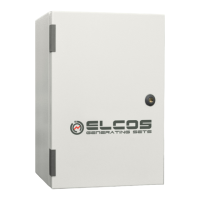
This document describes the ELCOS QC Automatic Transfer Switches, which are designed for managing power transfer between a main power source (Mains) and a generator set (G.S.). These devices are crucial for ensuring continuous power supply in various applications by automatically switching between the available power sources.
The ELCOS QC Automatic Transfer Switches are designed to monitor the presence and quality of the main power supply and, in case of failure or unacceptable parameters, automatically start the generator set and transfer the load to it. Once the main power supply is restored and stable, the switch transfers the load back to the mains and shuts down the generator. This automated process ensures uninterrupted power to critical loads. The system is equipped with a control panel that allows for manual operation, monitoring of system status, and configuration of various parameters. The control logic is designed to prevent simultaneous connection of both power sources, ensuring safety and preventing damage.
The transfer switches are available in various models, including QC.1.0060A, QC.1.0090A, QC.1.0125A, QC.1.0250A, QC.2.0400A, QC.2.0630A, QC.2.0800A, QC.3.1250A, QC.4.1600A, QC.4.2000A, QC.4.2500A, QC.4.3150A, QC.5.4000A, and QC.5.5000A, covering a wide range of power requirements. There are also models without a command panel, such as QC.E-40, which are designed for integration into existing control systems.
The ELCOS QC Automatic Transfer Switches come in various power ratings, from 10 KVA to 5000 KVA, accommodating diverse application needs. The reference power (KVA) and current (A) vary significantly across models. For instance, the QC.1.0060A model has a reference power of 40 KVA (400V) and 60A, while the QC.5.5000A model boasts 5000 KVA (400V) and 5000A. The switches are designed for 3-phase and neutral connections, ensuring compatibility with standard industrial power systems.
The dimensions (LxWxH) and weight (Kg) of the switchboards vary depending on the model. Smaller models like QC.1.0060A have dimensions of 60x25x80 Cm and weigh around 47 Kg, whereas larger models like QC.5.5000A are significantly larger and heavier, with dimensions of 260x100x190 Cm and a weight of 800 Kg. The enclosures are typically IP** rated, indicating protection against dust and water ingress, suitable for industrial environments.
The minimum wire gauge for connections is specified for different power levels to ensure safe and efficient operation. For example, a 10/15 KVA system requires a minimum wire gauge of 4 mmq, while a 180/275 KVA system requires 185-240 mmq. For higher power systems, such as 90/100 KVA, a maximum of 10 wires per phase of 185mmq eyelet D12 is recommended.
The transfer switches utilize motorized change-over switches, typically 4-pole contactors for smaller models and more robust motorized change-over switches for larger models, ensuring reliable and smooth power transfer. The control panels are equipped with indicators for Mains presence (PG), G.S. presence (PG.G.S.), Mains contactor status (TLG), G.S. contactor status (TLG.G.S.), alarms (ALLARME), and locked status (BLOCCO).
The ELCOS QC Automatic Transfer Switches are designed for ease of use and integration. The control panel provides clear visual indicators and allows operators to monitor the status of both power sources and the transfer switch itself. The system can be configured to operate in automatic or manual modes, providing flexibility for different operational requirements.
Before installation, it is crucial to ensure that the switchboard is intact and undamaged. The installation process involves meticulous compliance with the attached wiring diagram, proper identification of the installation location, and verification of voltage, current, and frequency parameters. The installer must ensure that all electrical connections are securely made and that the earthing protection conductor is correctly connected. Auxiliary circuit conductors must also be properly connected.
Safety distances must be maintained around the switchboard to prevent hazards from heat, deposits of fuel, flammable material, and chemical substances. The area around the switchboard must be clear of unauthorized personnel. The installer is responsible for ensuring that the installation complies with all relevant safety standards and regulations (e.g., CEI EN 61439-1, CEI 17-113/1, IEC 60947-3).
The control panel features buttons for "LOAD ON MAINS," "LOAD ON G.S.," "LOCK," and "AUTOMATIC," allowing for direct control over the transfer process. The "Emergency stop push button" is a critical safety feature that, when pressed, sets the QC switchboard panel to the LOCK position, preventing any automatic or manual operations.
Regular maintenance is essential to ensure the long-term reliability and safe operation of the ELCOS QC Automatic Transfer Switches. The manual provides detailed instructions for maintenance procedures, which should only be performed by qualified personnel.
Key maintenance activities include:
The manual also includes a troubleshooting guide to help identify and resolve common issues. This guide lists potential faults and their probable causes, such as:
For assistance with troubleshooting or any other issues, users are encouraged to contact ELCOS customer support. The manual provides contact details and emphasizes the importance of providing detailed information about the issue, including the switchboard data, purchase document, company name, and a description of the anomaly.
Proper storage and handling of the switchboard are also covered, emphasizing the need to protect it from damage during transport and storage. The packaging is designed to maintain the product's integrity, and specific temperature and humidity ranges are recommended for storage.
In summary, the ELCOS QC Automatic Transfer Switches are robust and reliable devices designed to ensure continuous power supply through automated transfer between mains and generator power. Their comprehensive design, detailed technical specifications, user-friendly features, and clear maintenance guidelines make them suitable for a wide range of critical power applications.

 To Next Page
 General