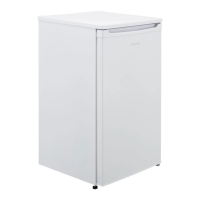
This document is the user manual for the Electra BFZU63WE Freezer. It provides essential information on safety, installation, operation, maintenance, and technical specifications for the appliance.
Function Description
The Electra BFZU63WE is a freezer designed for household and domestic use. Its primary functions include storing frozen food, freezing fresh food, and making ice cubes. The appliance utilizes Less Frost technology, which offers more efficient cooling, reduces the need for manual defrosting, and provides more flexible storage space due to its wrap-around evaporator.
Important Technical Specifications
- Model: BFZU63WE
- Operating Voltage: 220-240 V at 50Hz.
- Refrigerant: R600a (if applicable, check appliance label). R600a is an environmentally friendly and natural gas, but it is explosive.
- Climate Class: The appliance is designed to operate within specific ambient temperature ranges (T/SN = 10°C - 43°C) as stated on the information label. Operating outside these ranges may reduce cooling efficiency.
- T (tropical): 16 °C to 43 °C
- ST (subtropical): 16 °C to 38 °C
- N (temperate): 16 °C to 32 °C
- SN (extended temperate): 10 °C to 32 °C
- Dimensions (without handle):
- Height (H1): 821.0 mm
- Width (W1): 480.0 mm
- Depth (D1): 510.0 mm
- Space Required in Use (including handle and cooling air circulation):
- Height (H2): 971.0 mm
- Width (W2): 580.0 mm
- Depth (D2): 550.0 mm
- Overall Space Required in Use (including handle, cooling air circulation, and door opening for internal equipment removal):
- Width (W3): 580.5 mm
- Depth (D3): 987.5 mm
- Electrical Connection: Requires a properly installed fused socket with an efficient ground connection. A specially grounded 13-ampere plug is connected to the power cable. If the socket does not match, it must be replaced by a qualified electrician.
- Installation Clearances:
- At least 50 cm away from stoves, gas ovens, and heater cores.
- At least 5 cm away from electrical ovens.
- At least 2 cm between the freezer and a deep freezer to prevent humidity.
- At least 150 mm clearance at the top.
- Maximum of 75 mm distance between the appliance and the back wall.
- Maximum Freezing Capacity: The maximum amount of fresh food (in kg) that can be frozen in 24 hours is indicated on the appliance label.
- Spare Parts Availability: Original spare parts for specific components are available for a minimum of 7 or 10 years, based on the component type, from the market placement of the last unit of the model.
Usage Features
- Thermostat Setting: The freezer temperature is regulated automatically by a thermostat knob, with settings from 1 (minimum cooling) to 3 (maximum cooling).
- Setting 1: For short-term food storage.
- Setting 2: For long-term food storage.
- Setting 3: Maximum cooling position, leading to longer appliance operation.
- Temperature Setting Warnings:
- Ambient temperature, amount of stored food, and door opening frequency affect freezer temperature. Adjust settings as needed.
- Not recommended for operation in environments colder than 10°C.
- Allow 24 hours for the appliance to reach operating temperature when first switched on, avoiding opening the door or storing large quantities of food during this period.
- Unplug during power cuts and delay plugging back in for 5-10 minutes to prevent compressor damage.
- Ice Tray: Fill with water and place in the freezer. Twist the tray to remove ice cubes once frozen.
- Food Storage:
- Wrap and seal fresh food properly in airtight, non-leaking packaging (special freezer bags, aluminum foil, polythene bags, plastic containers).
- Divide fresh food into portions before freezing.
- Do not store fresh food next to frozen food.
- Consume thawed food shortly after defrosting.
- Never place warm food in the freezer.
- Follow manufacturer's instructions on food packaging for storage life (generally not more than 3 months if no information is provided).
- Ensure frozen food is purchased under appropriate conditions and packaging is undamaged. Transport frozen food in appropriate containers and place in the freezer as soon as possible.
- Avoid purchasing frozen food with signs of humidity or abnormal swelling, as this indicates improper storage and potential deterioration.
- Storage life depends on room temperature, thermostat setting, door opening frequency, food type, and transport time.
- The bottom drawer should be used for freezing food.
- Do not refreeze thawed frozen food.
- Certain spices in cooked dishes may change taste after freezing; add them after thawing.
- Suitable oils for freezing include margarine, calf fat, olive oil, and butter. Peanut oil and pig fat are unsuitable.
- Liquid food should be frozen in plastic cups; other food in plastic folios or bags.
- Door Opening: If the freezer door is difficult to open immediately after closing, this is normal; it will open easily once equilibrium is reached.
Maintenance Features
- Cleaning:
- Disconnect from power supply before cleaning.
- Do not wash by pouring water directly on it.
- Do not use abrasive products, detergents, or soaps.
- Rinse with clean water and dry carefully.
- Ensure no water enters the lamp housing or electrical components.
- Clean regularly with a solution of bicarbonate of soda and lukewarm water.
- Clean accessories separately by hand with soap and water; do not use a dishwasher.
- Clean the condenser with a brush at least twice a year to save energy and increase productivity.
- Defrosting (Less Frost Technology):
- Small amounts of frost can be removed with a brush or plastic scraper. Do not use metal or sharp scrapers, or mechanical devices.
- For heavy ice deposits, disconnect the appliance, empty contents into cardboard boxes wrapped in blankets or paper to keep cool.
- Defrost when the freezer is nearly empty to prevent temperature increase of contents.
- To accelerate defrosting, place bowls of warm water in the freezer compartment.
- After defrosting, clean the inside with warm water and bicarbonate of soda, then dry thoroughly. Reassemble all removable parts.
- Reconnect the appliance and leave it on setting '3' for 2-3 hours before reintroducing food.
- Plastic Scraper (in some models): Use the provided plastic scraper to remove accumulated frost regularly. Avoid sharp metal objects to prevent damage to the refrigerator circuit.
- Door Gasket: Must be clean and pliable. Replace if worn.
- Long-term Storage (e.g., holidays): Unplug the appliance, clean it, and leave the door open to prevent humidity and smell.

 Need help?

 To Next Page
 General