Need help?
Do you have a question about the Electro-Harmonix SUPEREGO SYNTH ENGINE and is the answer not in the manual?
Overview of the Superego and important safety warning for power supply.
Details on Momentary, Latch, and Auto modes for the Superego.
Explanation of key controls like knobs, footswitch, and toggle switch.
Instructions for connecting guitars and amplifiers to the Superego.
How to use the SEND and RETURN jacks for effects loops.
Details on the 9V DC power jack, current, and voltage limits.
Details on product warranty, registration, and service return process.
Information regarding FCC rules and potential radio interference.
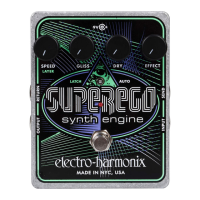
The Electro-Harmonix SUPEREGO Synth Engine is a unique and versatile pedal that combines elements of sampling, synthesis, and infinite sustain, allowing musicians to create a wide range of sonic textures. It enables users to freeze sounds, gliss between frozen sounds, layer sounds, and apply external effects specifically to the sustained sound. A key feature of the Superego is its ability to automatically detect and sustain new notes or chords without requiring the musician to engage a footswitch, offering a hands-free approach to sustain effects.
The Superego operates in three distinct modes: LATCH, MOMENTARY, and AUTO, selected via a toggle switch.
In Momentary mode, the effect is active only when the footswitch is pressed down. Releasing the footswitch bypasses the effect. To freeze a sound, it must be occurring at the moment the footswitch is pressed. Once frozen, the sound sustains for as long as the footswitch is held. An LED indicates when the effect is active, turning off once the effect has fully decayed after release. In this mode, the SPEED/LAYER knob controls the attack and decay time of the effect. Turning the knob clockwise slows down the fade-in and fade-out speed. The quickest attack and decay, with a nearly instantaneous fade, is achieved when the knob is fully counter-clockwise (CCW). Conversely, fully clockwise (CW) yields the longest attack and decay times, creating a more gradual fade. The decay time is always longer than the attack time for any given knob setting.
When in Latch mode, a single press of the footswitch activates the effect and lights the LED, sustaining the sound indefinitely even after the footswitch is released. To bypass the effect, a double-tap of the footswitch is required, and the LED will turn off. Each single press of the footswitch freezes a new sound. Latch mode also supports layering: each time a new note is sustained, it layers on top of previously sustained notes. The SPEED/LAYER knob functions as a layer control, adjusting the attenuation of older layers. Turning the knob fully CCW prevents layering, allowing only the newly latched samples to be heard. As the knob is turned clockwise, less attenuation occurs, increasing the volume of older layers. At its maximum CW position, all layers remain at full volume.
In Auto mode, the Superego automatically detects and sustains new notes or chords played by the musician, provided they are loud enough to trigger a sustain. To activate the effect in Auto mode, press the footswitch once; the LED will light. To return to bypass, double-tap the footswitch. If the footswitch is pressed and held while the effect is active in Auto mode, the Superego stops accepting new notes and indefinitely sustains the currently frozen sound. This allows the musician to play over the sustained sound. When the footswitch is not held, sustained notes automatically fade out at a speed determined by the SPEED/LAYER knob. Turning this knob clockwise increases the fade-out time. At its maximum CW position, sustained notes do not fade out. In Auto mode, the SPEED/LAYER knob adjusts the decay of auto-triggered samples. Fully CCW results in a very short decay time, creating a staccato and reverberant effect. As the knob is turned clockwise, the decay time increases. At fully CW, the sampled sound plays until a new sample is triggered or the effect is disengaged.
The DRY knob adjusts the volume of the unaltered instrument signal. Fully CCW mutes the dry signal, while turning it clockwise increases its volume, reaching unity gain around the "2 o'clock" position. The EFFECT knob controls the volume of the wet effect signal. Fully CCW yields no wet effect signal, and turning it clockwise increases the effect's volume.
The GLISS knob adjusts the speed of the gliss effect, which morphs one frozen note or chord into the next, similar to a portamento function. Turning the GLISS knob clockwise slows down the gliss effect. To completely disable gliss, turn the knob fully CCW. For optimal gliss effect, it is recommended to use Auto mode, turn the DRY knob completely down, and set the GLISS and SPEED knobs at 12 o'clock or higher.
The Superego features standard input and output jacks. The INPUT jack has an impedance of 2.2Mohms, and the OUTPUT jack has an impedance of approximately 200 ohms. Additionally, SEND and RETURN jacks form an effects loop, allowing external effects to process only the wet signal. The SEND jack is an output with impedance < 5k ohms, and the RETURN jack is an input with impedance = 2.2M. To use this loop, connect the SEND jack to the input of the first effect in the loop and the output of the last effect in the loop to the RETURN jack. The SEND jack is muted when the Superego is in Bypass. The SEND jack can also function as a "wet out" by connecting it to another amplifier or effects chain while leaving the RETURN jack disconnected.
The Superego requires a 9.6VDC-200BI power supply (center negative, 200mA), such as those used by Boss® & Ibanez®. It draws 140mA at 9VDC. The device does not operate on batteries. Using an incorrect adapter can damage the unit and void the warranty. The maximum allowable power supply voltage is 10.5 VDC.
For maintenance, Electro-Harmonix provides a one-year warranty covering defects in materials or workmanship for original purchasers from authorized retailers. Repaired or replaced units are warranted for the unexpired portion of the original warranty term. For service, users should include a brief problem description, contact information, a copy of the receipt, and a check or money order.
 General
| Type | Synth Engine |
|---|---|
| Technology | Analog |
| Current Draw | 100 mA |
| Weight | 1.5 lbs |
| Bypass | True Bypass |
| Modes | Latch, Momentary, Auto |
| Inputs | 1 x 1/4" |
| Outputs | 1 x 1/4" |
| Input Impedance | 1M ohm |
| Output Impedance | 1k ohm |
| Power Supply | 9V DC adapter (included) |

 To Next Page